
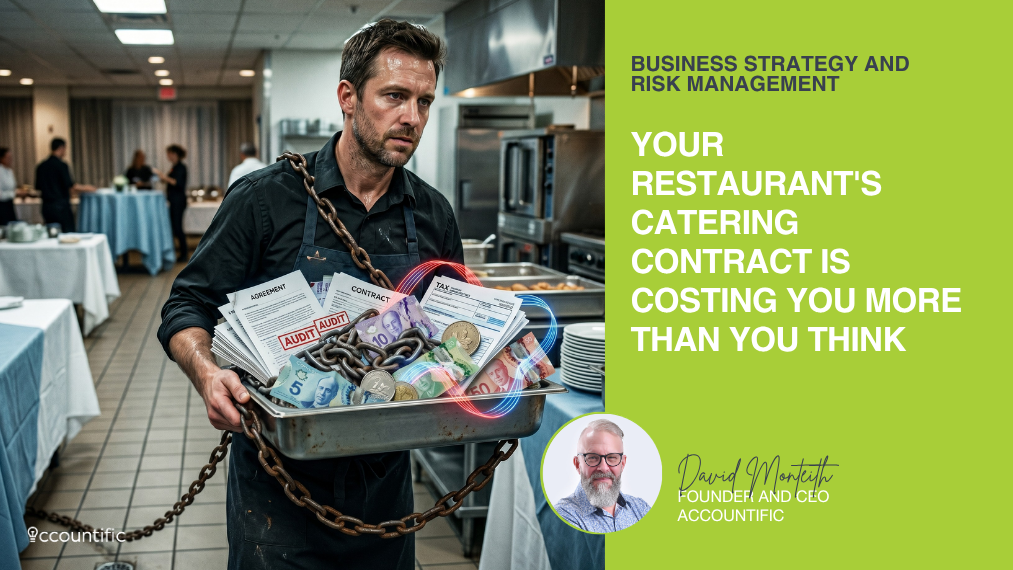
Why the Catering Contract Your Restaurant Signs Is a Financial Liability
TLDR Summary
Event deposits received by restaurants are taxable for GST/HST purposes at the exact time they become non-refundable, not at the time of the event, which frequently causes severe remittance errors. Moreover, off-site catering contracts require precise dollar-specific cancellation terms rather than percentage-based penalties to be legally enforceable. Furthermore, catering events involving alcohol demand strict adherence to specialized provincial liquor permits to avoid voiding your liability insurance. Ultimately, the true profitability of a catering event must be rigorously calculated beforehand, as hidden labour and logistics costs can completely erode your margins.
Why Read the Full Article
You will learn the exact chronological mechanisms of deposit tax liability under the Excise Tax Act, how to structure legally defensible cancellation tiers, and the specific provincial liquor compliance steps you must take in Ontario, British Columbia, and Alberta. This guide provides the mathematical framework to accurately model the hidden costs of off-site operations and protect your bottom line.
How Accountific Helps
If the ideas in this article feel like a lot to manage alone, there’s a team that does this every day for restaurants in Canada. Accountific helps restaurant clients calculate true catering event profitability before signing contracts and ensures that deposit accounting, including HST timing, is handled correctly from the moment the deposit lands in the account. Visit Accountific to learn more.
—
The Canadian foodservice industry operates within an increasingly hostile economic environment. Severe margin compression, inflation-indexed wage escalations, and distinct shifts in consumer dining habits force operators to aggressively pursue alternative revenue streams. The most common strategic pivot involves expanding a traditional dining room operation into off-site event production. Catering presents a highly attractive theoretical proposition. Bulk sales, predetermined menus, guaranteed guest counts, and large upfront cash injections provide a perceived buffer against the intense unpredictability characterizing daily walk-in traffic.
The pursuit of this auxiliary revenue frequently blinds operators to the severe structural risks inherent in event execution. When you transition from a standard reactive operator to a proactive event producer, you fundamentally alter the legal and administrative architecture of your business. The administrative complexity required to execute a specialized off-site contract significantly exceeds the requirements of managing daily restaurant floor operations. A standard point-of-sale system and traditional cash-basis accounting methods completely fail to capture the nuanced liabilities associated with long-term event planning.
When you enter into a catering agreement, your business assumes the role of a logistics coordinator, a mobile food manufacturer, and an off-site liquor provider. Each distinct role carries heavy, specific regulatory burdens. The initial influx of cash from an early booking routinely masks underlying financial distress. This phenomenon traps operators in a cycle of false profitability. You look at your bank account, see a massive balance, and mistakenly assume your business is thriving. We regularly analyze this precise danger on our blog, detailing how operators fall victim to the hidden costs draining restaurant bank accounts. Unearned deposit revenue is frequently misinterpreted as net profit. When you use funds intended for future event execution to cover immediate operational shortfalls, you deplete the capital required to purchase specialized inventory and fund extended labour hours on the actual event date.
To convert off-site event production from a high-risk gamble into a sustainable, highly profitable business line, you must master the structural mechanics of your agreements. This comprehensive analysis dissects the four primary vulnerabilities embedded in standard industry agreements: federal tax compliance, contract law enforceability, provincial liquor regulations, and underlying cost accounting.
Federal Sales Tax Compliance: Navigating CRA Deposit Regulations
The most pervasive financial liability in off-site operations stems from the mismanagement of federal sales tax obligations. The Canada Revenue Agency enforces explicit, uncompromising directives regarding the taxation of advance payments and contract forfeitures under the Excise Tax Act. Restaurant accounting personnel routinely misclassify the nature of funds received at the signing of an agreement, triggering severe statutory remittance errors and exposing the business to devastating audits.
Distinguishing Between Prepayments and Security Deposits
For taxation purposes, a critical legal distinction exists between a prepayment and a security deposit. You must categorize incoming funds correctly the moment they hit your ledger. A prepayment is an advance payment applied directly to the final cost of a known, supplied service. According to standard GST Memorandum, if an agreement specifies the recipient is required to pay an amount before the property or service is actually provided, the tax regarding this prepayment is payable at the time the prepayment is paid or becomes due. In this scenario, you must collect and remit the applicable tax immediately upon receiving the funds.
Conversely, a true deposit is defined as an amount given by a recipient as security for the performance of an obligation. As stipulated in subsection 168(9) of the Excise Tax Act, a deposit given in respect of a supply is not regarded as consideration for the supply unless and until the supplier applies the deposit against the final consideration. When a corporate client pays a $5,000 fee to secure a future date six months in advance, there are no immediate tax consequences. The tax only becomes payable by the recipient at the exact time you formally apply the deposit against the final invoice for the taxable supply.
The primary compliance failure occurs when generic bookkeeping systems automatically generate tax liabilities upon the initial receipt of a security deposit. This artificially inflates your immediate tax burden, draining cash from your operating account months before it is legally required. Conversely, failing to recognize the tax liability when the deposit legally transitions into applied consideration results in severe under-remittance penalties. You must implement a disciplined ledger system to track these distinct financial states.
The Mechanics of Forfeited Deposits Under Section 182
The financial liability escalates dramatically when a client cancels a contracted event and forfeits their initial payment. Many operators wrongly assume retaining a cancelled event fee represents pure, untaxed compensatory revenue. This assumption directly contravenes federal tax law and creates massive audit exposure.
Under Section 182(1) of the Excise Tax Act, if a deposit is forfeited to a registrant because of a breach, modification, or termination of an agreement to make a taxable supply, the statute deems a taxable supply to have been made by the supplier. Consequently, liability for the tax is incurred exactly at the time of the forfeiture. The CRA considers your restaurant to have collected the tax on the forfeited amount. You are legally responsible for remitting this deemed tax immediately.
The tax collected is calculated on a tax-included basis using specific mathematical fractions determined by the province in which the supply occurs. The standard formula outlined in the Excise Tax Act for deemed consideration is (A/B) multiplied by C, where C is the total amount paid or forfeited.
The following table illustrates the statutory tax fractions applied to forfeited funds across different Canadian tax jurisdictions:
| Province / Territory | Applicable Tax Rate | ETA Tax Fraction Calculation | Deemed Tax on a $10,000 Forfeited Deposit |
| British Columbia | 5% GST | 5 / 105 | $476.19 |
| Alberta | 5% GST | 5 / 105 | $476.19 |
| Ontario | 13% HST | 13 / 113 | $1,150.44 |
| Nova Scotia | 15% HST | 15 / 115 | $1,304.35 |
| New Brunswick | 15% HST | 15 / 115 | $1,304.35 |
When an Ontario-based restaurant retains a $10,000 non-refundable fee following a sudden client cancellation, the operator must report $1,150.44 as HST collected during the reporting period in which the forfeiture occurred. Retaining the full $10,000 without remitting the fractional tax constitutes tax evasion. When the CRA conducts an audit and identifies unremitted tax on these forfeitures, you become liable for the principal tax amount plus compounding arrears interest, accruing daily.
Partial Refunds and Complex Contract Modifications
The application of Section 182 becomes highly complex when an operator exhibits flexibility. Suppose an agreement states a reservation fee is non-refundable. The client cancels, and you choose to return a portion of the funds to maintain goodwill. The tax rules immediately bifurcate. The portion of the funds retained by your restaurant is classified as a forfeiture. Tax is payable on the specific retained amount at the exact time of forfeiture. The portion refunded to the client retains its status as a refundable deposit and carries no tax consequences.
Alternatively, if you issue a credit for a future event rather than a cash refund, the funds remain on account as a security deposit. Because the agreement is deemed modified rather than terminated, the funds are not yet treated as a forfeiture. Accurate tracking of these distinct financial states requires a highly sophisticated accounting structure. Relying on generic, off-the-shelf software inevitably leads to commingled funds and inaccurate tax filings.
Contractual Architecture: Eradicating Percentage-Based Penalties
Your agreement serves as the primary shield protecting your financial stability. Poorly drafted agreements transform theoretical risks into tangible financial losses. Two specific areas of contract law demand rigorous attention: the structuring of cancellation penalties and the modernization of force majeure clauses.
The Legal Vulnerability of “Non-Refundable” Language
Restaurant operators routinely rely on the phrase “non-refundable deposit” to deter cancellations. In Canadian contract law, simply labelling an initial payment as non-refundable does not guarantee you retain the funds without legal challenge. Courts actively scrutinize retained funds to determine whether they represent a genuine pre-estimate of damages or an unlawful penalty.
If a client pays a $15,000 reservation fee for a $30,000 corporate retreat six months in advance, and subsequently cancels five months prior to the date, you will face severe legal difficulty retaining the entire $15,000. Because your business has ample time to mitigate losses by re-booking the date or reallocating scheduled resources, retaining a massive prepayment is viewed by the legal system as a disguised penalty. Penalties are generally unenforceable in contract law. A genuine security deposit, acting solely as a reservation fee, typically constitutes only a small percentage of the total price.
To ensure strict enforceability, you must abandon arbitrary percentage-based penalties in favour of tiered, dollar-specific liquidated damages clauses. A percentage-based policy stating “50 percent of the total event cost is due upon cancellation” invites immediate disputes over the definition of the final event cost. If the menu or guest count was actively undergoing revision at the time of cancellation, the baseline number is entirely ambiguous.
A structurally sound agreement outlines exact dollar amounts tied to a strict chronological schedule of unrecoverable costs. By explicitly linking the retained amounts to verifiable financial exposure, you transform an unenforceable penalty into a legally protected damage recovery mechanism.
The following table demonstrates a highly defensible, chronological liquidated damages schedule for a $30,000 proposed event:
| Chronological Cancellation Window | Liquidated Damages Amount | Verifiable Business Rationale |
| Greater than 90 Days Prior | $1,500 | Covers executive administrative time, menu tasting costs, and initial booking friction. |
| 89 to 30 Days Prior | $5,000 | Covers lost opportunity cost for the date and dedicated management planning hours. |
| 29 to 14 Days Prior | $12,000 | Covers specialized, non-returnable ingredient procurement and committed vendor deposits. |
| Less than 14 Days Prior | $30,000 (Full Value) | Covers locked labour schedules, complete perishable inventory, and total revenue loss for the date. |
When a client signs an agreement featuring this specific framework, they acknowledge the precise financial harm their cancellation causes your business at various chronological stages. This removes ambiguity and provides your legal counsel with a definitive, enforceable document in the event of a dispute.
Modernizing the Force Majeure Clause for Canadian Operators
The concept of force majeure relieves parties of contractual obligations during unforeseeable, unavoidable events. This concept requires a total overhaul in the modern foodservice industry. Historically, generic clauses citing “Acts of God” were inserted into agreements without specific consideration of the hospitality supply chain.
Recent global disruptions, shifting municipal health mandates, and severe localized weather events prove generic clauses offer completely inadequate protection. A robust agreement must explicitly define the events triggering the clause and dictate the precise financial resolution. For restaurant operators in Canada, a highly specified force majeure clause must account for distinct, industry-specific operational threats.
First, you must address venue inaccessibility. In scenarios where you cater an off-site event and the destination venue becomes inaccessible due to localized infrastructure failure, such as a burst municipal water main or a severe power grid failure, the agreement must stipulate who absorbs the cost of the already prepared food. Without explicit language, the client will demand a full refund, leaving your business to absorb the entire cost of the wasted inventory and deployed labour.
Second, you must address sudden supply chain collapses. If a specific, contracted high-value ingredient becomes unavailable due to regional agricultural failures or abrupt import restrictions, the agreement must authorize your executive chef to substitute ingredients of equal value without constituting a breach of contract. A failure to include a substitution authorization clause allows a hostile client to demand a massive discount or cancel the event entirely based on your inability to source a specific requested item.
Third, you must protect your business against severe labour crises. In the event of a sudden illness outbreak among your specialized culinary staff making safe execution impossible, the agreement must outline the absolute limits of your liability. The clause must explicitly cap your damages at the total return of the initial reservation fee. This specific limitation prevents the client from suing your business for the consequential damages of ruining a major corporate event, such as the cost of their venue rental, guest travel, and reputational harm. Without these modernized definitions, an operator forced to cancel an event due to factors completely outside their control remains fully liable for breach of contract.
The Liquor Licensing Minefield: Provincial Compliance for Off-Site Service
The profitability of off-site event production is intricately linked to the sale of alcohol. Serving liquor outside of your primary licensed footprint introduces severe regulatory risk. Provincial liquor boards enforce strict protocols for off-site service. Operating outside these parameters constitutes an illegal sale of alcohol. This triggers massive fines, potential loss of your primary dining room liquor licence, and the immediate voiding of your commercial general liability insurance.
The regulatory frameworks governing off-site liquor service vary drastically by province. You must intimately understand your specific jurisdictional requirements to prevent catastrophic operational failures. We consistently warn operators about the dangers of relying on outdated revenue models. As outlined in our analysis of how your most profitable revenue stream is disappearing, the pressure to maximize off-site alcohol sales is immense. You must execute this strategy with absolute regulatory precision.
Ontario: Navigating the AGCO Caterer’s Endorsement
In Ontario, an operator wishing to serve alcohol at off-site locations must obtain a Caterer’s Endorsement from the Alcohol and Gaming Commission of Ontario (AGCO). This endorsement functions as a direct add-on to your existing standard liquor sales licence. It permits the sale and service of liquor at locations where your primary licence does not apply.
The AGCO imposes strict operational parameters on the Caterer’s Endorsement. The event must be sponsored by a third party, not the restaurant itself. You cannot use a catering endorsement to host your own pop-up promotional party in a local park. The event cannot exceed ten consecutive days and is strictly prohibited from occurring in any private residence. Furthermore, all unsold liquor must be transported directly back to your primary licensed establishment’s inventory immediately following the event.
A critical compliance factor in Ontario involves the precise definition of “exclusive control.” If you cater an event in an area over which you hold exclusive control, such as a leased banquet hall where you are the sole vendor, you must submit a specialized “Caterer’s Endorsement Premises Form” to the AGCO to formally register the space. Once registered, individual event notifications are not required for that specific location.
If the venue is not under your exclusive control, you face a severe administrative burden. You are legally required to notify the AGCO, the local police department, the local fire department, the local health department, and the municipal building department prior to every single event. You must provide these agencies with details regarding attendance, boundaries, and specific hours of operation. Failure to execute these municipal notifications invalidates the legality of your alcohol service entirely. If an alcohol-related incident occurs at an improperly notified event, your liability insurance provider will deny coverage, leaving your business exposed to ruinous civil litigation.
British Columbia: The LCRB Catering Licence Requirements
British Columbia treats off-site operations with exceptional regulatory rigor. The province classifies a Catering Licence as a distinct, standalone entity governed by the BC Catering License. While Ontario utilizes an endorsement model attached to an existing licence, British Columbia operators must apply for an entirely separate Catering Licence.
The LCRB mandates your primary business focus must remain the preparation and service of food. Crucially, the LCRB requires your establishment to possess a full commercial kitchen. This specific infrastructure requirement prevents businesses without adequate food-safe facilities from masquerading as caterers simply to operate as mobile bars. The application process requires a Business BCeID, a $950 initial fee, extensive criminal record checks, and a formal statutory declaration.
British Columbia enforces highly specific rules regarding the transfer of liquor inventory between your various licences. A licensee is permitted to purchase or sell up to a combined annual total of $10,000 worth of liquor between a food primary establishment and a catering business held by a different legal entity. If your catering licence and your primary dining room licence are held by the identical legal entity, this transfer allowance increases to $100,000 annually. Every single transfer must be meticulously documented in a specialized liquor register, retained on-site for a minimum of six years. Off-book transfers, where you casually move a case of wine from the restaurant to the catering van without logging the transaction, represent a serious contravention of the Liquor Control and Licensing Act.
Alberta: Operating Under the AGLC Caterer’s Extension
In Alberta, operators holding a Class A, B, or C licence are permitted to apply for a Caterer’s Extension to provide liquor service away from the primary premises. The Alberta Gaming, Liquor and Cannabis (AGLC) commission enforces distinct rules ensuring food remains the absolute central component of any off-site operation.
Under a Caterer’s Extension, the licensee must ensure a selection of food items is continually available throughout the entire duration of the liquor service. The AGLC strictly regulates the integration of liquor into your event pricing structure. Liquor cannot be included in a blanket admission price for a function. It must be tracked, measured, and priced according to mandatory AGLC minimum pricing board policies.
Similar to the regulations in Ontario, Alberta requires all unused liquor to be transported immediately back to the primary licensed premises following the conclusion of the event. AGLC policy also mandates operators submit an Application for Public Function or Caterer’s Extension form a minimum of three weeks prior to the event date. This establishes a strict, non-negotiable administrative deadline. You must build this three-week lead time directly into your client onboarding and contract signing processes. Signing a contract two weeks before an event in Alberta guarantees you will be operating without a valid liquor extension.
The following table summarizes the primary compliance hurdles across the three major provincial jurisdictions:
| Province | Regulatory Authority | Required Authorization Type | Critical Compliance Constraints |
| Ontario | AGCO | Caterer’s Endorsement | Strictly prohibited in private residences. Maximum 10-day limit. Mandatory municipal notifications required for all non-exclusive venues. |
| British Columbia | LCRB | Catering Licence | Requires a full commercial kitchen. Strict monetary tracking limits ($10k-$100k) on cross-licence liquor transfers. Mandatory 6-year register retention. |
| Alberta | AGLC | Caterer’s Extension | Minimum 3-week application lead time required. Liquor cannot be bundled into blanket admission pricing. Continuous food availability is mandatory. |
Deconstructing True Profitability: The Illusion of High-Margin Events
The overarching threat to a restaurant engaging in off-site operations is the failure to calculate true profitability before a contract is signed. Catering revenue is highly deceptive. The sudden influx of a massive, single-day sales figure frequently blinds operators to the escalating variable costs and hidden overhead inherent in mobile food production.
To achieve financial control, you must abandon intuitive, gut-feel pricing in favour of rigorous pro-forma mathematical modelling. The profitability of an event must be ruthlessly stress-tested against your baseline operating metrics. Many operators fall into the trap of pricing a catering menu exactly like their dining room menu, ignoring the massive structural differences in how the food is produced, transported, and served. This frequently leads to the illusion of profitability versus cash flow reality that drains restaurant bank accounts.1
The Escalation of Cost of Goods Sold (COGS)
In a highly controlled restaurant environment, food cost is optimized through exact portioning, immediate utilization of prep materials, and the ability to repurpose surplus ingredients into daily specials to minimize waste. Off-site operations instantly introduce massive, unavoidable inefficiencies into your COGS model.
Food transported off-site requires specialized disposable packaging, thermal retention equipment, and extended holding times. These factors significantly increase the rate of ingredient degradation and spoilage. You cannot repurpose wilted greens or over-held proteins from a buffet line; they go directly into the garbage. Furthermore, standard operating procedures mandate building a contingency buffer into your food supply. You typically produce 10 to 15 percent extra volume to prevent running out of food during a buffet service or to handle unexpected, unannounced dietary requests from guests.
This contingency buffer is rarely fully monetized. If you price a plate based on a theoretical 30 percent food cost calculated in the controlled environment of your main kitchen, the practical realities of off-site waste, transport packaging, and mandatory contingency overproduction frequently push your actual food cost closer to 40 or 45 percent.
Dynamic Off-Site Labour Premiums
Labour cost represents the most aggressive variable in your profitability equation. In a traditional dining room setting, front-of-house labour is subsidized by guest gratuities, and kitchen labour is distributed across hundreds of individual transactions throughout a steady eight-hour service. Off-site operations demand highly concentrated bursts of intense labour. This disrupts standard scheduling and frequently triggers severe overtime premium rates.
Analyzing the labour requirements for an off-site event reveals three distinct operational phases, each carrying unique, unbillable costs:
- The Preparation Phase: Your culinary team must prep the event menu without disrupting the daily restaurant service. This often requires scheduling prep cooks for early morning or late-night shifts, pulling your core staff into premium wage territory.
- The Execution and Transit Phase: Staff must be paid for the time spent loading vehicles, navigating traffic to the venue, and setting up the mobile infrastructure. This represents completely unbillable time where wages are paid without any concurrent revenue generation.
- The Strike and Breakdown Phase: Following the event, your staff must break down the equipment, transit back to the restaurant, unload the vehicles, and sanitize the transport gear. An event scheduled to end at 11:00 PM routinely requires your staff to work intensely until 2:00 AM.
If you commit to a $20,000 contract assuming your standard restaurant labour ratio of 30 percent applies, you will face severe margin compression. A $20,000 event requires specialized staff members working 12-hour shifts encompassing prep, transit, service, and strike. When these staff members push into overtime thresholds, the true labour cost consumes a massive portion of your gross revenue.
Hidden Administrative and Capital Overhead
Beyond the direct costs of food and labour, mobile operations introduce hidden administrative and capital overhead costs rarely factored into the initial per-plate pricing strategy. These include:
- Vehicle and Logistics Logistics: Mileage tracking, commercial vehicle insurance riders, fuel, and specialized transport van rentals.
- Equipment Amortization: Executing these events requires specialized chafing dishes, expensive insulated carriers, mobile staging, and specific serving utensils. The rapid depreciation, loss, and replacement cost of this equipment must be allocated across your contracts.
- Administrative Friction: The countless hours spent negotiating the agreement, coordinating logistical details with the venue, applying for provincial liquor extensions, and managing client tastings represent a massive drain on your management resources. This is time your general manager is not spending optimizing the primary restaurant floor.
A Comparative Profitability Model
To illustrate the severe financial liability of poorly structured agreements, consider a pro-forma analysis of a $20,000 off-site event compared directly against a $20,000 standard service night in your primary dining room.
| Financial Metric | Standard Restaurant Service | Off-Site Catering Event | Variance Rationale |
| Gross Revenue | $20,000 | $20,000 | Equivalent top-line revenue generated. |
| Food Cost (COGS) | $6,000 (30%) | $8,000 (40%) | Inclusion of mandatory 15% overproduction buffer, specialized disposable packaging, and off-site spoilage limits. |
| Direct Labour Cost | $6,000 (30%) | $9,000 (45%) | Extended unbillable transit times, strike labour, set-up hours, and overtime premiums for core staff. |
| Logistics & Admin Overhead | $400 (2%) | $1,600 (8%) | Vehicle rentals, commercial insurance riders, equipment breakage, and dedicated management planning hours. |
| Total Direct Costs | $12,400 (62%) | $18,600 (93%) | Escalated cost structure driven entirely by operational inefficiencies and mobile logistics. |
| Net Contribution | $7,600 (38%) | $1,400 (7%) | Massive margin dilution exposing the business to severe risk. |
The analysis demonstrates a highly anticipated $20,000 contract generates a net contribution of only 7 percent. When factoring in the immense stress placed on your core operations, the diversion of your executive chef’s focus, and the massive regulatory and tax liabilities assumed, an event yielding a 7 percent margin constitutes a severe financial hazard. Without exacting pre-event financial modelling, you effectively subsidize your clients’ events through your own uncompensated labour and operational wear-and-tear.
Strategic Financial Control: Translating Raw Data Into Decisions
Mitigating the liabilities embedded in off-site operations requires a total transition from reactive operational survival to proactive financial control. You must implement structural safeguards across your accounting, legal, and operational frameworks. The complexity of tracking HST timing on forfeited deposits, managing disparate provincial liquor regulations, and calculating dynamic labour models vastly exceeds the capacity of standard bookkeeping software and intuition-based management.
Financial administration within the Canadian food and beverage industry has evolved into a highly specialized discipline. Relying on generic accounting practices exposes your business to statutory penalties and invisible profit leaks. You must build a financial infrastructure capable of supporting the complex reality of your expanded operations.
Achieving Financial Clarity and Operational Agility
To insulate your business against contractual and tax liabilities, you must establish a rigorous system of proactive financial reporting. The absolute foundation of this system is the strict decoupling of unearned reservation fees from your operational capital. Security deposits must be recognized exclusively as liabilities on your balance sheet, not recorded as immediate revenue. This specific accounting protocol prevents the cash flow trap, ensuring the capital is preserved until the specific expenses related to the event are incurred.
Furthermore, your point-of-sale data must be integrated seamlessly with dynamic cost-accounting software to generate accurate, real-time insights into ingredient price fluctuations. Event menus must be engineered using current, localized supplier pricing, rather than static historical data, to ensure the proposed per-plate price protects the required profit margin.
Analyses provided by our strategic advisors indicate operators implementing weekly financial reviews, rather than relying on delayed monthly or quarterly statements, possess the agility necessary to pivot pricing strategies in response to sudden inflationary pressures. Detailed weekly tracking of labour hours ensures the hidden costs of prep and transit do not trigger catastrophic overtime expenditures. You must use data to verify your pricing models continuously.
The Necessity of Specialized Administrative Partnerships
The administrative burdens of running a fully compliant, highly profitable off-site operation are immense. Managing payroll for transient event staff, generating accurate T4s and Records of Employment, tracking statutory holiday pay, and ensuring precise, timely GST/HST remittances require dedicated, specialized expertise.
The penalty for failing to properly account for the 13/113th deemed tax on a forfeited event deposit in Ontario is not merely financial; it triggers heightened, ongoing scrutiny from the Canada Revenue Agency. The penalty for failing to file a Caterer’s Endorsement Premises Form is the total loss of your liability insurance coverage. You cannot manage these risks on a spreadsheet late at night after a busy service.
Firms possessing deep, specialized knowledge of the Canadian restaurant industry provide the necessary infrastructure to manage these exact burdens. We leverage technological automation to streamline your data collection, translating raw operational data into strategic, actionable intelligence. We ensure your contracts are priced based on mathematical certainty rather than competitive guessing, and we construct robust accounting barriers preventing severe compliance errors.
This comprehensive approach to financial management transitions you from a state of intense administrative overwhelm into a position of absolute financial control. It provides you with the clarity required to build a stable, thriving business and reclaim your time. We give you the financial foundation to focus entirely on your craft, reduce your stress, and execute flawless events. Take the first step toward running a smarter, more profitable restaurant and book a consultation with our specialized team today at https://calendly.com/davidmonteith.
David Monteith, founder of Accountific, is a seasoned digital entrepreneur and a Xero Silver Partner Advisor with over three decades of business management and financial expertise. He specialises in providing tailored Xero solutions for food and beverage businesses, streamlining accounting processes and delivering valuable financial insights that drive client success. David also serves as CFO of Great Work Online, a digital marketing agency serving food and beverage businesses, where he leads budgeting, financial oversight, and business management. This dual perspective gives Accountific clients more than bookkeeping mechanics — it brings a strategic view of how financial systems support better decisions, stronger operations, and long-term growth.