
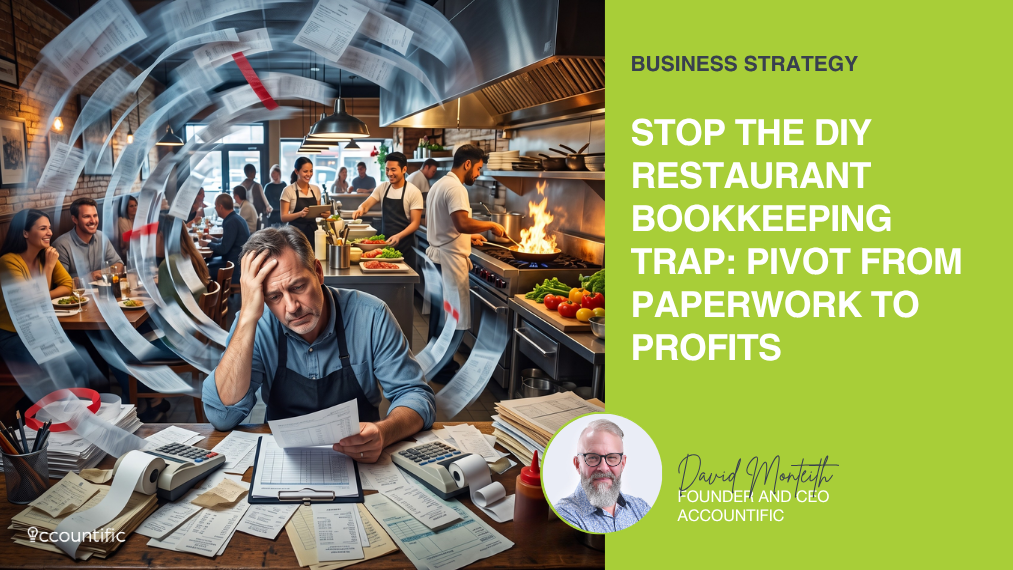
The Real Cost of Doing Your Own Restaurant Bookkeeping
TLDR
You opened a restaurant because you love food and hospitality, not because you wanted to spend your evenings buried in faded receipts and payroll deductions. Most operators handle their own books because they believe it saves money. The math says otherwise.
Run the numbers on your own time. When an owner works the floor, greeting regulars, resolving complaints, catching over-portioned plates before they leave the kitchen, that hour generates well over $100 in profit and saved expense. An owner spending ten hours a week on accounts payable, payroll, and delivery-app reconciliation loses roughly $4,000 in value every month. That is $48,000 a year in opportunity cost, and the real decision was never software versus bookkeeper. It was the bookkeeper’s fee against the value of the hours the software still eats.
The complexity makes it worse. A consulting firm processes twenty invoices a month. A busy diner processes hundreds of small transactions a day, and every one has to flow correctly into food sales, alcohol sales, taxes collected, and delivery fees. Third-party apps remit payments net of commission, so recording the bank deposit as top-line revenue hides your true delivery costs and deflates your sales. Daily reconciliation is the only version that works. Weekly or monthly guarantees corrupted data.
Then there is the compliance exposure, which is where the DIY approach turns expensive fast. Miss a source-deduction remittance by eight days, and the CRA charges a 10 per cent penalty on the spot. A second late remittance in the same calendar year can trigger a 20 per cent penalty. Late GST/HST filing runs a compounding two-part formula, prescribed interest sits at 7 per cent and compounds daily, and none of it is deductible. A restaurant on a five per cent margin has to generate $20,000 in fresh sales just to absorb a single $1,000 fine.
The article walks through the full picture, from the Owner-Hour Audit to prime cost tracking, the payroll penalty tables, the audit red flags the CRA’s automated systems look for, and the retention costs that pile up when an owner disappears into the back office during a labour shortage. The conclusion is direct. The scarcest resource in the building is your time on the floor, and reconciling deposits is the worst possible use of it.
Why You Should Read the Full Article
The summary makes the case. The article gives you the numbers to act on it. It breaks down the exact Owner-Hour Audit calculation so you can run it against your own hours and hourly value. It details the five data streams you have to reconcile every single day and shows precisely how delivery-app commission structures distort your books when handled incorrectly. It lays out the full CRA penalty architecture, including the source-deduction remittance schedule by employer category, the daily-compounding T4 late-filing tables, the GST/HST two-part late penalty formula, and the specific ledger patterns that flag a restaurant for a net worth audit. It covers the six-year document retention rule and the exact receipt details the CRA requires for any purchase over $100. And it connects the back-office trap to the labour crisis, showing how administrative isolation drives the turnover costs that dwarf any bookkeeping fee.
How Accountific Helps
Accountific works exclusively with Canadian food business owners. We handle the big three: bookkeeping, payroll, and tax compliance, so the recurring hours come off your calendar and go back to running the floor. We integrate your point-of-sale directly with cloud accounting, digitize your receipts into an audit-proof archive, and deliver weekly reporting so you always know your true profitability instead of operating a month behind on gut feel. Book a consultation directly with David at https://calendly.com/davidmonteith.
The Owner-Hour Audit: What Your Time on the Books Really Costs
You opened your establishment because you possess a distinct passion for the culinary arts and hospitality. You are a master of food, not a master of spreadsheets. Yet, the daily reality of running a food and beverage operation often traps you behind a desk. You spend countless evenings surrounded by faded receipts, balancing point-of-sale reports, and calculating complex payroll deductions.
Financial administration is a massive source of stress. It steals time away from running the restaurant floor, managing your staff, and creating exceptional customer experiences. Many operators accept this burden as a necessary evil. They believe handling their own books saves the business money.
The numbers tell an entirely different story.
The Canadian restaurant sector operates under one of the most demanding economic environments in the country. Net profit margins are brutally thin. A healthy establishment operates on a margin between three and nine per cent. At these margins, every operational inefficiency actively threatens your survival. The administrative burden is immense. The Canadian Federation of Independent Business reports that business owners spend an average of 735 hours per year on regulatory compliance. That is the equivalent of 32 full working days dedicated solely to red tape and paperwork.
The Mathematics of the Owner-Hour Audit
The real cost of doing your own bookkeeping is the hourly value of your time in its highest and best use. For almost every operator, the highest use is on the floor. Your time belongs with your staff, building sales, and optimizing the customer experience, not reconciling daily deposits.
To understand the financial damage of administrative isolation, we must run a basic Owner-Hour Audit. This simple calculation multiplies the hours you spend on the books per month by the true economic value of your time.
Establishing the Baseline Value
We begin by establishing the raw wage value of an operator. Data from Statistics Canada and the Job Bank indicate the median wage for restaurant owners and managers sits near $26.00 per hour, with experienced owners in prime markets reaching well over $38.00 per hour.
This represents the baseline. The true opportunity cost is significantly higher.
When you stand at the front of the house, you drive immediate revenue. You greet regulars, resolve complaints instantly, and monitor the speed of service. You observe portion sizes leaving the kitchen and identify waste. The financial impact of an owner optimizing operations in real-time often exceeds $100 per hour in generated profit and saved expenses.
The Cost of Administrative Isolation
Consider an owner who spends ten hours a week managing accounts payable, calculating payroll, and attempting to reconcile delivery app payouts. That is 40 hours per month.
Using the conservative opportunity cost of $100 per hour, this owner bleeds $4,000 of potential value every single month. Annually, the business loses $48,000 in opportunity cost.
The comparison is not software cost versus bookkeeper cost. The decision rests entirely on the bookkeeper cost versus the value of the owner’s hours the software still demands. Framed this way, the decision stops being about affordability. It becomes a strategic mandate about the best use of the scarcest resource in the building.
When you operate on “gut feel” because your records are a month behind, strategic decision-making becomes incredibly difficult. You cannot price a menu accurately if you lack a clear, up-to-the-minute understanding of your true profitability. Specialized professional services take the recurring hours off your calendar. The scarcest resource in the restaurant goes back to running it, not to reconciling it.
The Unique Complexity of Restaurant Bookkeeping
Generalist accounting firms often fail to grasp the specific demands of the hospitality sector. Restaurant bookkeeping is drastically more complex than most other industries. A consulting firm might process twenty invoices in a month. A busy diner processes hundreds of small transactions every single day.
Every single transaction requires accurate flow into your accounting records. The margin for error is nonexistent. A restaurant generating $1.5 million in annual revenue, earning a five per cent net margin, brings home $75,000. A simple two per cent increase in food costs immediately erodes $30,000 of that hard-earned profit.
Daily Sales Reconciliation and the Point of Sale
The foundation of your financial control rests on daily sales reconciliation. Doing this weekly or monthly is a guaranteed recipe for corrupted data.
Every day, you must reconcile multiple data streams:
- The Point of Sale end-of-day report showing total sales by type.
- The physical cash drawer close.
- The credit and debit card batch totals.
- Third-party delivery application payouts from DoorDash, SkipTheDishes, and Uber Eats.
- Gift card activations and redemptions.
Each stream flows into a daily sales entry. You must split this revenue accurately across food sales, alcohol sales, taxes collected, and delivery fees. In Ontario, food and alcohol carry a 13 per cent Harmonized Sales Tax. Mishandling these categories leads directly to compliance failures and steep fines.
Third-party delivery apps create massive reconciliation headaches. They remit payments net of their commission fees. If you record the bank deposit as top-line revenue, you artificially deflate your sales and hide your true commission costs. You lose complete visibility into the profitability of your delivery channels.
Prime Cost and Inventory Management
Prime cost represents the sum of your total food, beverage, and labour expenses. Healthy full-service restaurants in Canada target a prime cost of approximately 65 per cent. Tracking this metric requires relentless precision.
Inventory is volatile and highly perishable. The cost of raw ingredients fluctuates weekly based on supply chain disruptions and seasonal availability. If a walk-in cooler fails, or if a line cook consistently over-portions a premium protein, your prime cost spikes immediately.
You must also track inventory losses due to spoilage. These losses are fully deductible under the cost of goods sold. When you fail to log these variables accurately, your Profit and Loss statement tells a lie.
You must read how smart owners maximize restaurant profits and gain control to understand the full impact of inventory management. Beyond the direct cost of waste, excessive inventory ties up valuable cash. Capital locked in goods that spoil before they sell creates a fatal cash trap. You need that cash for payroll and unexpected repairs.
The Art of Menu Engineering
We do not just organise numbers; we turn them into actionable insights. Menu engineering represents the ultimate fusion of culinary art and financial science.
You combine your POS sales data with precise food cost calculations to map the performance of every individual item on your menu. You categorize dishes based on their popularity and their profitability.
Does your menu say “Steak and Potatoes” or “8oz AAA Alberta Sirloin with Duck-Fat-Roasted Fingerling Potatoes and a Red Wine Jus”? One is a list; the other is a story that makes mouths water. But a great description only works if the math behind the dish is sound.
When you identify a highly popular item with a poor profit margin, you take immediate action. You adjust the portion size, source alternative ingredients, or raise the price slightly. When you identify a highly profitable item with low sales, you train your front-of-house staff to actively upsell it. You feature it prominently on the menu layout. You cannot execute this strategy if your data is three months out of date. Proactive, timely data enables agile decision-making.
The Payroll Minefield: Canada’s Most Complex Labour Sector
Managing payroll, issuing T4s, and filing Records of Employment is a complex, time-consuming burden. It distracts you from core business operations and exposes you to severe regulatory risk. The restaurant industry features the most complicated payroll structure in the country.
You employ part-time staff, casual workers, and seasonal hires. You navigate variable schedules, tipped wages, and frequent statutory holiday calculations. Young workers frequently cycle in and out of the business, leading to high turnover and continuous administrative onboarding.
The Compliance Fear and Source Deductions
You worry about missing tax deadlines and facing penalties from the Canada Revenue Agency. This compliance fear is completely justified. The government views source deductions as trust funds held on behalf of the employee. They demand absolute precision and punctuality.
The CRA categorizes employers based on their Average Monthly Withholding Amount. This categorization dictates your remittance schedule.
New and small employers typically qualify as regular remitters. You must send your deductions to the CRA on or before the 15th day of the month following the month you paid your employees.
As your business grows, you become an accelerated remitter. Threshold 1 accelerated remitters face two deadlines per month. Deductions on remuneration paid in the first 15 days are due by the 25th of the same month. Deductions on remuneration paid from the 16th to the end of the month are due by the 10th of the following month.
Missing these deadlines triggers an aggressive, escalating penalty structure under CRA regulations.
| Days Late | Penalty Applied to Outstanding Balance |
| 1 to 3 Days | 3 per cent |
| 4 to 5 Days | 5 per cent |
| 6 to 7 Days | 7 per cent |
| More than 7 Days | 10 per cent |
The CRA shows no leniency. If you owe $4,000 in source deductions and you submit the payment eight days late, you incur an immediate $400 penalty.
The situation worsens for repeat offenses. If the CRA assesses you a late penalty more than once in a single calendar year, they apply a massive 20 per cent penalty to the second and all subsequent failures. This applies if they determine the failure occurred knowingly or under circumstances of gross negligence.
T4 Slips and Daily Fines
The annual distribution and filing of T4 slips creates a severe administrative bottleneck every February. You must file these slips with the CRA and distribute them to your employees by the last day of February following the calendar year.
Failing to meet this deadline incurs a daily compounding penalty based entirely on the number of slips you issue.
| Number of Slips | Daily Penalty Rate | Maximum Penalty Assessed |
| 1 to 50 | $10 per day | $1,000 |
| 51 to 500 | $15 per day | $1,500 |
| 501 to 2,500 | $25 per day | $2,500 |
| 2,501 to 10,000 | $50 per day | $5,000 |
A restaurant employing 60 staff members throughout the year falls into the second tier. Filing the T4 summary ten days late results in a fast $150 penalty according to the CRA. You also face a separate penalty for failing to distribute the physical slips to the employees on time, which runs at $25 per day per slip, up to a maximum of $2,500.
Furthermore, the CRA mandates electronic filing for employers submitting more than five information returns. If you file six T4 slips on paper, the CRA assesses a flat $125 penalty simply for using the wrong submission format.
Surviving the CRA Crosshairs: Sales Tax and Audits
Restaurant businesses operate under intense scrutiny from the Canada Revenue Agency. The industry ranks consistently among the most frequently audited sectors in the national economy.
The CRA conducts targeted industry-specific audit programs. They understand the historical cash intensity of the business. They know operators frequently mismanage mandatory tip income reporting. They look actively for GST and HST categorization errors.
The Punitive Cost of Late GST/HST Filing
The Excise Tax Act outlines strict financial consequences for failing to remit sales taxes. The penalty for late filing operates on a highly aggressive two-part formula.
The CRA assesses a baseline penalty of one per cent of the total unpaid amount. They add an extra 0.25 per cent of the unpaid amount for every complete month the return remains overdue. This monthly addition caps at 12 months.
If you owe $20,000 in unremitted HST and you file the return six months late, the calculation is brutal. You pay an initial $200. You add $50 for each of the six months, totaling $300. The final penalty sits at $500.
If the CRA sends you a formal demand to file a return and you ignore it, you face an automatic $250 penalty. This demand penalty applies even if you owe absolutely zero tax.
The Compounding Weight of Prescribed Interest
Penalties represent only the initial layer of financial punishment. Interest charges compound the damage daily.
If you fail to pay an amount due, the CRA applies interest on the outstanding debt and on the penalties themselves. The government adjusts the prescribed interest rate quarterly. For the third quarter of 2026, the prescribed interest rate charged on overdue taxes, Canada Pension Plan contributions, and Employment Insurance premiums sits firmly at 7 per cent.
This 7 per cent rate compounds daily. A daily compounding rate creates a massive mathematical snowball. Tax penalties and interest charges are entirely non-deductible. You must pay these debts using pure after-tax income. A $1,000 penalty requires a restaurant operating at a five per cent margin to generate $20,000 in brand new sales just to break even on the fine.
The Anatomy of an Audit
You must build defensive protocols to survive an audit. The CRA automated systems flag returns exhibiting specific high-risk indicators.
If your ledger shows a 50 per cent food cost while comparable local restaurants run at 30 per cent, the algorithm flags your file. Extreme variances often suggest unreported cash sales. If you claim Input Tax Credits equivalent to 80 per cent of your collected HST, the math looks suspicious and invites a review. Owners taking large cash draws without reconciling the amounts to a T4 or T5 slip invite deep net worth audits.
You must retain all original documents, including sales invoices, receipts, bank statements, and contracts. The law requires you to keep these records for a minimum of six years after the end of the last tax year they relate to. A safer practice is seven years, as the clock only starts upon filing the return.
A receipt for a purchase over $100 requires precise detail to be valid. It must show the date, the seller’s name and address, the buyer’s name and address, a full description of the goods, and the seller’s GST/HST number. Standard cash register tapes frequently omit the buyer’s name or the detailed description. It is your strict responsibility to immediately write the missing details on the receipt. Attempting to reconstruct faded thermal paper receipts three years later during a hostile audit is a nightmare you must avoid. It is critical to ask yourself if your restaurant could survive a CRA audit, because the answer always lies in your bookkeeping.
The Human Cost: Labour Shortage and Team Retention
The punitive nature of Canadian tax compliance forces you to dedicate disproportionate attention to back-office duties. This distraction occurs at the worst possible moment. The national food service industry faces a devastating structural labour shortage.
Prior to recent economic shifts, the sector employed 1.2 million individuals. Current metrics indicate the industry requires up to 130,000 additional workers just to stabilize operations. British Columbia recently saw the largest year-over-year drop in employment of any province, shedding nearly 5,000 restaurant jobs in a single month as operators cut shifts to survive low demand, according to Restaurants Canada.
You cannot solve a labour crisis from the back office.
Leadership and the Cost of Turnover
Working in a restaurant is intensely demanding. It requires long hours, unpredictable schedules, and constant physical movement. When an owner withdraws to process manual payroll, they abandon the front line. Administrative isolation creates a massive leadership vacuum.
Unsupervised staff experience higher stress. Service quality declines rapidly. Employees feel unappreciated and unsupported. Consequently, employee turnover accelerates.
Replacing a single trained line cook or an experienced server incurs immense hidden costs. You spend money on job postings. You waste hours conducting interviews. You lose productivity during the training period. The financial damage of losing a great employee dwarfs the monthly fee of a professional bookkeeping service.
To explore effective solutions for team building, read our analysis on tackling labour shortages in the Canadian restaurant industry. Creating a positive work environment, executing comprehensive training protocols, and fostering a supportive culture are non-delegable duties. You must be present to lead.
Compliant Incentive Programs
Retaining staff requires innovative thinking. You must build reward systems aligning employee behaviour with your financial goals.
If you want to drive high-margin appetizer sales, you create a server contest. You track the average cheque size and reward the top performer. If you want to reduce kitchen waste, you can track the number of “re-fire” tickets and reward the most consistent line cook.
You can offer a high-quality chef’s knife or a tax-free gift card under the CRA non-cash gift rules. But you cannot execute these programs if your data is a mess. You need precise, real-time metrics to judge the contests fairly. You need an organized logbook to track the gifts and defend them during an audit. This is why you must carefully build a compliant incentive program for your restaurant to ensure rewards do not become liabilities. Outsourcing your financial administration gives you the time and the data required to build a thriving culture.
The Four-Step Path to Financial Control
We understand the unique challenges facing restaurants in Canada. We are not generalists. We live and breathe restaurant finances. We serve exclusively as a specialized bookkeeping, payroll, and tax compliance partner for passionate food business operators.
Our mission is to make your financial management simple, seamless, and straightforward. We transition your business from chaos to absolute control through a proven four-step process.
Step 1: Book a Consultation
The journey begins with a conversation. We discuss your current pain points, your growth goals, and the specific bottlenecks in your administrative workflow. We identify the blind spots in your current reporting and map out a customized strategy tailored to your exact operational model.
Step 2: Set up or Review
We examine the architecture of your accounting system. For new clients, we either build a clean, highly efficient ledger from scratch or we conduct a comprehensive cleanup of your existing file. We establish the proper chart of accounts specific to the food service industry, separating perishable and non-perishable inventory ledgers to ensure maximum accuracy.
Step 3: Automate the Process
Manual data entry belongs in the past. We leverage cutting-edge technology to automate the collection of your financial records. We integrate your Point of Sale system directly with cloud-based accounting software. This ensures daily sales flow seamlessly into the correct revenue and tax categories. We digitize your physical receipts, transforming a chaotic shoebox into an organized, compliant, and audit-proof digital archive.
Step 4: Achieve Control
Through weekly reporting and expert support, you finally step into the driver’s seat. We provide weekly bookkeeping, ensuring you always possess a current, accurate picture of your financial health. We handle the “big three” burdens comprehensively. We execute the bookkeeping, we process the payroll, and we file the tax compliance forms on time, every time. You gain one trusted partner and complete peace of mind.
Actionable Intelligence: Three Reports That Change Everything
We refuse to just organize numbers; we turn them into actionable insights. To read a full breakdown of these tools, review our guide detailing how three financial reports put you in control of your future.
The Profit & Loss Statement
The Profit & Loss Statement functions as your ultimate report card. It presents a clear overview of total revenue and expenses over a specific period. By reviewing this weekly instead of monthly, you catch margin erosion instantly. If the cost of dairy spikes on Tuesday, you will see the impact on Friday. You adjust menu pricing immediately, rather than waiting four weeks and absorbing thousands in losses. This level of insight is exactly how smart restaurant owners keep the cash they earn.
The Cash Flow Statement
Profit on paper means nothing if you lack the cash to make payroll. The Cash Flow Statement tracks the exact movement of liquid capital. It reveals the timing of your inflows against your mandatory outflows. This document prevents fatal liquidity crises and allows you to plan equipment purchases without starving your operating accounts.
The Balance Sheet
The Balance Sheet provides a snapshot of your overall financial health. It details your assets against your liabilities. It tracks the exact value of your inventory. A bloated balance sheet reveals when you have too much cash locked up in the walk-in freezer. It highlights operational inefficiencies and guides you toward leaner, more agile inventory management. Learning to read these metrics helps you uncover your restaurant’s financial red flags before they threaten your survival.
Stop Reconciling and Start Running Your Restaurant
The Canadian restaurant industry is unforgiving. Success demands your absolute focus, your culinary vision, and your relentless dedication to the customer experience. The administrative mechanisms supporting the business determine the ultimate profitability of those efforts.
The Owner-Hour Audit proves the economic fallacy of doing it yourself. The financial value of an operator managing the dining room floor, coaching staff, and driving top-line revenue universally exceeds the cost of outsourced financial administration.
The punitive nature of the Canadian regulatory framework leaves zero room for error. The Canada Revenue Agency enforces strict compliance through escalating penalties, daily compounding interest, and targeted industry audits. Minor delays in GST remittance or T4 filing trigger fines capable of erasing an entire week of hard-earned profit. Attempting to navigate this complex tax landscape without specialized tools introduces unacceptable risk into your business model.
You need to step away from the spreadsheets. You need to reclaim your time and protect your margins. Accountific takes the recurring hours off your calendar, ensuring the scarcest resource in the restaurant goes to running it, not to reconciling it. We provide the financial clarity and control you need to build a stable, thriving business and improve your work-life balance.
If you are ready to eliminate compliance fear and turn your raw data into actionable profit, the next step is simple. Let us build the financial foundation your restaurant deserves. Schedule a strategy session today and book a consultation.
David Monteith, founder of Accountific, is a seasoned digital entrepreneur and a Xero Silver Partner Advisor with over three decades of business management and financial expertise. He specialises in providing tailored Xero solutions for food and beverage businesses, streamlining accounting processes and delivering valuable financial insights that drive client success. David also serves as CFO of Great Work Online, a digital marketing agency serving food and beverage businesses, where he leads budgeting, financial oversight, and business management. This dual perspective gives Accountific clients more than bookkeeping mechanics — it brings a strategic view of how financial systems support better decisions, stronger operations, and long-term growth.