
TLDR: The Illusion Of Profitability Versus Cash Flow Reality
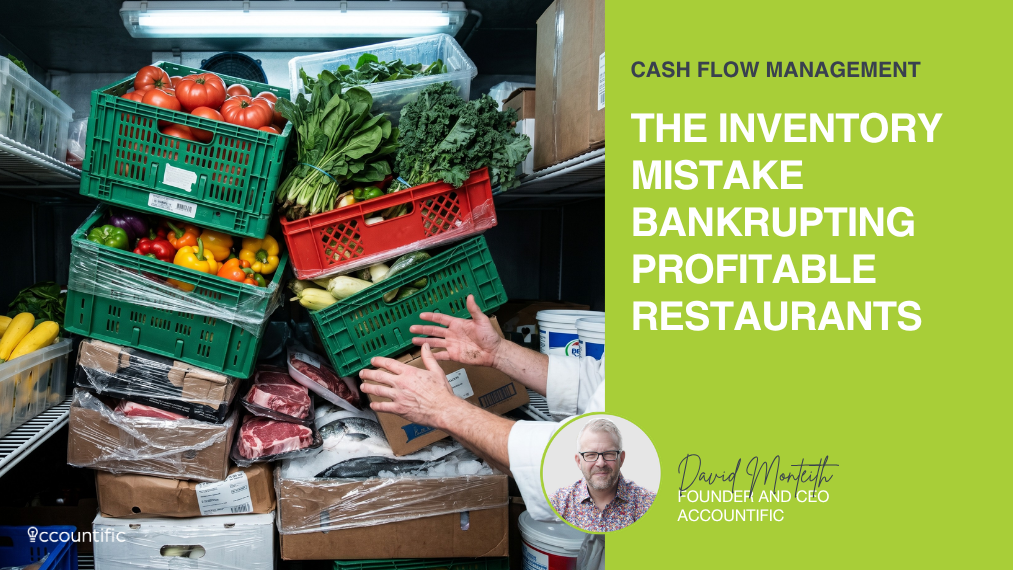
Your profit and loss statement says the business is making money. Your bank account tells a different story. For thousands of Canadian restaurant operators, the capital required for payroll, rent, and CRA remittances is not missing; it is sitting in the walk-in cooler, locked inside overstocked perishable inventory that is slowly rotting its way toward the garbage.
This is the inventory cash trap, and it follows a predictable, devastating pattern. The business pays for raw materials upfront, depleting working capital instantly. When consumer demand does not match purchasing volume, unused ingredients spoil. The business pays twice, once to buy the product and once to throw it away, while generating zero revenue from the investment. A casual dining operator running a 38% food cost when the structural benchmark is 32% is bleeding pure profit on every single transaction, regardless of how full the dining room is.
The problem runs deeper than bulk purchasing decisions. Variance between theoretical and actual inventory, the gap between what the POS says the kitchen should have used and what is actually on the shelf, exposes a second layer of silent destruction. Any variance above 5% signals systemic failure. It points to employee theft of premium proteins and spirits, unreported spoilage, or chronic over-portioning by line cooks who have never been held accountable to the recipe. A restaurant discovering this at the month-end has already lost the margin. Weekly counts — daily counts for high-value items — are the only mechanism that catches it in time.
Supplier payment terms add a third dimension that most owners never optimize. The difference between Cash on Delivery and Net 30 terms is not just a payment schedule — it is 30 days of working capital that can cover a payroll cycle, an emergency equipment repair, or a CRA remittance that cannot be delayed. Negotiating a single primary supplier from Net 7 to Net 30 terms transforms a balance sheet without changing a single menu price.
Why You Need to Read the Full Article
The summary names the problems. The full article gives you the exact numbers to quantify how much each one is costing your specific restaurant. It breaks down the COGS formula, Beginning Inventory plus Purchases minus Ending Inventory divided by Food Sales, and shows you the exact benchmarks by restaurant segment so you can measure your performance against the right target, not the industry average. It walks through the variance analysis framework that exposes theft, spoilage, and over-portioning before they compound into a crisis. It explains the lean ordering methodology that one multi-location pizza operator used to cut total spoilage by 60% by aligning delivery schedules with actual daily preparation needs. And it maps the complete GST/HST and payroll remittance compliance structure, including the CRA’s penalty formula, the escalating late payroll remittance penalties from 3 to 20 percent, and the exact remittance deadlines for every employer classification, because capital locked in excess inventory is almost always the root cause of the missed tax payments that turn a cash flow problem into a government enforcement problem. If you are running your restaurant on gut feel and monthly reports, this article is the financial framework that replaces both.
Book a Consultation with David Monteith
The inventory cash trap is one of the most fixable problems in the Canadian restaurant industry, and it is almost always invisible until someone with weekly financial data sits down and shows the owner exactly where the capital is going. At Accountific, we work exclusively with Canadian food business owners. We connect directly to your point-of-sale system, reconcile your purchases against your actual sales data weekly, and produce the variance and COGS reports that expose hidden waste, theft, and over-portioning before they destroy the margin. We manage your payroll remittances, your GST/HST compliance, and your T4 filings with precision so that a cash flow crunch from excess inventory never cascades into a CRA penalty situation. We give you the weekly financial clarity to make agile, data-driven decisions, not the monthly autopsy that arrives thirty days after the damage is already done.
If you are ready to find out exactly where your capital is trapped and what it would take to free it, book a no-obligation consultation directly with David. We will review your current systems, identify the leaks, and build the financial foundation your restaurant deserves.
—
A perfectly executed menu guarantees nothing regarding financial survival. Operators across the Canadian foodservice sector consistently fall into a predictable, devastating financial trap. Monthly profit and loss statements show robust net income, yet the business bank account sits dangerously near zero. The capital required for payroll, rent, and tax remittances remains inaccessible. The funds reside inside the walk-in cooler, locked in perishable inventory.
Financial professionals identify this operational failure as being “inventory-rich and cash-poor”. The phrase describes a systemic breakdown where purchasing volume severely outpaces actual consumption. Overstocking perishable ingredients creates a brutal double loss mechanism for the enterprise. The business pays for the raw materials upfront, depleting working capital instantly. Subsequently, the operation pays a second financial penalty when unused perishables spoil, requiring waste removal and permanently destroying the initial investment. A restaurant sustaining a 35% food cost against a structural benchmark of 28% bleeds capital daily.
Gut feeling fails completely to identify these structural deficits. Accurately diagnosing liquidity requires disciplined, weekly financial tracking. Specialized firms like Accountific provide the exact weekly bookkeeping required to expose these hidden cash drains. Financial clarity transforms a struggling operation into a controlled, profitable enterprise. Operators achieve absolute control over their finances, significantly reducing administrative stress and freeing valuable time to focus on hospitality excellence.
Macroeconomic Pressures Defining Canadian Foodservice
The contemporary Canadian economic environment punishes operational inefficiency ruthlessly. The industry faces unprecedented headwinds extending through 2025 and 2026, altering consumer behaviour fundamentally. Recent surveys demonstrate 74% of Canadians are aggressively reducing discretionary spending to survive broader economic pressures. Dining out represents the primary target for these household budget cuts, with 56% of consumers actively avoiding restaurant visits. Takeout and delivery services face similar severe reductions, experiencing a 50% drop in consumer participation.
Sales forecasts reflect these grim consumer realities. While the industry achieved a temporary 6.9% sales spike in early 2025 due to a targeted GST/HST holiday, the long-term outlook appears heavily constrained. Nominal growth projections for 2026 recently suffered a downward revision to 2.3%, a significant drop from previous optimistic estimates. The entire sector operates under a persistent 9% economic output gap compared to pre-pandemic benchmarks established in 2019.
Cost pressures compound the revenue challenges. Menu price inflation projected at 4.2% struggles to offset rising operational expenses across the supply chain. Canada’s food price report in 2025 projects continuous increases across all major supply categories, squeezing margins tighter.
| Food Category | Anticipated Price Increase (2025) |
| Meat | 4% to 6% |
| Restaurants | 3% to 5% |
| Vegetables | 3% to 5% |
| Dairy | 2% to 4% |
| Seafood | 1% to 3% |
| Fruits | 1% to 3% |
These aggressive macroeconomic pressures directly drive severe business failures. In May 2025, the national business closure rate reached 4.8%, with the accommodation and food services sector contributing 13.0% to the overall closure increase across the country. By September 2025, business insolvency filings across Canada spiked by an alarming 21.2% in a single month. Surviving this hostile environment demands flawless execution in cost control and capital preservation.
The Mathematical Mechanics Of Cost Of Goods Sold
Understanding the inventory cash trap requires a rigorous breakdown of the Cost of Goods Sold (COGS). This metric dictates the fundamental profitability of any food enterprise. COGS represents the direct costs attributable to the production of the goods sold by a company.
The mathematical formula dictates precise tracking:
Food Cost Percentage = (Beginning Inventory + Purchases – Ending Inventory) ÷ Food Sales × 100.
This calculation demands accurate, timely data collection. Relying on visual assessments or monthly counts guarantees failure. A full calendar month allows systemic problems to compound unnoticed, destroying margins before management recognizes the threat. The gap between a successful enterprise and a bankrupt operation often rests within a few percentage points of this metric.
Industry benchmarks vary strictly by the specific operational model. Maintaining margins requires measuring against these established segment standards:
| Restaurant Segment | Target COGS Percentage |
| Fast Food / Quick Service | 28% to 32% |
| Casual Dining | 30% to 35% |
| Fine Dining | 35% to 40% |
| Cafes and Coffee Shops | 20% to 25% |
| Pizza (Delivery-Heavy) | 24% to 28% |
Fine dining establishments tolerate higher food costs due to premium pricing and higher average cheque sizes. Conversely, fast-casual concepts must maintain lower percentages to survive lower price points and high transaction volumes. A casual dining establishment operating at a 38% food cost bleeds cash continuously. Every dollar spent above the 32% maximum benchmark represents pure profit evaporating from the balance sheet.
To read a detailed breakdown of these margin killers, review the Accountific guide on killing hidden restaurant costs. The guide explains how operators often reduce purchasing artificially in September simply to stockpile cash, a desperate operational maneuver masking deeper structural flaws.
The Trap Of The Overstocked Walk-In Cooler
Restaurant operators frequently fall victim to the psychological trap of bulk purchasing. Suppliers offer enticing discounts for volume orders. Buying fifty cases of tomatoes instead of ten cases appears mathematically sound on paper. The unit price drops, theoretically improving the margin on the final dish.
The reality of foodservice operations tells a completely different story. Buying the fifty cases requires a massive upfront cash outlay. The capital exits the bank account and transforms into highly perishable physical assets sitting on a shelf. The business loses all financial flexibility. If an unexpected equipment failure occurs, the operator cannot pay the repair technician with cases of tomatoes. The cash is trapped.
The situation deteriorates further as the clock ticks. Fresh produce, premium proteins, and dairy products possess strict expiration windows. When consumer demand fluctuates unexpectedly, the excess inventory begins to spoil. The kitchen staff throws the rotten tomatoes into the garbage. The business paid for the product, paid the labour to prep the product, and received zero revenue in return. The theoretical margin improvement provided by the bulk discount disappears entirely, replaced by a massive net loss.
Lean Ordering Methodologies And Capital Preservation
Data-driven operators reject traditional bulk purchasing models entirely. Purchasing excess inventory to secure minor supplier discounts frequently destroys liquidity. Smart owners implement lean ordering methodologies, commonly known as restaurant supply chain management, based entirely on actual consumption patterns.
This precise reduction translates directly into thousands of dollars of preserved working capital monthly. The system matches supplier deliveries with exact customer demand, minimizing the duration perishable goods remain in fragile storage environments. Setting automatic low-stock alerts at 125% of lead-time usage prevents dangerous stockouts while simultaneously protecting vital cash reserves.
Execution requires disciplined stock rotation. The First-In, First-Out (FIFO) method ensures kitchen staff utilize older perishables before accessing newer deliveries. One multi-location pizza brand successfully cut total spoilage by 60% solely by aligning its delivery schedules with actual daily preparation needs.
Technology accelerates these efficiencies. Modern inventory management systems utilize Internet of Things (IoT) sensors and Radio Frequency Identification (RFID) tags. IoT sensors provide continuous real-time data regarding specific storage conditions. Walk-in coolers must strictly maintain temperatures between 34 and 38 degrees Fahrenheit, while freezers require temperatures at or below zero degrees Fahrenheit. A single compressor failure destroys thousands of dollars of capital overnight.
Scratch kitchens face amplified difficulties implementing these controls. Restaurants creating menu items entirely from raw ingredients find calculating accurate food costs incredibly complex. Multiple recipes utilize identical base ingredients, obscuring exact consumption rates. Precise unit conversion metrics and yield tracking become mandatory for survival in these environments. Accountific works directly with your POS data to reconcile these complex purchases against actual sales, turning raw data into actionable insights.
Variance Analysis Exposing Theft And Waste
Theoretical inventory calculates the exact amount of product a kitchen should use based on POS sales data. Actual inventory represents the physical product remaining on the shelves. The difference between these two figures represents variance.
Variance serves as the ultimate diagnostic tool for operational efficiency. A detailed variance report highlights specific discrepancies, revealing critical failures in purchasing, storage, or daily usage. Healthy operations aim for a variance strictly under 2%. Any variance exceeding 5% signals severe, systemic operational failure requiring immediate intervention.
Unexplained variance points directly to three destructive forces:
- Employee Theft: High-value products like premium steaks or liquor are leaving the building unauthorized.
- Unreported Spoilage: Ingredients expiring and ending up in the garbage without proper documentation.
- Chronic Over-portioning: Line cooks serving larger quantities than the recipe dictates, slowly eroding the margin on every single plate leaving the kitchen.
Monthly counting rituals fail to catch these issues in time. Counting inventory sections weekly, or conducting daily counts for high-value items like premium proteins, catches discrepancies before losses escalate into bankruptcy.
Strategic Supplier Negotiations And Working Capital
Inventory management extends far beyond the physical kitchen. The financial agreements structuring supplier relationships act as powerful cash flow levers. Managing accounts payable strategically determines the exact liquidity available for immediate operational needs.
Operators must negotiate terms protecting their working capital while maintaining strong vendor relationships.
| Payment Term | Definition | Strategic Impact |
| Cash on Delivery (COD) | Payment required immediately upon receipt of goods. | Destroys liquidity. Forces the business to pay before generating revenue from the product. |
| Net 7 | Payment due within 7 days of the invoice date. | Typical for high-frequency produce and fresh perishables. Highly restrictive on cash flow. |
| Net 30 | Payment due within 30 days of the invoice date. | Standard industry benchmark. Provides adequate time to sell the inventory, generate revenue, and pay the supplier from the proceeds. |
| Net 45 / Net 60 | Payment due within 45 or 60 days. | Extended terms reserved for massive volume accounts. Maximizes capital preservation. |
| 2/10 Net 30 | A 2% discount applied if paid within 10 days; otherwise, full payment is due in 30 days. | Requires careful mathematical analysis to determine if the 2% savings outweighs the immediate loss of working capital. |
Transitioning a primary supplier from Net 7 to Net 30 terms transforms a balance sheet instantly. The restaurant gains 23 days of additional liquidity. This capital becomes available to cover payroll obligations, handle emergency equipment repairs, or execute timely CRA tax remittances. Supplier relationships provide options when demand shifts unexpectedly. Consolidating orders with fewer suppliers often secures better pricing matrices and simplified administrative management.
Bookkeeping Infrastructure And Financial Health
Operational strategies hold zero value without accurate financial reporting. Blending personal and business expenses represents the foundational mistake bankrupting independent operators across the country. Using a personal credit card for a commercial supply run creates a severe bookkeeping disaster, triggering massive red flags during a CRA audit. To ensure your financial foundation is solid, review whether your restaurant can survive a CRA audit. Establishing dedicated business banking accounts and credit facilities remains completely non-negotiable.
Financial clarity relies heavily on understanding how money moves through the business. Waiting for an annual meeting with an accountant leaves you flying blind for twelve months. Accountific solves this pain directly by providing proactive, weekly bookkeeping. You always have a current, accurate picture of your financial health, enabling agile decision-making based on facts, not intuition.
To understand the metrics driving profitability, read the Accountific framework detailing what Canadian restaurant owners should review every week. The framework moves leadership away from blind guessing toward active, data-driven financial management.
Cash Flow Statements Demystified
The Cash Flow Statement tracks the exact movement of capital through the enterprise. This document tells the true story of a restaurant’s survival.
The Cash Flow Statement is separated into three critical sections:
- Operating Activities: Captures capital generated from core business operations. This includes funds received from food and beverage sales, minus cash paid for wages, inventory purchases, and daily operational expenses.
- Investing Activities: Reflects cash flows related to purchasing or selling long-term assets, such as commercial kitchen equipment, dining room furniture, or property acquisitions.
- Financing Activities: Details capital flows stemming from debt instruments, business loans, line of credit adjustments, and equity investments.
Understanding these categories prevents owners from making catastrophic reinvestment errors. Positive operating cash flow must fund daily obligations before management considers investing activities like expensive dining room renovations. Accountific organizes these numbers flawlessly, turning raw data into clear reports showing exactly where your money goes.
The Canada Revenue Agency And Tax Compliance
The CRA serves as the ultimate arbiter of business survival. Capital locked in excess inventory inevitably leads to missed tax deadlines. The ensuing penalties and compounding interest rates destroy profit margins permanently. Compliance fear represents a massive burden for restaurant owners, stealing focus away from creating great customer experiences.
Accountific acts as a comprehensive service, providing a one-stop shop for the big three administrative burdens: bookkeeping, payroll, and tax compliance. This architecture gives you complete peace of mind, knowing professionals handle the deadlines.
GST And HST Remittance Schedules And Penalties
Filing and payment deadlines depend entirely on the business’s assigned reporting period. Monthly and quarterly filers must submit their returns and payments exactly one month after the end of their reporting period.
The 2025 and 2026 quarterly fiscal deadlines strictly follow this schedule:
- Quarter 1 (Jan 1 to Mar 31): Due April 30
- Quarter 2 (Apr 1 to Jun 30): Due July 31
- Quarter 3 (Jul 1 to Sep 30): Due October 31
- Quarter 4 (Oct 1 to Dec 31): Due January 31
Annual filers generally face a deadline three months after their fiscal year-end. Self-employed individuals operating with a December 31 fiscal year end receive an extension to file until June 15, yet they must still pay any amount owed by April 30. When a due date falls on a Saturday, Sunday, or recognized public holiday, the CRA considers the submission on time if received or postmarked on the next business day.
The CRA calculates late-filing penalties using a specific algebraic formula: A + (B × C).
- A represents 1% of the total amount owing.
- B represents 25% of the value of A.
- C represents the number of complete months the return remains overdue, up to a maximum of 12 months.
Consider a fictional restaurant owing $50,000 in GST/HST filing exactly six months late. The business faces a massive penalty of $2,250. The formula breaks down as $500 plus ($125 multiplied by 6 months).
Penalties compound through interest charges. The CRA applies a prescribed interest rate on overdue GST/HST remittances, typically hovering around 7%, compounding daily. This interest calculation begins the exact day following the missed deadline. The agency offers zero grace periods.
Electronic filing remains mandatory for most registrants. Failing to file electronically triggers an immediate $100 penalty for the first offense, escalating to $250 for every subsequent incorrect submission. Ignoring a formal demand to file results in a flat $250 penalty applied alongside all other compounding interest charges. Furthermore, operators cannot claim an income tax deduction for any penalty paid regarding GST/HST failures. Navigating the Canadian tax infrastructure requires absolute precision, which is exactly how smart restaurants handle GST, payroll, and T4 deadlines without panic.
Payroll Remittance Regulations And Financial Exposure
Labour costs consistently match or exceed food costs, demanding equal scrutiny. Scheduling excess staff during slow periods drains cash reserves rapidly, while understaffing during peak volume destroys the customer experience. Accurately managing the payroll process involves strict adherence to CRA remitting schedules.
The CRA classifies employers into specific remitter types based on their Average Monthly Withholding Amount (AMWA) from two calendar years prior.
Quarterly Remitters:
New small employers or businesses maintaining an AMWA between $0 and $2,999.99 qualify for quarterly remitting, provided they possess a perfect compliance record. Their due dates fall on April 15, July 15, October 15, and January 15.
Regular Remitters:
Businesses with an AMWA between $0 and $24,999.99 operate as regular monthly remitters. They must submit deductions by the 15th day of the month following the calendar month in which the employees received payment.
Accelerated Remitters (Threshold 1 & 2):
Large operations with an AMWA between $25,000.00 and $99,999.99 must remit up to twice a month. Deductions from the 1st to the 15th require payment by the 25th of the same month. Deductions from the 16th to the end of the month require payment by the 10th of the following month. Massive operations exceeding $100,000.00 in AMWA must remit up to four times monthly, specifically on the 3rd working day following the 7th, 14th, 21st, and the final day of the month.
Late payroll remittances trigger immediate, escalating percentage-based penalties:
- 1 to 3 days late: 3% penalty
- 4 to 5 days late: 5% penalty
- 6 to 7 days late: 7% penalty
- More than 7 days late: 10% penalty
Repeated failures knowingly committed within a single calendar year trigger a devastating 20% penalty. This immense compliance pressure is why spending more on payroll saves your margins when managed correctly through professional oversight.
The CRA enforces strict deadlines for annual reporting. Employers must file T4 and T4A information returns by February 28 of the following year. For the 2025 tax year, the agency granted temporary relief, waiving late-filing penalties for information returns filed on or before March 7, 2025. Operators should never rely on administrative grace periods for fundamental business compliance. Accountific manages these T4 and ROE headaches entirely, ensuring flawless execution of complex payroll requirements.
Federal Tax Bracket Updates For The Coming Years
Accurate payroll processing requires constant software updates to reflect changing federal and provincial tax legislation. On May 27, 2025, the Government of Canada tabled legislation reducing the lowest income tax rate. Effective July 2025, a prorated tax rate of 14% applied to the lowest bracket.
For 2026 and all subsequent tax years, the comprehensive federal tax brackets will be restructured entirely:
- Income under $58,523: 14% tax rate
- Income from $58,523 to $117,045: 20.5% tax rate
- Income from $117,045 to $181,440: 26% tax rate
- Income from $181,440 to $258,482: 29% tax rate
- Income of $258,482 and over: 33% tax rate
Calculating Gross Pay, Employment Insurance (EI), Canada Pension Plan (CPP), and Income Tax against these new thresholds requires sophisticated payroll management. Accountific handles these exact calculations, ensuring timely remittances and absolute tax compliance, eliminating the administrative terror of changing federal codes.
Digital Integration And Revenue Velocity
Preserving cash flow through lean inventory practices represents only half the operational equation. The second half involves accelerating revenue velocity. Efficient inventory management integrates seamlessly with advanced Point of Sale (POS) analytics.
Reconciling POS sales data against supplier purchases generates precise menu engineering reports. This data exposes the exact profitability of every individual menu item. Identifying high-margin dishes allows operators to restructure their menus, promoting items generating the most cash while eliminating low-margin, high-prep alternatives.
Does your menu say “Steak and Potatoes” or “8oz AAA Alberta Sirloin with Duck-Fat-Roasted Fingerling Potatoes and a Red Wine Jus”? One is a generic list; the other is a compelling story making mouths water and driving sales.
This digital infrastructure extends into customer acquisition. Search Engine Optimization (SEO) strategies drive revenue velocity directly. Approximately 65% of traffic to food websites originates from organic search queries. Optimizing an online menu with specific, localized keywords increases digital traffic by 25% to 40%. When hungry consumers search for specific cuisines within a localized geographic radius, the optimized restaurant captures the reservation. The digital marketing agency Great Work Online provides specific expertise in driving this digital traffic for the foodservice sector. High revenue velocity forgives many minor operational errors, keeping the cash flow cycle moving efficiently.
Securing Financial Control With Expert Support
The Canadian restaurant industry remains an unforgiving environment for operators relying on intuition. The transition from chaotic survival to sustainable profitability requires a fundamental shift in philosophy. Operations must abandon the dangerous habit of burying working capital in overstocked walk-in coolers. They must implement precise variance tracking, negotiate strategic supplier payment terms, and maintain flawless compliance with CRA tax and payroll regulations.
These strategies demand an unbreakable bookkeeping foundation. Attempting to manage complex inventory matrices, variable labour schedules, and compounding tax liabilities without weekly financial visibility guarantees eventual insolvency.
Accountific provides the exact financial architecture required to survive and thrive. Through specialized, weekly bookkeeping, we deliver the clarity needed to make agile, data-driven decisions. The comprehensive service eliminates the burden of payroll processing and tax compliance, lifting the administrative weight off your shoulders. The ultimate result provides absolute control over your enterprise.
Our four-step process transforms chaos into clarity. We start with a comprehensive consultation to understand your unique operational needs. Next, we review or completely rebuild your accounting systems to ensure maximum efficiency. We then automate the entire data collection process, removing manual data entry bottlenecks. Finally, you achieve absolute control through weekly reporting and expert advisory support, putting you firmly in the driver’s seat of your finances.
Operators ready to abandon the stress of unknown cash flow dynamics and build a truly profitable business must take the immediate first step. Establish control today. Secure the future of your enterprise and book a consultation. Financial clarity transforms culinary passion into sustainable, generational success.
——————–
David Monteith, founder of Accountific, is a seasoned digital entrepreneur and a Xero Silver Partner Advisor. Leveraging over three decades of business management and financial expertise, David specialises in providing tailored Xero solutions for food and beverage businesses. His deep understanding of this industry, combined with his proficiency in Xero, allows him to streamline accounting processes, deliver valuable financial insights, and drive greater success for his clients.