
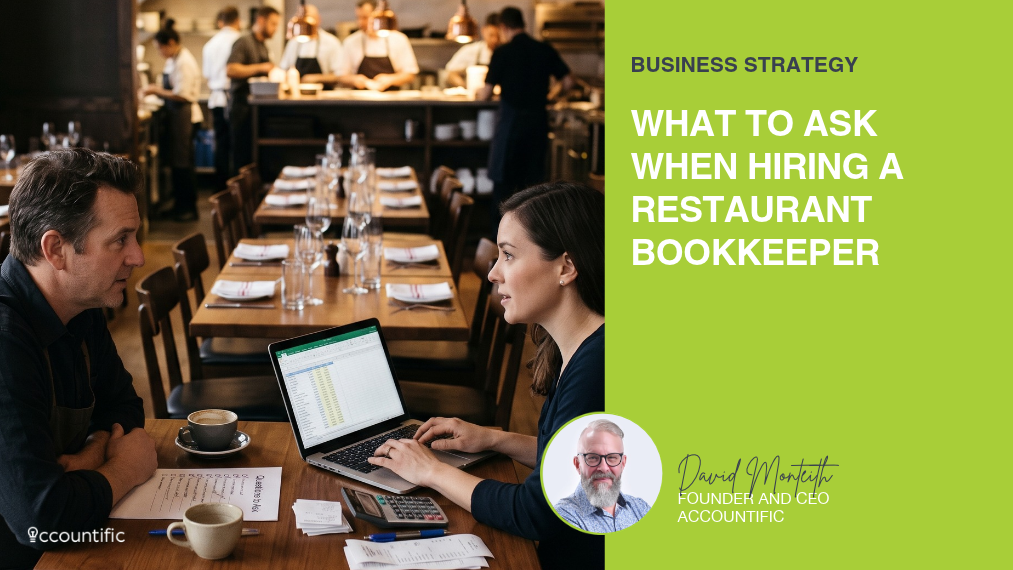
Questions to Ask Before Hiring a Restaurant Bookkeeper in Canada
The questions that separate a bookkeeper who knows restaurants from one who says they do, and what a good answer to each one sounds like
TLDR
Most questions owners ask a bookkeeper they’re thinking of hiring (rates, software, years in business) get confident answers from almost everyone. They don’t tell you much. The questions that do are the ones only someone who has actually worked inside restaurant books can answer well.
Start with what we call the kitchen questions. Ask how they treat tips that go through a tip pool or tip-out, what they do when POS sales and bank deposits don’t match, how they record delivery platform payouts and gift cards, which provincial filings they’ll track for you, and how they split cost of goods. A restaurant bookkeeper answers each one specifically, and usually asks you something back about how your operation works.
Then ask about the work itself: what happens each week, who does it and who checks it, and what’s in and out of scope, in writing. Ask what report you’ll get and who explains it. Finally, ask who will own the software login, the CRA access, and the records, and what happens if you part ways.
Bookkeeping isn’t a regulated profession in Canada, so the questions you ask are doing the screening a licence would do in other fields. Interview at least two candidates, ask each the same questions, and compare the answers side by side.
Why You Should Read the Full Article
The article goes through each question in five groups, explains why it matters in a restaurant specifically, and describes what a good answer sounds like next to a vague one. It covers the red flags worth walking away from, and it ends with a shortlist you can print and take into your next interview, whether you’re hiring someone in-house or choosing an outside firm.
How Accountific Helps
Accountific works only with food and beverage businesses, so these are the questions we expect to be asked, and we’re happy to answer every one of them before anyone signs. On a first consultation, we’ll walk through how we’d handle your tips, your POS and delivery reconciliation, your provincial filings, and your weekly reporting, and we’ll show you what the weekly report looks like. If you’re interviewing bookkeepers now, book a consultation with David and add us to your list.
You’ve narrowed it down to three. Each one has a good website, and two have a little fork-and-knife icon on the page that says “Industries we serve.” All three say they work with restaurants. All three use Xero or QuickBooks Online. Their rates are within shouting distance of each other.
So you ask a question you half-expect to stump them: “How would you handle the tips we pool and share with the kitchen?”
The first one says they’d record them as wages. The second says tips are the staff’s business and don’t go through the books. The third asks you two questions back. Who decides how the pool is split, and do the card tips come in through your POS or get paid out in cash at the end of the night?
Only one of those three has spent real time inside a restaurant’s books. And you found out in one question.
Why the usual questions don’t help much
Most owners start where you’d start with any service: what do you charge, what software do you use, how long have you been doing this, can you send references. Those are fair questions, and you should ask them. The trouble is that almost every bookkeeper answers them well. They don’t tell you whether the person can handle a restaurant.
It helps to know that bookkeeping isn’t a regulated profession in Canada. CPB Canada, which grants the Certified Professional Bookkeeper designation, says it plainly: unlike CPAs, the bookkeeping profession is unregulated. Anyone can call themselves a bookkeeper, and anyone can add restaurants to their list of industries.
That isn’t a reason for suspicion. Plenty of excellent bookkeepers have no formal designation. It just means your questions have to do the screening. The ones below are grouped so you can work through them in order, and each comes with a description of what a good answer sounds like.
This piece follows on from our earlier article on the DIY bookkeeping trap. If you’ve been doing the books yourself and you’re ready to hand them over, this is the next step.
Group one: the kitchen questions
These five are the heart of the interview. A generalist can learn the answers, but only someone who has worked in restaurant books will give them without hesitation.
How do you treat tips that go through a tip pool or tip-out?
This is the single best test, because the answer has real consequences for payroll. CRA separates tips into two kinds. Controlled tips are tips the employer controls or holds and then pays out to staff, such as a mandatory service charge or a tip pool the employer sets up. CPP and EI have to be deducted from controlled tips. Direct tips go straight from the customer to the employee, with the employer having no say in the amount or how it’s shared, and they aren’t subject to CPP or EI deductions.
A good answer uses those terms, or describes the same distinction in plain language, and then asks how your pool actually works, because that decides which category your tips fall into. A vague answer treats all tips the same way, in either direction.
What do you do when POS sales and bank deposits don’t match?
In a restaurant, they almost never match on their own. Card batches settle a day or two late and arrive net of processing fees, tips ride inside the deposits, and delivery apps pay out in bundles. A good answer describes a routine: matching each day’s sales to its deposit, recording fees and tips on their own lines, using clearing accounts that should sit near zero, and listing anything that doesn’t tie out. We set out what that weekly routine should include in What Weekly Restaurant Bookkeeping Actually Includes.
A weak answer says the bank feed takes care of it.
How do you record delivery platform payouts and gift cards?
Both are places where restaurant books commonly go wrong. A delivery payout arrives with commissions, promotions, and refunds already taken off, so recording it as sales at the net amount understates revenue and hides what the platform is costing you. A good answer records the gross sale and the commission separately. Gift cards are a liability when sold and only become revenue when redeemed. A bookkeeper who records gift card sales as revenue on the day they’re sold will make holiday months look better than they were.
Which provincial filings will you track for us?
Federal obligations are the same everywhere. Provincial ones aren’t. Depending on where you operate, that can mean provincial sales tax (in some provinces PST applies to restaurant meals, in others only to alcohol), workers’ compensation reporting, and stat holiday pay rules that differ from one province to the next. A good answer names the specific obligations in your province without being prompted. If you operate in more than one province, ask how they keep track of each.
How will you split cost of goods?
A single cost of goods account can’t tell you whether a problem is in the kitchen or behind the bar. A good answer separates food, beverage, and alcohol at a minimum, and asks whether packaging deserves its own line if takeout is a big part of your sales. This question also shows whether they think about your books in terms of how a restaurant is run, or just in terms of where transactions go.
Group two: the work itself
Once you know they understand restaurants, find out what they’ll actually do.
What happens each week? Ask them to walk you through it step by step. You’re listening for a regular close with reconciliation, instead of a general promise to keep the books up to date.
Who does the work, and who checks it? If it’s a firm, ask whether the person doing your books is the person you’ll talk to, and whether a second person reviews the work. If it’s an individual, ask whether anyone ever reviews their reconciliations. One person doing everything with no review is the weakest arrangement for both accuracy and control.
What’s included, and what isn’t? Ask for the scope in writing. Weekly bookkeeping, payroll processing, CRA remittances, GST/HST and PST filings, year-end support, and clean-ups of past records are often priced and offered separately. Corporate tax returns and year-end financial statements are usually your accountant’s job. A written list now prevents most of the frustration later.
How quickly do you respond, and how? A short question about a payroll problem the day before payday needs a fast answer. Ask what a normal response time is and whether you’ll have a direct contact.
Group three: what you’ll see
The work is only useful if it reaches you in a form you can act on.
What will I get each week? A good answer describes a short report: sales compared with last week, prime cost as a percentage of sales, cash in the bank once tax, tips owed, and payroll remittances are set aside, and a list of anything that didn’t reconcile. Ask to see a sample, with client details removed.
Who explains it? A report that arrives with nobody to talk it through tends to sit unread. Ask who you’d call with a question about the numbers, and whether they’re comfortable with an owner who wants to understand them.
Group four: ownership and the exit
This group is the one owners skip most often, and it’s the one that matters most if the relationship ever ends.
Whose name will the software login be in? The main administrator account for Xero or QuickBooks Online should sit under a business email you control, with the bookkeeper given their own user access. Be cautious with anyone who wants to set the account up under their own email.
How will you access our CRA accounts? Owners can authorize a bookkeeper or accountant as a representative through My Business Account, check what they’ve done on the account, and remove their access when the relationship ends, as described in CRA’s representative authorization overview. That’s the arrangement to ask for.
Where will our records live? CRA expects businesses to keep records and supporting documents for six years from the end of the last tax year they relate to. The records should be stored somewhere the business controls, so they stay with you, whoever does the books.
What happens if we part ways? A good answer describes a handover: files and access returned, the current period closed, and notes left for whoever comes next. We call the bigger version of this the handover test, and it’s covered in Outsourced vs. In-House Bookkeeper.
Group five: credentials and protection
These questions round out the picture.
What training or certifications do you hold? Designations like CPB and certifications from Xero or QuickBooks show a commitment to the work. They’re useful signals without being requirements. Experience inside restaurant books matters more, and the kitchen questions test for that directly.
Do you carry professional liability insurance? Errors and omissions coverage protects you if a mistake costs money. Ask whether they carry it.
Can I speak with a restaurant client? Ask for a reference from an operation similar in size and format to yours, and ask that client how responsive the bookkeeper is and whether they’ve ever caught a problem early.
The best answer to a restaurant question is usually another question about your restaurant.
How to read the answers
Specific answers matter more than perfect ones.
A bookkeeper who knows restaurants tends to answer with detail, uses the right terms without showing off, and asks you questions back about how your tip pool is run, which POS you use, which delivery apps you’re on, and how many locations you have. That back-and-forth is a good sign. It means they’re thinking about your books in particular.
A few answers are worth treating as red flags:
- “We handle everything,” with no description of what everything means.
- No clear difference between controlled and direct tips.
- A plan to set up your accounting software under their email.
- No review of their work by anyone else, ever.
- No written scope, or a price offered before they’ve asked anything about your volume.
- A weekly report described as “whatever you need,” with no example to show.
None of these is automatically disqualifying on its own. Together, they usually describe someone who’ll be learning restaurant bookkeeping on your books.
The shortlist to take into the interview
Print this and bring it with you. Ask every candidate the same questions so you can compare the answers side by side.
- How do you treat tips that go through a tip pool or tip-out?
- What do you do when POS sales and bank deposits don’t match?
- How do you record delivery platform payouts and gift cards?
- Which provincial filings will you track for us?
- How will you split the cost of goods?
- What happens each week, step by step?
- Who does the work, and who reviews it?
- What’s included and what isn’t, in writing?
- What will I get each week, and can I see a sample?
- Whose name will the software login be in, and how will you access our CRA accounts?
- What happens if we part ways?
- Can I speak with a restaurant client similar to us?
Where to start this week
Pick the five questions from the list that matter most for your operation. If you’re tip-heavy, the tip question goes first. If you run multiple provinces, the filings question moves up.
Interview at least two candidates. One conversation gives you nothing to compare against.
Ask each for a sample weekly report and a restaurant reference, and follow up on both.
Then compare the answers side by side, and weigh specific, restaurant-aware answers above a lower rate. The cheapest option rarely stays cheapest once a tip or sales tax error has to be fixed.
If you’re deciding between bringing someone in-house and using an outside firm, our earlier article on fractional bookkeeping covers how part-time outsourced support works for restaurants.
At Accountific, we work only with food and beverage businesses, and we’d be glad to be one of the bookkeepers you interview. Bring the shortlist. We’ll answer each question, show you a sample weekly report, and explain how we’d set up your tips, POS, and delivery reconciliation, and provincial filings in Xero or QuickBooks Online. Clients have told us that what they value most is advice from people who know the industry, and the relief of no longer worrying about a major mistake. Book a consultation with David to start the conversation. You can also see how we set up Xero for food and beverage businesses on our Xero partner page.
Key Takeaways
- Common questions about rates, software, and experience get good answers from almost every bookkeeper and don’t test restaurant knowledge.
- Bookkeeping is unregulated in Canada, according to CPB Canada, so the questions you ask do the screening.
- The kitchen questions cover tips, POS and deposit matching, delivery payouts and gift cards, provincial filings, and cost of goods.
- A restaurant bookkeeper should know that CRA requires CPP and EI to be deducted from controlled tips but not from direct tips.
- Ask for the weekly process, the reviewer, and the scope in writing before you sign.
- Ask to see a sample weekly report and who will explain it.
- The business should own the software login, the CRA access, and the records, whoever does the books.
- Specific answers and questions asked back about your operation are good signs. “We handle everything” is not.
- Interview at least two candidates with the same questions and compare the answers side by side.
Frequently Asked Questions
What questions should I ask before hiring a restaurant bookkeeper?
Ask questions that only someone with restaurant experience can answer well. These include how they treat tips that go through a tip pool or tip-out, what they do when POS sales and bank deposits don’t match, how they record delivery platform payouts and gift cards, which provincial filings they’ll track, and how they split cost of goods. Then ask about their weekly process, who reviews their work, what’s in and out of scope, what report you’ll receive, and who will own the software login, CRA access, and records.
Are bookkeepers regulated in Canada?
No. CPB Canada, which grants the Certified Professional Bookkeeper designation, states that unlike CPAs, the bookkeeping profession is unregulated. Anyone can offer bookkeeping services without a licence or designation. Many skilled bookkeepers have no formal designation, so owners should rely on specific questions, sample reports, and references from similar businesses to judge a bookkeeper’s ability, and treat designations as a useful signal rather than a requirement.
How should a restaurant bookkeeper handle tips?
A restaurant bookkeeper should distinguish between controlled and direct tips, as the Canada Revenue Agency does. Controlled tips are tips the employer controls or holds and then pays to staff, such as a mandatory service charge or an employer-run tip pool, and CPP contributions and EI premiums must be deducted from them. Direct tips go straight from the customer to the employee without employer control and aren’t subject to CPP or EI deductions. Which category applies depends on how the restaurant’s tip pool and tip-outs actually work.
What should a restaurant bookkeeper do when POS sales don’t match bank deposits?
A restaurant bookkeeper should match each day’s POS sales to its bank deposit every week, recording card processing fees, card tips, and delivery platform commissions on their own lines so the two figures tie out. Clearing accounts used for this matching should stay at or near zero. Anything that doesn’t reconcile, such as a missing card batch or a short cash deposit, should be listed and followed up rather than left in the books.
What report should a restaurant bookkeeper provide each week?
A restaurant bookkeeper should provide a short weekly report showing sales compared with the previous week, prime cost as a percentage of sales, cash in the bank after sales tax, tips owed and payroll remittances set aside, and a list of items that didn’t reconcile. Owners should ask to see a sample report before hiring and should know who will explain the numbers when they have questions.
Who should own the accounting software login when I hire a bookkeeper?
The business should own the main administrator account for its accounting software, under a business email address the owner controls. The bookkeeper should be given their own user access, which can be removed when the relationship ends. Owners should be cautious about any bookkeeper who wants to set up the account under their own email, because it can leave the business dependent on that person to access its own financial records.
How do I give a new bookkeeper access to my CRA business account?
Business owners can authorize a bookkeeper or accountant as a representative through the Canada Revenue Agency’s My Business Account. The owner can choose the level of access, review online transactions the representative makes, and remove the authorization when the relationship ends. This is safer than sharing personal login details and keeps the business in control of its own tax accounts.
How many bookkeepers should I interview before hiring one for my restaurant?
Interview at least two, and ideally three, so you have answers to compare. Ask each candidate the same questions, including the restaurant-specific questions about tips, POS reconciliation, delivery payouts, provincial filings, and cost of goods. Ask each for a sample weekly report and a reference from a restaurant client similar in size and format to yours, then compare the answers side by side before deciding.
About the Author
David Monteith is the founder of Accountific, a Canadian digital bookkeeping practice that works only with food and beverage businesses. He’s a Xero Silver Partner Advisor with more than 30 years of experience in business management, accounting and small business finance, and he builds tailored Xero solutions for restaurants, cafés, bakeries, breweries and multi-unit groups. David is also CFO of Great Work Online, a digital marketing agency for food and beverage businesses, which gives him a dual perspective on the day-to-day bookkeeping and the strategy it should support.