
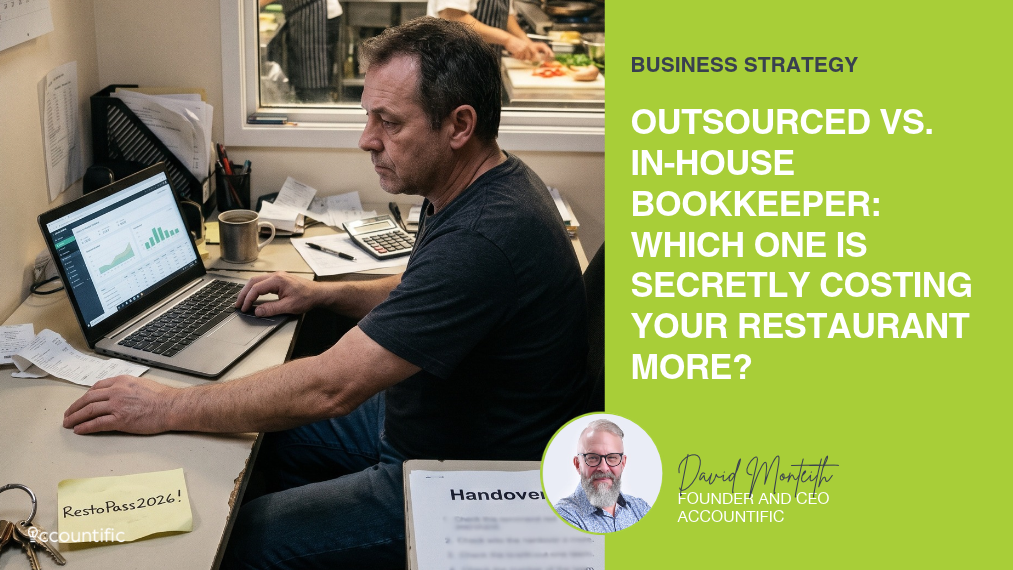
Outsourced Restaurant Bookkeeping or an In-House Bookkeeper
How to decide which one fits your restaurant, based on how much work there is, how specialised it is, and what happens to your books when the person doing them leaves
TLDR
The choice between outsourced restaurant bookkeeping and an in-house bookkeeper comes down to four things: how much bookkeeping your restaurant actually generates, how restaurant-specific that work is, how exposed you are if one person holds it all, and who checks the work. Price matters, but it’s the last thing to compare, because the cost of getting the other four wrong is usually higher.
If the weekly work doesn’t come close to filling a full-time role, or it calls for restaurant knowledge a generalist won’t have (tips, provincial sales tax, delivery platforms, stat holiday pay), outsourcing usually fits better. If you run several locations with daily purchasing and a lot of paper moving through the office, an in-house person often earns their place, ideally paired with an outside firm that reviews and reconciles the work.
Many restaurants land somewhere in the middle. An in-house admin collects invoices, counts cash, and handles daily entry, while an outside team does the weekly reconciliation, payroll review, filings, and reporting.
Whichever route you take, run what we call the handover test: if the person doing your books left tomorrow, could someone else pick them up within a week using only the logins and the files? If the answer is no, that’s the first thing to fix.
Why You Should Read the Full Article
The article works through each of the four factors with the questions to ask about your own restaurant, and it’s honest about what each option does well and where each one struggles. It covers the costs of an in-house hire that don’t show up in the wage, the risk most owners only discover when someone gives notice, and the hybrid setup many growing restaurants end up using. It finishes with simple scenarios to help you place your own operation, and a short list of protections to put in place whichever way you go.
How Accountific Helps
Accountific works as the outside bookkeeping team for food and beverage businesses that don’t need a full-time hire, and alongside in-house staff for groups that do. We run the weekly close, payroll and CRA remittances, and GST/HST and PST filings in Xero or QuickBooks Online, with the process documented so it never depends on one person. For restaurants with their own bookkeeper or admin, we can handle the reconciliation, review, and reporting while your team keeps the daily entry. If you’d like to work out which setup fits your restaurant, book a consultation with David.
She’s been with you six years. She knows which supplier always short-ships the dairy, why the POS double-counts gift card redemptions on busy nights, and which delivery app pays out late. She does payroll every second Thursday without being asked. You haven’t thought about the books in years, and that was the whole point.
Then, in the middle of November, she gives two weeks’ notice.
Over the next few days, you find out how much lived in her head. The Xero login is tied to her email. The CRA account lists her as the contact. The payroll schedule, the tip-out calculation, and the month-end routine were never written down. Holiday catering season is about to start, and the person who knew how everything fit together is training nobody, because there’s nobody to train.
Most in-house arrangements never reach that week. It’s still the scenario owners plan for least, and it’s a good place to start the decision, because it shows how much more than cost sits behind the choice between outsourced and in-house bookkeeping.
Four factors that decide it
There’s no answer that suits every restaurant. A single café and a six-location group need different things, and so does a restaurant whose owner enjoys the numbers compared with one whose owner wants nothing to do with them.
What does hold across every operation is the set of questions. The right setup depends on four factors:
- How much bookkeeping work the restaurant actually generates
- How specialised that work is
- How exposed the business is if one person holds it all
- Who checks the work
Cost comes after these four. Once you know what the work involves and what the risks are, comparing prices gets much easier, and much more honest.
Factor one: how much work your restaurant generates
Start by measuring the work instead of guessing at it.
For four weeks, count what moves through the books. That means supplier bills, card batches and cash deposits, delivery platform payouts, payroll runs, tip payouts, and any catering deposits or gift card sales. Note how much of it arrives on paper and how much comes in through integrations.
The count tends to surprise owners in one of two directions. A single location with a well-connected POS, a handful of main suppliers and digital invoices often generates far less work than the owner assumed, because most of the volume flows in automatically and only needs to be checked. A group with several locations, a central kitchen and daily deliveries generates a steady stream of paper that someone has to collect, chase and enter every day.
That difference is the first signal. If the work fits comfortably inside part of a week, a full-time hire will either have time to fill or will need other duties to justify the role. If the work fills the week and much of it involves physically gathering documents on site, a person in the building starts to make sense.
Factor two: how specialised the work is
Restaurant bookkeeping has its own problems, and they’re the ones that cause trouble with the CRA and with staff.
Tips are the clearest example. Whether a tip is controlled or direct changes how CPP and EI apply, and the answer depends on how your tip pool and tip-outs actually work. Then there’s sales tax: in some provinces PST applies to restaurant meals, in others only to alcohol, and takeout and delivery bring their own rules. Add stat holiday pay calculations that vary by province, delivery platform payouts that bundle sales with commissions and refunds, gift card liabilities, and workers’ compensation reporting.
A strong general bookkeeper can learn all of this. The question is whether they’ll learn it on your books, and what the mistakes cost while they do. A firm that works only with food and beverage businesses has usually seen each of these problems across many clients, which means the rule is already known before it’s needed.
This is also where the true cost of a hire shows up. An employee’s cost goes well past the wage. As an employer, you contribute an amount equal to the employee’s CPP contributions and 1.4 times their EI premiums, according to the CRA. On top of that come vacation pay, workers’ compensation premiums, software licences, training, and your own time managing and covering for the role. None of that makes a hire the wrong choice. It just belongs in the comparison.
Factor three: what happens when one person holds it all
This is the risk owners plan for least, and it’s the one that hurts most.
When a single person does the books, they often end up holding the logins, the process, and the history. It happens gradually and without anyone intending it. Then that person leaves, gets sick, or takes a long-planned month away, and the restaurant discovers how much it was relying on them.
The consequences aren’t abstract. Payroll source deductions don’t stop being due because the bookkeeper left. For employers, CRA classes as regular remitters, they’re due by the 15th of the month after the deductions were taken, according to CRA’s remittance schedule, and late payments draw penalties and interest. For a corporation, directors can be held personally liable for source deductions that aren’t remitted. Sales tax returns, supplier payments and staff pay all keep coming due too.
We use a simple check for this, the handover test. If the person doing your books left tomorrow, could someone else pick them up within a week using only the logins and the files? To pass, you need four things in place: the logins owned by the business, the CRA access set up properly, a written description of the weekly and monthly routine, and records stored somewhere the business controls.
An outsourced team lowers this risk because the process lives with a team instead of one person, and good firms document it as a matter of course. Outsourcing has its own version of the risk, though. Firms have turnover too, and switching providers can be painful if the firm owns the software subscription or the files. The handover test applies to an outside firm just as much as to an employee.
Factor four: who checks the work
One person doing everything means nobody is reviewing anything.
That matters for accuracy, because everyone makes errors and a second set of eyes catches most of them. It also matters for control. When the same person enters supplier bills, pays them and reconciles the bank account, there’s no separation between those duties, and that’s the arrangement where mistakes and the occasional dishonest act both go unnoticed for the longest time. We covered the wider version of this in our article on theft and waste.
An outsourced firm usually has review built in, with a senior person checking the work of the person doing the weekly close. An in-house bookkeeper can get the same protection if someone outside reviews their reconciliations regularly. Either way, the owner should be getting a short weekly report that shows what was reconciled and what wasn’t, as we described in What Weekly Restaurant Bookkeeping Actually Includes.
Before you compare costs, ask what happens to your books the week the person doing them is gone.
What an in-house bookkeeper does well
It’s worth being fair to both sides, because each has strengths the other can’t match.
An in-house bookkeeper is in the building. They can walk to the office to collect the invoice the chef left on the pass, count the float with the closing manager, and ask the GM about a strange charge before lunch service. They learn the business at a level of detail an outside team rarely reaches, and they’re available the moment something comes up.
For a restaurant with a lot of paper, cash handling or daily purchasing, that presence is worth a great deal. It’s also why many groups keep someone on site even when the reconciliation and reporting go to an outside firm.
What outsourced bookkeeping does well
An outsourced firm brings knowledge and continuity. The team has usually seen your problems before, the process doesn’t walk out the door with one person, and review is part of how the work gets done. The service can scale up or down as you open a location or go through a slow season, without hiring, training, or managing anyone.
The trade-off is distance. An outside team can’t pick an invoice up off the pass, so outsourcing works best when the restaurant runs a digital workflow, with supplier bills captured by email or an app like Hubdoc, the POS and bank feeds connected to the accounting software, and someone on site who sends what’s needed each week. Response time matters too. Ask any firm how quickly they answer questions and who you’ll be dealing with week to week.
The hybrid many growing restaurants end up with
Plenty of restaurants don’t choose one or the other. They split the work along the line where each side is strongest.
An in-house admin or office manager handles the on-site tasks: collecting and scanning invoices, counting cash, entering daily sales and bills, and answering staff questions. An outside firm handles the work that benefits from specialist knowledge and review: the weekly reconciliation, payroll review and remittances, sales tax filings, clean-ups, and the owner’s weekly report.
This setup suits restaurants that have outgrown the owner doing the books at night but don’t have enough specialist work to justify a senior in-house bookkeeper. It also passes the handover test more easily, because no single person holds the whole process.
A simple way to decide
These scenarios won’t fit every restaurant exactly, but most owners can see themselves in one of them.
You run a single location, and you’ve been doing the books yourself at night or on weekends. Outsourcing is usually the better fit. The volume rarely justifies a hire, and an outside team gives you the restaurant-specific knowledge and the review you don’t have now. We wrote about the limits of doing it yourself in our DIY bookkeeping article.
You have a long-serving bookkeeper, and you’re growing to a second or third location. Keep the person, but add outside review and document the process. If the specialist work is growing faster than they can keep up with, move the reconciliation, payroll review, or filings to an outside firm and let them focus on the daily work they do well.
You run a larger group with a central kitchen, daily deliveries, and a lot of paper. An in-house team usually makes sense for the daily volume. Pair it with outside review or an outside firm for payroll, filings, and reporting, so the group isn’t relying on one person’s judgment for everything.
You have a bookkeeper who’s leaving. Don’t rush a replacement hire before you’ve counted the work. A gap is often the best moment to look at the whole setup, and an outside firm can usually keep the books current while you decide.
If you’re weighing outside help, our earlier piece on fractional bookkeeping covers how part-time outsourced support works for restaurants.
Protect yourself whichever way you go
A few protections apply to every setup, in-house, outsourced or hybrid.
The business should own the accounting software subscription and the main administrator login, in a business email address the owner controls. Bookkeepers and firms get their own user access, which can be removed when they leave.
CRA access should run through the business. Owners can authorize a bookkeeper or accountant as a representative through My Business Account, review what they’ve done on the account, and remove their access when the relationship ends, as described in CRA’s representative authorization overview. Avoid having anyone file under their own personal access to your accounts.
Records should live in a place the business controls. CRA expects businesses to keep records and supporting documents for six years from the end of the last tax year they relate to, and those records need to survive any change of bookkeeper.
The routine should be written down. A page or two describing the weekly close, the payroll steps, the tip calculation, and the filing calendar is enough to make the next handover far easier.
Where to start this week
You don’t need to make a decision today to make progress.
Run the handover test honestly. Picture the person doing your books gone tomorrow and list what you’d be missing.
Write down every login the books depend on and whose email it’s tied to. Move anything tied to a personal address over to the business.
Check who’s authorized on your CRA business account and remove anyone who shouldn’t be there.
Then start the four-week count of bills, deposits, payouts, and payroll runs, so the next conversation about who does the work starts from real numbers.
If the count and the handover test point toward outside help, or toward a hybrid, we’d be glad to talk it through. Our process starts with a consultation, then we set up or review your existing books, automate what can be automated, and run the weekly close so you stay in control. Clients have told us the responsiveness of a remote team surprised them, and that the knowledge behind the advice was the real value. Book a consultation with David and we’ll help you work out which setup fits your restaurant. If Xero is part of the plan, you can see how we set it up for food and beverage businesses on our Xero partner page.
Key Takeaways
- The choice between outsourced and in-house restaurant bookkeeping depends on four factors: volume, specialisation, key-person risk and review.
- Measure the work for four weeks before deciding, counting bills, deposits, payouts and payroll runs.
- Restaurant bookkeeping involves specialist issues like controlled tips, provincial sales tax and delivery payouts that a generalist may need time to learn.
- An employee’s cost goes past the wage, including the employer’s matching CPP contribution and EI at 1.4 times the employee premium, according to the CRA.
- The handover test asks whether someone else could pick up your books within a week using only the logins and the files.
- One person entering bills, paying them, and reconciling the bank with no outside review is the weakest arrangement for both accuracy and control.
- An in-house bookkeeper brings on-site presence, while an outsourced firm brings specialist knowledge, continuity and built-in review.
- Many growing restaurants use a hybrid, with an in-house admin for daily tasks and an outside firm for reconciliation, payroll review, filings and reporting.
- Whatever the setup, the business should own the software, the CRA access and the records.
Frequently Asked Questions
Should a restaurant outsource bookkeeping or hire an in-house bookkeeper?
A restaurant should decide based on four factors: how much bookkeeping work it generates, how specialised that work is, how exposed it is if one person holds all the knowledge, and who reviews the work. Outsourcing usually fits a restaurant whose weekly bookkeeping doesn’t fill a full-time role or that needs restaurant-specific knowledge of tips, provincial sales tax, and delivery platforms. An in-house bookkeeper makes more sense for larger operations with daily purchasing and a lot of paper to handle on site, ideally with outside review of their work.
What does outsourced restaurant bookkeeping include?
Outsourced restaurant bookkeeping typically includes the weekly close (matching POS sales to bank deposits, coding supplier bills, recording tips and payroll, and reconciling every account), along with a regular report for the owner. Many firms also provide payroll processing, CRA remittances, GST/HST and PST filings, clean-ups of past records, and accounting software setup. The scope varies between providers, so owners should ask for a written list of what’s included and what isn’t before signing.
How do I know how much bookkeeping work my restaurant generates?
The most reliable way is to count it for four weeks. Track the number of supplier bills, card batches and cash deposits, delivery platform payouts, payroll runs, tip payouts and any catering deposits or gift card sales, and note how much arrives on paper versus through integrations with the POS and bank. A single location with connected systems often generates less work than expected, while a multi-location group with daily deliveries can generate enough paper to fill an in-house role.
What does an in-house bookkeeper cost beyond their wage?
Beyond the wage, a Canadian employer pays an amount equal to the employee’s CPP contributions and EI premiums of 1.4 times the employee’s premium, according to the Canada Revenue Agency. Other costs include vacation pay, workers’ compensation premiums, software licences, training, and the owner’s time spent managing the role and covering absences. These costs don’t make a hire the wrong choice, but they belong in any comparison with an outsourced service.
What is key-person risk in restaurant bookkeeping?
Key-person risk is the exposure a restaurant faces when one person holds the logins, processes, and history of its books. If that person leaves or is suddenly unavailable, payroll remittances, sales tax filings, and supplier payments can be delayed, and CRA penalties and interest can follow. Owners can reduce the risk by keeping software and CRA access under the business’s control, documenting the weekly and monthly routines, and storing records where the business owns them.
What is the handover test for restaurant bookkeeping?
The handover test is a simple check Accountific uses to measure key-person risk. It asks whether someone else could pick up the restaurant’s books within a week, using only the logins and the files, if the person doing them left tomorrow. Passing it requires business-owned software logins, properly authorized CRA access, a written description of the bookkeeping routine, and records stored somewhere the business controls. The test applies equally to in-house bookkeepers and outside firms.
Can a restaurant use both an in-house bookkeeper and an outsourced firm?
Yes, and many growing restaurants do. In a typical hybrid setup, an in-house admin or office manager collects invoices, counts cash, and handles daily entry, while an outsourced firm does the weekly reconciliation, payroll review, CRA remittances, sales tax filings, and owner reporting. This splits the work along each side’s strengths and reduces key-person risk, because no single person holds the entire process.
How do I give an outsourced bookkeeper access to my CRA account safely?
Business owners can authorize a bookkeeper or accountant as a representative through the Canada Revenue Agency’s My Business Account. From the profile section, the owner can add a representative, view and change the level of access, review online transactions the representative has made, and remove the authorization when the relationship ends. Keeping access set up this way, rather than sharing personal logins, means the business stays in control of its own tax accounts.
About the Author
David Monteith is the founder of Accountific, a Canadian digital bookkeeping practice that works only with food and beverage businesses. He’s a Xero Silver Partner Advisor with more than 30 years of experience in business management, accounting and small business finance, and he builds tailored Xero solutions for restaurants, cafés, bakeries, breweries and multi-unit groups. David is also CFO of Great Work Online, a digital marketing agency for food and beverage businesses, which gives him a dual perspective on the day-to-day bookkeeping and the strategy it should support.