
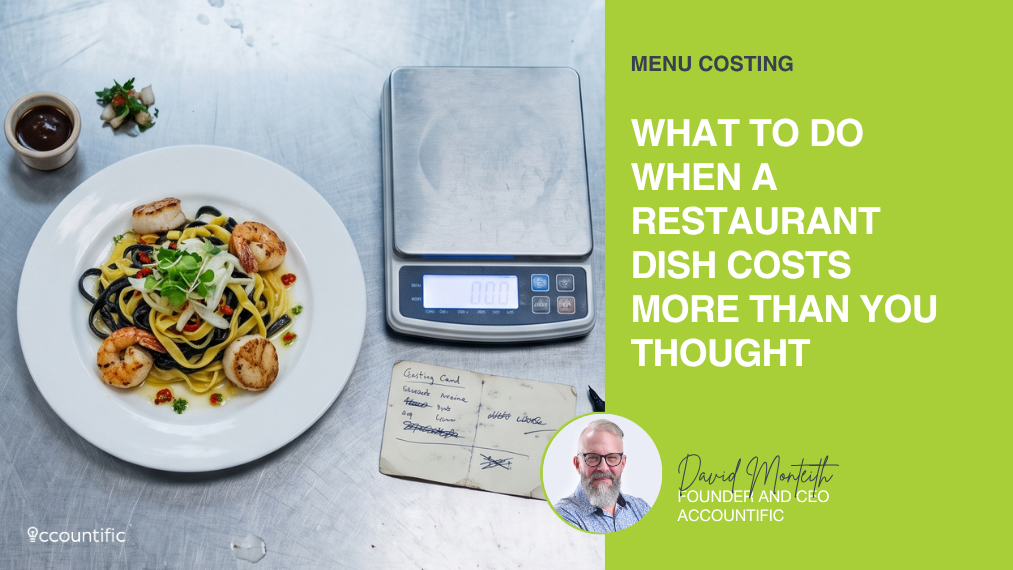
You’ve Costed the Plate, and the Number Isn’t What You Expected. Here Are Your Four Options.
TLDR
You did the work. You costed the dish properly, every component, trim included, priced against current invoices. Then you divided by the menu price and the number came back higher than you expected.
That’s where most costing work stalls. Not because the arithmetic is hard, but because nobody tells you what to do next. The number sits there looking like bad news, and the instinct is either to raise the price or to quietly put the card in a drawer and carry on.
There are four responses, and one of them is doing nothing. Being comfortable with the current price is a legitimate outcome. Some dishes earn their place at a higher food cost because they pull people through the door or sell alongside things that carry real margin. The difference now is that you’re choosing it rather than discovering it later.
Portion is often the quietest correction. A plate that has drifted larger than its original spec can usually be brought back without a single guest noticing, while cutting below what regulars expect tends to cost more goodwill than it saves.
Swapping an ingredient works when the substitute genuinely holds up on the plate. A different cut, another supplier, a cheaper garnish can move the number a long way. Change the heart of a signature dish, though, and you risk changing why people order it at all.
Then there’s the price itself, the most visible lever and often the most honest one. An operator who has costed the plate can move a price with confidence, because they know exactly what it has to cover.
Why You Should Read the Full Article
The article works through each of the four options in turn: when leaving the price alone is the right call and how to tell, how to correct portion drift without damaging the guest experience, which ingredient swaps are safe and which quietly change the dish, and how to approach a price increase so it lands well. It also covers how to decide between them when several would work, what to do when the number is so far off that no single lever closes the gap, and why the worst response is to cost a dish, dislike the answer, and do nothing.
How Accountific Helps
Accountific works only with Canadian food businesses, so this is a conversation we have with clients regularly rather than once a year. We’ll model each option against your actual numbers before you commit, so you can see what a portion correction, an ingredient swap, or a price move does to the margin on that dish and to your overall food cost. We’ll also tell you which of your other dishes carry the same ingredient, since a swap or a price change rarely affects just one plate. Book a consultation directly with David at https://calendly.com/davidmonteith.
The hardest part of menu costing isn’t the costing.
You can learn the method in an afternoon. List the components, price them against current invoices, correct for yield on the proteins, divide by the menu price. It’s arithmetic with a few traps in it, and once you’ve done one dish you can do the rest.
The hard part comes after. You’ve got a real number in front of you; it’s higher than you thought, and now you have to decide something. That’s where the work usually stops, because nobody tells you what the options actually are.
At the NEXT Food Expo in Calgary, David gave the room a short version: either you’re comfortable with the price, or you change the portion, the ingredients, or the price itself. Four options, and the first one is doing nothing.
Worth saying plainly before we get into them: the worst outcome is costing a dish, not liking the answer, and carrying on as though you never looked. You’ve now paid for the information and declined to use it.
Option one: leave it alone, on purpose
This gets dismissed too quickly, and it shouldn’t.
Not every dish needs to hit your target food cost. A plate can run high and still earn its place, and there are a few situations where that’s true.
The dish brings people in. If it’s the thing your restaurant is known for, the one that shows up in reviews and on people’s phones, it’s doing marketing work that doesn’t appear on its own costing card. Raising its price or shrinking it to hit a number can cost you more than the margin you recover.
The dish sells alongside things that carry margin. A high-food-cost main that reliably comes with wine, a starter, and a dessert is contributing more than its own line suggests. Looking at it in isolation gives you a misleading picture, which is one reason the full-menu view matters, something we covered in the complete guide to costing your restaurant menu and pricing for profit.
Or the dish is simply a premium item behaving the way premium items do. Fine dining regularly runs food costs in the 35 to 40 per cent range, compensated by higher pricing and the rest of the experience. A steak at 38 per cent that returns $26 a plate is often better for you than a side at 20 per cent returning $4.80.
The crucial difference is that this is now a decision rather than an accident. You know the number, you’ve weighed it, and you’ve chosen to leave it. That’s a completely different position from not knowing.
The worst response to a costed dish is to dislike the answer and do nothing. You’ve paid for the information and then declined to use it.
Option two: fix the portion
This is frequently the quietest fix available, and it’s the first one to check.
A lot of dishes that come back over target haven’t gotten more expensive so much as bigger. Portions creep during busy service when cooks plate by eye rather than by scale, and the larger version gradually becomes what the kitchen considers normal. Nobody decided it. It just happened across a few hundred covers.
If that’s what you’re looking at, you’re not reducing the dish. You’re returning it to the size it was always meant to be, and the size your menu price was set against. Guests who’ve been getting the drifted version for six months may notice slightly, but you’re correcting an error rather than taking something away.
The way to find out is to weigh a portion as it actually leaves the pass, unannounced, and compare it to the spec on the card. If the plate is running twelve per cent over spec, you’ve found your gap without touching the menu or your suppliers.
Where portion becomes risky is when you cut below the original spec to chase a number. Regulars notice, and a dish that visibly shrinks reads as a hidden price rise, which generates more resentment than an honest one. Shrinking the plate is usually the more expensive choice in the end, even though it feels like the gentler one.
Whatever you decide, make the new spec real. Put it on the card, show the station, and use scales and portion tools. A spec nobody enforces will drift straight back.
Option three: change an ingredient
Substitution can move a plate cost a long way, and it’s the option with the widest range of outcomes, from invisible to disastrous.
The safe end is genuine like-for-like. A different supplier on the same product. A cut that performs identically in a braise where the premium one was being wasted anyway. A garnish that was costing real money and adding very little, which is more common than most kitchens admit when they actually cost one out.
A useful question when you’re looking at the costing card: which of these lines is the guest paying attention to? The protein, usually. The sauce, often. The micro-herb on top, rarely. If a component is expensive and nobody is ordering the dish because of it, that’s where to look first.
The risky end is changing something load-bearing. If the dish is known for a specific ingredient, swapping it doesn’t reduce your cost so much as change what you’re selling. People notice, and they notice most on the dishes they order repeatedly, which are the ones you can least afford to get wrong.
Two practical points. First, re-cost after the swap rather than assuming the savings. Substitutes often behave differently in yield, and a lower raw price with worse trim can land you in the same place or worse. Second, check which other dishes use that ingredient before you change it, because a swap for one plate usually ripples across several, and so does the ordering pattern behind it.
Option four: move the price
The most visible lever and, in many cases, the most defensible.
Operators tend to approach price increases nervously, and the nervousness is usually worse than the reality. Guests have been living through the same cost environment you have. Grocery prices in Canada are up roughly 22 per cent since 2022, with retail beef climbing 17 per cent year over year in late 2025. A modest increase on a dish whose main ingredient has risen sharply is not going to surprise anyone who shops for groceries.
What costing gives you is confidence. An owner who has costed the plate knows precisely what the price has to cover and can raise it by the amount required rather than guessing high to feel safe or guessing low to avoid the conversation.
A few things that help it land. Move prices when the menu next reprints rather than mid-cycle, so the change arrives as part of a new menu instead of looking like a correction. Avoid raising everything by a flat percentage, since the dishes that need it aren’t evenly distributed and a blanket increase hits plates that were performing fine. And mind the round numbers people anchor to: moving from $18 to $19 reads differently from $19 to $20, even though the dollar is the same.
Also worth remembering that you’re setting a price against your own costs, not against the restaurant down the street. Their suppliers, portions, and waste are invisible to you, and matching their number means inheriting a margin you never calculated.
Choosing between them
Often more than one option would work, and the order below is a reasonable default.
Check the portion first, because if the dish has drifted, you may have no decision to make beyond restoring the spec. Then look for genuinely safe ingredient savings, particularly on components the guest isn’t choosing the dish for. Then consider the price. And treat “leave it alone” as a real option throughout, not as a failure to act.
Sometimes the gap is too wide for any single lever. A dish running fifteen points over target won’t be rescued by a garnish swap, and the price increase required would be large enough to move the dish out of its own category. At that point the honest conversation is whether the dish works at all, or whether it needs rebuilding rather than adjusting.
And whatever you change, re-cost afterwards. A correction you haven’t verified is just a different assumption. Costing is only useful while it reflects what’s actually leaving your kitchen, which is why keeping it current matters as much as doing it the first time.
The number was the easy part
Costing a dish gives you a fact. What you do with it is the actual work, and it’s a judgment call about your guests, your concept, and what the dish is for.
What you shouldn’t do is let the number sit there. On a sector operating margin that Statistics Canada put at 4.1 per cent in 2024, a dish running well over target on a high-volume item is a real leak, and knowing about it without acting is worse than not knowing.
Pick the lever. Make the change. Re-cost and confirm it worked.
If you’d like a second set of eyes before you commit to any of it, that’s what we’re for. Accountific works only with Canadian food businesses, so we’ll model each option against your actual numbers and show you what a portion correction, an ingredient swap, or a price move does to that dish and to your overall food cost. We’ll also flag which of your other plates use the same ingredient, because these changes rarely affect only one dish. Book a consultation directly with David at https://calendly.com/davidmonteith.
Key Takeaways
- The hard part of costing isn’t the arithmetic; it’s deciding what to do with a number you don’t like.
- There are four responses: leave the price alone deliberately, correct the portion, change an ingredient, or move the price.
- Leaving it alone is legitimate when the dish brings people in, sells alongside high-margin items, or is a premium plate behaving normally. The difference is you’re now choosing it.
- Check the portion first. Many over-target dishes have drifted larger rather than more expensive, and restoring the spec is invisible to guests.
- Cutting below the original spec reads as a hidden price rise and usually costs more goodwill than an honest increase.
- Safe ingredient swaps are the components guests aren’t choosing the dish for. Changing something load-bearing changes what you’re selling.
- Re-cost after an ingredient swap. A lower raw price with worse yield can land you back where you started.
- Price increases are more defensible than owners expect, with grocery prices up roughly 22 per cent since 2022.
- A dish running fifteen points over target usually needs rebuilding rather than adjusting.
Frequently Asked Questions
My dish costs more than I expected. What are my options?
There are four. You can decide you’re comfortable with the current price and leave it, which is legitimate when the dish draws people in, sells alongside higher-margin items, or is a premium plate behaving as premium plates do. You can correct the portion, which is often the quietest fix if the plate has drifted larger than its original spec. You can substitute an ingredient, provided the replacement genuinely holds up. Or you can raise the menu price, which is the most visible lever and often the most honest one. The worst option is to dislike the number and do nothing, because you’ve paid for the information and declined to use it.
Is it ever acceptable for a dish to run over my target food cost?
Yes, in several situations. A signature dish that brings people through the door is doing marketing work that never appears on its own costing card. A main that reliably sells alongside wine, a starter, and a dessert contributes more than its individual line suggests. And premium items simply run higher, with fine dining frequently sitting in the 35 to 40 per cent range, compensated by pricing and the wider experience. A steak at 38 per cent returning $26 a plate often serves you better than a side at 20 per cent returning $4.80. What matters is that you’ve weighed it and chosen it rather than discovered it at year-end.
Should I reduce portion sizes to lower my food cost?
Only if the portion has drifted above its original spec, in which case you’re correcting an error rather than taking something away. Portions creep during busy service when cooks plate by eye instead of by scale, and the larger version becomes the kitchen’s new normal without anyone deciding it. Weigh a portion as it actually leaves the pass and compare it to the card. Cutting below the original spec to chase a number is riskier, because regulars notice and a visibly shrinking plate reads as a hidden price increase, which generates more resentment than an honest one.
How do I know if an ingredient swap is safe?
Ask which components the guest is actually choosing the dish for. The protein usually, the sauce often, the micro-herb on top rarely. Swapping something nobody orders the dish for is low risk, particularly if it’s expensive relative to what it contributes. Changing a load-bearing ingredient, one the dish is known for, doesn’t reduce your cost so much as change what you’re selling, and people notice most on the dishes they order repeatedly. Always re-cost after a substitution rather than assuming the saving, because a lower raw price with worse yield can leave you no better off.
When should I raise a menu price instead of changing the dish?
When the cost increase is genuine and external, when the dish is already at its correct portion, and when there’s no ingredient you can change without altering what the dish is. Price increases are generally better received than operators expect, since guests have experienced the same cost environment, with grocery prices in Canada up roughly 22 per cent since 2022. Costing gives you the confidence to raise by the amount actually required rather than guessing. Move prices when the menu next reprints rather than mid-cycle, and avoid flat percentage increases across the board, because the dishes that need it aren’t evenly distributed.
What if the dish is far over target and no single change fixes it?
A dish running something like fifteen points over target usually can’t be rescued by any one lever. A garnish swap won’t close that gap, and the price increase required would push the dish out of its own category on your menu. At that point, the useful question is whether the dish works at all in its current form. It may need rebuilding from the concept up, or it may be a candidate for removal. Both are better answers than leaving a significant loss-maker on a high-volume menu position.
Should I price my dish based on what nearby restaurants charge?
No. Matching a competitor’s price means inheriting a margin you never calculated, because their suppliers, portion sizes, recipes, and waste are all invisible to you. Their $19 pasta might carry a $4 plate cost or a $9 one, and you have no way to tell which. Costing builds the price up from your own ingredients and portions, which means the menu price becomes a decision you make deliberately against a target you set. Competitor pricing is useful context for what your market will bear, but it’s a poor basis for setting a number.
Do I need to re-cost after making a change?
Yes, and it’s the step most often skipped. A correction you haven’t verified is just a different assumption. This matters most after ingredient substitutions, where yields frequently differ from the original product, and a lower invoice price can disappear entirely into extra trim. It also matters after a portion correction, since the point is to confirm the plate is genuinely back at spec rather than approximately so. Re-costing after a change takes minutes on an existing card, and it’s what turns an intention into a verified result.
David Monteith, founder of Accountific, is a seasoned digital entrepreneur and a Xero Silver Partner Advisor with over three decades of business management and financial expertise. He specialises in providing tailored Xero solutions for food and beverage businesses, streamlining accounting processes and delivering valuable financial insights that drive client success. David also serves as CFO of Great Work Online, a digital marketing agency serving food and beverage businesses, where he leads budgeting, financial oversight, and business management. This dual perspective gives Accountific clients more than bookkeeping mechanics — it brings a strategic view of how financial systems support better decisions, stronger operations, and long-term growth.