
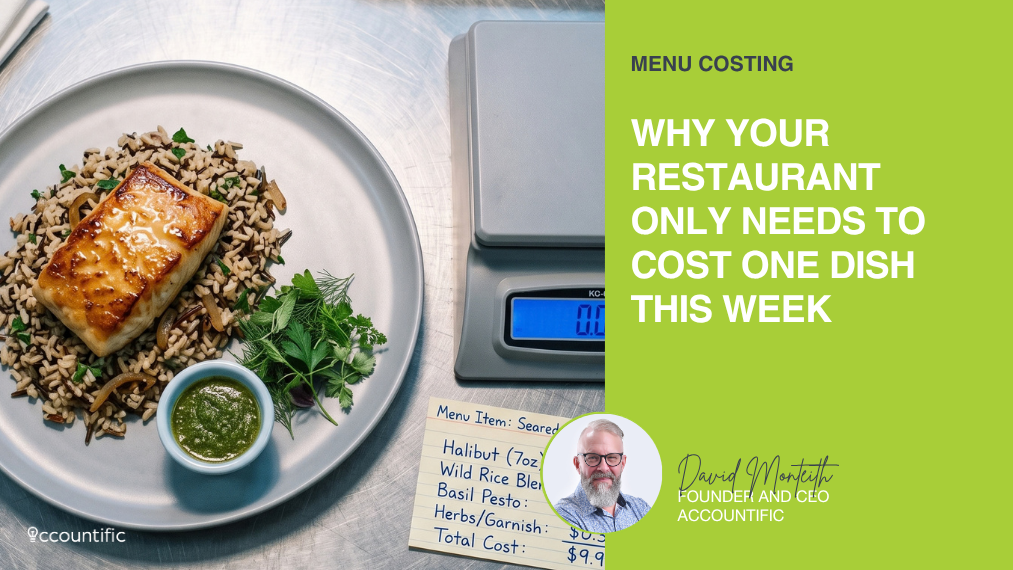
Stop Waiting for a Slow Month to Cost Your Whole Menu and Start With the Plate That Matters Most
TLDR
Most restaurant owners know they should have their menu costed. Most don’t, and they carry a bit of guilt about it every time the subject comes up. At the NEXT Food Expo in Calgary, David Monteith told a room full of operators to let that go and do something smaller instead. Pick one dish. Cost it properly. Start this week.
The reason the full-menu job never happens is that it’s a project, and projects need a slow month that never arrives. Forty items, each with a dozen components, is the kind of task that gets pushed to January and then to next January. Meanwhile, every plate leaving your pass is priced on a guess.
One dish is different. It fits in a single sitting; it needs nothing more than your recent invoices and a scale, and it produces a real number at the end. That number tells you more about your business than a rough estimate across the whole menu ever could.
Which dish you pick matters. Your biggest seller is the strongest first choice, because any costing error on it repeats every time the dish goes out. Your most valuable plate is the other good option, since the dollars at risk on each one are highest. Both give you a return on the hour you spend.
Costing it properly means every component, including the oil it’s cooked in, the garnish nobody counts, and the trim you lose before a protein is ever portioned. Skip those, and you’ll finish with a number that feels precise and isn’t.
The point isn’t the single dish. It’s that the first plate teaches you the method, and the method is what makes the rest of the menu possible.
Why You Should Read the Full Article
The article walks through choosing your first dish and why the biggest seller and the highest-cost plate are the two best candidates, how to pull that information from your POS in a few minutes, and what belongs on the costing card that most operators leave off. It covers the trim and yield correction that catches almost everyone, what to do with the number once you have it, and how to use the first dish as a template so the second and third take a fraction of the time. Full costing methodology across the whole menu is covered in our complete guide, so this piece stays on getting the first one done.
How Accountific Helps
Accountific works only with Canadian food businesses, which means menu costing is part of the regular work rather than a special project. We’ll sit down and cost your first dish with you, using your real invoice prices and your actual portions, so you finish with a number you can trust and a method you can repeat on your own. From there, we keep your costs visible in your books, so the next dish is easier than the first. Book a consultation directly with David at https://calendly.com/davidmonteith.
At the NEXT Food Expo in Calgary this September, David ran a workshop called Where the Margin Went, and it opened with something operators don’t often hear from an accountant.
Don’t beat yourself up about your menu.
Nearly every owner in the room knew their menu wasn’t fully costed. Most had known it for years. And the guilt attached to that was doing nothing except making the whole subject easier to avoid.
So the workshop started somewhere smaller. Pick one dish this week. Cost it completely. That’s the whole assignment.
Why the full-menu job never gets done
The reason costing sits undone isn’t laziness. It’s scale.
A forty-item menu, costed properly, is a real project. Every dish needs its components listed, every component needs a current price, and the prices live across a dozen invoices from four suppliers. Do the arithmetic on how long that takes, and it lands somewhere between a long weekend and a week of evenings.
So it gets scheduled for a slow month. And restaurants don’t have slow months; they have less busy ones, which get filled with the other thing you’ve been putting off. The costing project moves to next quarter, then next year, and the menu keeps going out priced on instinct.
Meanwhile, the stakes are real. Statistics Canada put the operating profit margin for food services and drinking places at 4.1 per cent in 2024, with cost of goods sold the largest expense line. At four cents on the dollar, you can’t afford a menu priced by feel, and you especially can’t afford to wait another year to find out.
One dish breaks the deadlock. It takes an hour, not a week. It needs your last few invoices and a scale. And unlike a vague plan to “do the menu sometime,” it actually finishes.
Choosing the right first plate
Not every dish is worth being first. Two are.
Your biggest seller. This is the strongest pick, because a costing error here doesn’t happen once. It repeats every single time the dish leaves the pass. If you’re selling a hundred and fifty of something a week and your plate cost is off by a dollar and a half, that’s a couple of hundred dollars a week you never see, on one item. Fix the number on your highest-volume dish, and you’ve protected the widest stretch of your menu with a single hour’s work.
Your most valuable plate. The other good candidate is the dish with the most money moving through it, usually your premium protein or your highest-priced entrée. Volume might be lower, but the dollars at stake on each plate are much higher, and expensive ingredients are exactly where costing mistakes hide.
You don’t need to guess which is which. Your point-of-sale system has a product mix report that ranks items by units sold and by revenue, and five minutes with it will tell you both. Just read it carefully, because POS reporting has its own quirks, which we covered in Why Your Restaurant POS System Is Lying to You About Your Actual Sales.
Pick one. Not three. One.
The full-menu job is why costing never starts. One plate costed properly will tell you more about your business than forty plates guessed at.
What “fully costed” actually means
Here’s where the hour is either well spent or wasted.
Costing a dish means listing every single thing on the plate, not just the parts you think of as ingredients. Take a burger. The patty and the bun are obvious. So are the cheese, the lettuce, the tomato, the onion, and the pickle. Then there’s the sauce, which has its own recipe and its own cost per portion. There’s the side of fries. There’s the oil they were cooked in and the salt they were finished with.
That last group is what gets skipped, and skipping it is why so many “costed” dishes carry numbers that are a few points optimistic. None of those items cost much on their own. Together they’re often five to eight per cent of the plate, which is the difference between a dish that works and one that doesn’t.
The other piece almost everyone misses is trim. The price on your invoice is not the price of the food you put on a plate. Buy a whole protein, and you lose weight to silverskin, fat, bone, and the tapered ends before you portion anything. If only two-thirds of what you bought makes it to a plate, your real cost per usable kilogram is half again what the invoice said. Correcting for that takes about a minute of arithmetic, and on an expensive protein it can move your plate cost more than every other line combined. The full yield method is in our complete guide to costing your restaurant menu and pricing for profit.
Cost it against what you’re paying right now, too. Not what you paid when you wrote the recipe. Prices have moved a long way in a short time: the Bank of Canada noted retail beef up 17 per cent year over year in late 2025, and grocery prices roughly 22 per cent higher than in 2022. A costing built on old invoices is just a tidier guess.
What to do with the number
You’ll finish with a plate cost. Divide it by your menu price, and you have that dish’s food-cost percentage.
Then compare it to something real. The industry generally treats 28 to 35 per cent as a healthy range, with the National Restaurant Association putting the full-service average at 32.4 per cent for 2026. Your own target depends on your concept and your labour model, but that band tells you whether the number you just calculated is roughly where it should be.
Three outcomes are possible, and all of them are useful.
The dish comes in about where you expected, and you’ve confirmed something you were only assuming. That’s worth the hour.
The dish comes in better than you thought, which sometimes means there’s room to improve the plate, or that you’ve been underpricing something guests already love.
Or the dish comes in worse, which is the outcome that pays for the exercise. Now you know, and you have options. What you do next, whether that’s adjusting the portion, changing an ingredient, or moving the price, is a whole decision in itself, and one worth taking seriously rather than defaulting to a price increase.
The second dish is the easy one
The real return on your first plate isn’t the plate.
The first time through, you’re figuring out where to find prices, how to convert a case price into a per-gram cost, how to handle a sauce that yields twelve portions, and how to account for trim. That’s the slow part, and it’s a one-time cost.
The second dish uses all of it. So does the third. Operators who’ve done one properly usually find the next few take fifteen or twenty minutes each, and at that pace a menu that felt impossible in January is largely done by spring, a dish at a time, without ever blocking off a week.
That’s the actual argument for starting small. Not that one dish is enough, but that one dish is how you build the thing that gets the rest done.
Start this week
Pull your product mix report. Find your biggest seller. Get your last month of invoices where you can see them, put a scale on the bench, and cost that one plate completely, trim included.
You’ll know more about your restaurant at the end of it than you did this morning. And you’ll have the method that makes the next one easy.
If you’d rather not do the first one alone, we’ll do it with you. Accountific works only with Canadian food businesses, so costing a plate from real invoice prices is part of our regular week rather than a special project. Bring us the dish you picked, and we’ll cost it together, sort out the trim and yield on your proteins, and set your books up so the numbers stay visible for the next dish and the one after that. Book a consultation directly with David at https://calendly.com/davidmonteith.
Key Takeaways
- Costing the whole menu is a project that waits for a slow month that never comes. Costing one dish takes an hour and actually gets finished.
- Your biggest seller is the best first pick, because a costing error there repeats on every plate that leaves the pass. Your highest-value dish is the other strong candidate.
- Your POS product mix report will identify both in about five minutes, ranked by units sold and by revenue.
- Fully costed means every component: the sauce, the oil, the seasoning, and the garnish. Those small items often run five to eight per cent of the plate.
- The invoice price isn’t the plate price. Correcting for trim and yield can move the cost of an expensive protein more than every other line combined.
- Cost against current invoices, not the prices you wrote the recipe on. Beef was up 17 per cent year over year in late 2025.
- Compare your result to the 28 to 35 per cent range the industry treats as healthy, then decide whether the dish needs a change.
- The first dish is slow because you’re learning the method. The second and third usually take fifteen to twenty minutes.
Frequently Asked Questions
Which dish should I cost first?
Start with your biggest seller. A costing error on a high-volume dish repeats every time that dish goes out, so fixing the number there protects more of your margin than anywhere else on the menu. The alternative strong pick is your most valuable plate, usually a premium protein or your highest-priced entrée, where the dollars at stake per plate are highest. Your POS product mix report will rank items by both units sold and revenue, so you can identify either in a few minutes.
How long does it take to cost one dish?
Budget about an hour for your first one. Most of that time goes into learning the method rather than doing the arithmetic: finding current prices, converting case prices into per-portion costs, working out yields on sauces and prepped items, and accounting for trim. Once you’ve done one, subsequent dishes typically take fifteen to twenty minutes, because the method carries over and many of the ingredient prices are already worked out.
What do I need before I start?
Your last month of supplier invoices, a digital scale, your recipe as it’s actually made on the line today, and the dish’s current menu price. That’s it. You don’t need software. A sheet of paper or a spreadsheet will do for a single dish, and it’s worth doing it manually the first time so you understand what the software would be doing for you later.
What counts as part of the plate cost?
Everything that goes out with the dish. The protein, the starch, the vegetables, and the sauce, plus the items most operators skip: cooking oil, seasoning, garnish, and any bread or side that goes with it automatically. Those smaller items frequently add up to five to eight per cent of the total plate cost, which is enough to move a dish from acceptable to unprofitable without anyone noticing.
Why does trim matter so much when costing a dish?
Because the price on the invoice is not the cost of the food that reaches a plate; when you buy a whole protein, you lose weight to silverskin, fat, bone, and tapered ends before portioning. If a third of the purchased weight becomes trim, your real cost per usable kilogram is around 50 per cent higher than the invoice price. On expensive proteins, that single correction can shift the plate cost more than every other ingredient line combined.
What food cost percentage should the dish come in at?
The industry generally treats 28 to 35 per cent of the menu price as a healthy range, and the National Restaurant Association put the full-service average at 32.4 per cent for 2026. The right target for your restaurant depends on your concept, your pricing, and your labour model, so treat those figures as a reference point rather than a rule. What matters more is that you now have a real number to measure against a target you set deliberately.
What if the number comes back worse than I expected?
That’s the most useful outcome, because it means you’ve found something that was costing you money invisibly. You have several options: adjust the portion back to its original spec, swap an ingredient for a comparable one at a lower cost, or raise the menu price. You can also decide the dish earns its place at a higher food cost because of what it does for the rest of your business. The important part is that the decision is now informed rather than accidental.
Do I have to cost the entire menu eventually?
Ideally yes, but not all at once and not on a deadline. The value of the first dish is that it teaches you a repeatable method, so the rest of the menu becomes a series of short tasks rather than one large project. Many operators work through their top ten sellers over a couple of months, which typically covers the large majority of their sales volume, then fill in the remainder as time allows.
David Monteith, founder of Accountific, is a seasoned digital entrepreneur and a Xero Silver Partner Advisor with over three decades of business management and financial expertise. He specialises in providing tailored Xero solutions for food and beverage businesses, streamlining accounting processes and delivering valuable financial insights that drive client success. David also serves as CFO of Great Work Online, a digital marketing agency serving food and beverage businesses, where he leads budgeting, financial oversight, and business management. This dual perspective gives Accountific clients more than bookkeeping mechanics — it brings a strategic view of how financial systems support better decisions, stronger operations, and long-term growth.