
Compliance and Profitability in Canadian Restaurants
TLDR
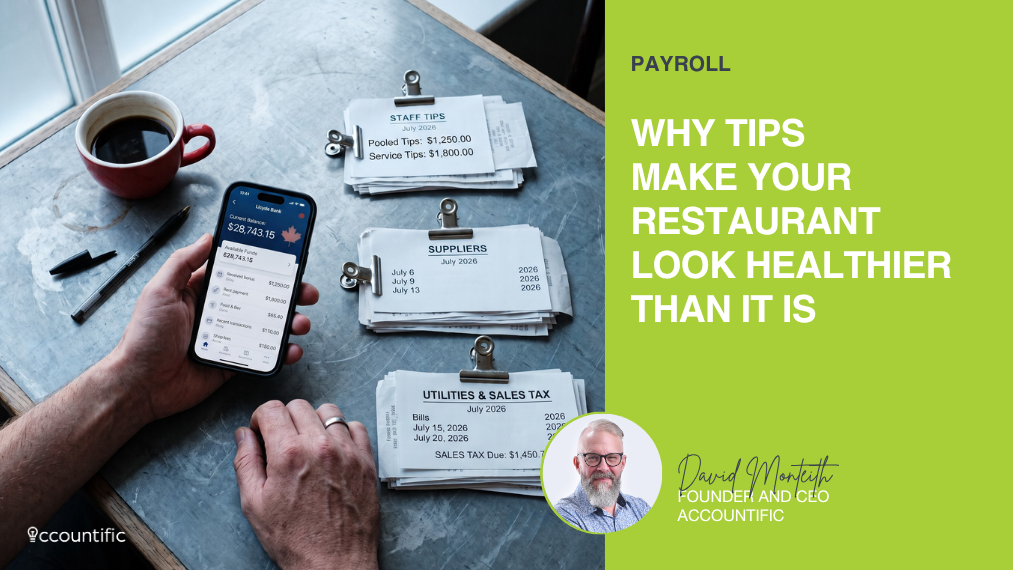
Tips that run through your restaurant’s bank account are not revenue. They are a liability in transit, money you are holding on behalf of your staff before you pay it out. When you count them in your read of how the night went, you overstate the health of the business. A $9,000 Saturday with $1,500 in tips inside it was really a $7,500 sales day, and the other $1,500 belongs to your servers.
The distortion is worst for card-heavy restaurants. In 2024, cash represented 2.5 billion transactions, just 11 per cent of total payment volume in Canada, while credit and debit cards together made up 63 per cent, according to Payments Canada’s Canadian Payment Methods and Trends report. Almost every gratuity now arrives electronically and lands in your account before it leaves again. The float sitting in your account on any given morning can be several thousand dollars that looks like working capital and is not.
The fix is a bookkeeping decision, not a software upgrade. Book tips to a liability account called Tips Payable, never to a revenue line. That keeps your profit and loss statement honest, and it stops you from calculating GST/HST on money that was never a sale. The Canada Revenue Agency (CRA) confirms a voluntary tip freely given by a customer is not subject to GST/HST, while a mandatory service charge you add to the bill is.
Booking tips correctly also protects your cash decisions. Owners who separate tip float from operating cash make cleaner calls on payroll timing, supplier payments, and what they can actually draw for themselves. The tip float is other people’s money, and spending it is borrowing you did not agree to.
This article shows the mechanism with real arithmetic, gives you the journal entries, and sets out how the tip liability connects to the payroll classification rules that decide whether those same tips also carry CPP and EI.
Why You Should Read the Full Article
The full article gives you the working numbers: a Saturday-night worked example run to the dollar, a before-and-after treatment comparison table, a table separating what is revenue from what is float, the exact Tips Payable journal entries, a five-step process for stripping tip float out of your read, and an FAQ covering the GST/HST and T4 questions owners ask most. Anything already covered in depth in our tip-out payroll guide gets a link, not a re-teach, so this piece stays on the money read.
How Accountific Helps
Accountific works only with Canadian food businesses, so tip float is a problem we handle every week. We keep tips off your revenue line and out of your operating-cash picture by booking them to a dedicated Tips Payable liability account; we configure your point-of-sale mapping so gratuities never post as sales, and we deliver weekly reporting that shows your real revenue and the tip money you are holding as two separate numbers. The result is that the figures you decide on reflect the business, not the float. Book a consultation directly with David at https://calendly.com/davidmonteith
Key Takeaways
- Tips that pass through your account are a liability in transit, not income, and booking them as revenue overstates your sales.
- Cash fell to 11 per cent of total payment volume in Canada in 2024, per Payments Canada, so nearly every tip now flows electronically through your account before payout.
- A voluntary tip is not subject to GST/HST, but a mandatory service charge added to the bill is, per CRA policy.
- Booking tips to a Tips Payable liability account keeps the profit and loss statement honest and stops HST being calculated on non-sales.
- The 2026 CPP rate is 5.95 per cent up to the $74,600 Year’s Maximum Pensionable Earnings, per the CRA, and controlled tips carry that cost while direct tips do not.
- Separating tip float from operating cash gives you a true read before you decide payroll timing, supplier payments, or owner draws.
- The distortion is largest for full-service restaurants, where Canadians tipped 17.6 per cent on average as of April 2022 according to Restaurants Canada.
What counts as tip float in a restaurant, and why does it distort your numbers?
Tip float is the pool of gratuity money sitting in your bank account after customers have paid but before you have paid it out to staff. Tip float distorts your numbers because it inflates both your apparent sales and your apparent cash, making a $7,500 sales night read like a $9,000 night and making your bank balance look like it holds working capital it does not.
A restaurant collects tips faster than it pays them out. A customer taps a card on Friday, the gratuity lands in your account that night, and the server who earned it might not be paid until the following Wednesday payroll run. During those days, the money sits with you. Tips Payable is the liability account that names this money for what it is: cash you owe to someone else.
The read gets distorted in two places at once. Your revenue read climbs because the tip rode into the account on top of the sale, and your cash read climbs because the money is physically in the bank. Both readings feel like good news. Neither is true. You have the same business you had before the tip arrived, plus an obligation to hand that tip to your staff.
Card-heavy restaurants feel this hardest. When cash was common, servers pocketed gratuities directly, and the money never touched your books. In 2024, cash represented 2.5 billion transactions, only 11 per cent of total payment volume in Canada, so the direct-cash path has mostly closed. Nearly every dollar of gratuity now enters through the terminal, joins your deposit, and has to be carried as a liability until payout.
Are tips revenue for my restaurant?
Tips are not revenue for your restaurant. A voluntary gratuity is money the customer intends for your staff, and you are only holding it in transit, so it never becomes income of the business. The correct treatment is to book the tip to a liability account, Tips Payable, and clear that liability when you pay staff.
Revenue is money you earned by selling food and drink. A tip is money a customer gave for service, intended to pass through you to a person. The CRA treats a freely given tip as something the customer paid, not something the business sold, which is exactly why a voluntary tip is not subject to GST/HST. Money that is not a sale should not sit on your sales line.
The exception is the mandatory service charge. When you add a set percentage to a large-party bill or a banquet contract, that charge is part of what the customer must pay you for the meal, so the CRA treats it as consideration and GST/HST applies to it. A banquet invoice of $1,000 plus a mandatory 15 per cent service charge of $150 means you charge GST/HST on the full $1,150, per CRA guidance for the travel and convention industry.
The distinction matters for your books. A voluntary tip is a liability, booked to Tips Payable, outside GST/HST and outside revenue. A mandatory service charge is revenue, inside GST/HST, and it flows through your sales line like any other sale. Mixing the two is where owners either overpay tax or expose themselves to an assessment.
How tip float overstates a Saturday night: a worked example
Tip float overstates a busy night by folding the gratuity pool into both your sales read and your cash read. Strip it out and the real business appears. The example below takes a single Saturday at a mid-sized full-service restaurant and runs the numbers to the dollar.
Picture a restaurant that rings $9,000 in total card settlements on a Saturday. Customers tipped an average of 17 per cent, so roughly $1,308 of that settlement is gratuity money and $7,692 is the actual food and drink sale before tax. If the owner reads the $9,000 as the night’s take, the owner has overstated real sales by $1,308, about 17 per cent too high.
The tax layer makes it worse. The $7,692 sale in Ontario carries 13 per cent HST of about $1,000, which is also not the restaurant’s money; it belongs to the CRA. So of the $9,000 that landed, only about $6,692 represents actual sales value that the business earned. The tip float and the sales tax together account for roughly $2,308 that an untrained read would count as a healthy night.
Now scale it across a week. A restaurant doing $63,000 in weekly card settlements at a 17 per cent average tip is holding around $9,000 in tips at any given point in the payout cycle. An owner who watches the bank balance and sees that $9,000 as spendable, and pays a produce supplier with it on Tuesday, has quietly spent money owed to staff. Payday still comes, and the tips still have to be paid, so the shortfall surfaces later as a cash squeeze that the P&L never predicted.
| Line | Amount |
| Total Saturday card settlement | $9,000 |
| Less voluntary tips (17%) | ($1,308) |
| Less HST collected on sales (13% in Ontario) | ($1,000) |
| Real sales value earned by the restaurant | $6,692 |
Booking tips as a liability: the journal entries
Book tips to Tips Payable when they arrive and clear Tips Payable when you pay staff. This keeps gratuity money off your revenue line and out of your earnings, so your profit and loss statement shows only what the restaurant actually sold. The mechanism is two simple entries.
When a $115 bill is settled with a $100 meal, $13 HST, and a $15 tip on a card, the deposit hits your bank for $128. The entry splits that deposit into three homes:
- Debit Cash (Bank) $128, the full amount that landed.
- Credit Sales $100, the food and drink actually sold.
- Credit GST/HST Payable $13, the tax you are holding for the CRA.
- Credit Tips Payable $15, the gratuity you are holding for your staff.
Notice that Sales rises by $100, not $115. The tip never touches revenue. When payroll runs, and you pay the $15 to the server, the second entry clears the liability:
- Debit Tips Payable $15, removing the obligation.
- Credit Cash (Bank) $15, the money leaving to the employee.
After both entries, Tips Payable returns to zero for that transaction and your books show a $100 sale, exactly what happened. If you had instead credited the full $115 to Sales, your revenue would be overstated by $15, your GST/HST calculation could pick up tax on money that was never a sale, and your margins would read higher than they are. Owners who want the fuller picture of how a clean liability structure protects the balance sheet can read our guide to correcting the bookkeeping habits that hide your cash.
| Treatment | Sales recorded | GST/HST risk | P&L accuracy |
| Tip booked to Sales (wrong) | Overstated by tip amount | Tax may be calculated on non-sales | Margins read falsely high |
| Tip booked to Tips Payable (right) | Only true food and drink sales | Tax only on actual sales | Margins reflect the real business |
Does my restaurant owe GST/HST on tips?
Your restaurant does not owe GST/HST on voluntary tips. A gratuity a customer freely leaves, whether cash on the table or an amount added when paying by card, is not consideration for a sale, so no GST/HST applies. GST/HST applies only when you add a mandatory or suggested service charge to the bill yourself.
The CRA position is specific. A tip freely given by a customer, for example an amount the customer writes in on the terminal, is not subject to GST/HST. The moment you impose the charge, the tax treatment flips, because a mandatory amount is part of the price the customer must pay for the meal.
Banquet and large-group contracts are where restaurants get caught. A Tax Court of Canada decision involving an Ontario banquet hall confirmed that an automatic 15 per cent gratuity written into event contracts was mandatory, formed part of the consideration, and was therefore subject to HST. Calling a mandatory charge a tip does not make it one, a point our clients often meet first through our work on why a restaurant’s catering contract is a financial liability.
Getting this right depends on booking discipline. When voluntary tips sit in Tips Payable and never enter your sales line, they stay outside your GST/HST return automatically. When mandatory service charges are booked to revenue, they carry their tax correctly. Clean accounts make the tax answer fall out on its own instead of forcing a judgment call every filing period.
The link to payroll: controlled versus direct tips
Booking a tip as a liability answers the cash and revenue question, but it does not by itself answer the payroll question. Whether those same tips also carry CPP and EI depends on whether the CRA treats them as controlled or direct, a separate test based on who controls the money. We cover the full classification, the case law, and the payroll math in our guide to how successful restaurant operators are rethinking their tip-out payouts, so this section stays brief.
A controlled tip is one the employer possesses and then pays out, and the CRA treats it as remuneration that carries CPP contributions, EI premiums, and T4 reporting. A direct tip passes from customer to employee with the employer acting only as a conduit, and it carries none of those deductions. The Federal Court of Appeal in Ristorante a Mano held that electronic tips deposited into the restaurant’s account and paid out later were controlled, because the money passed through the employer’s hands.
For 2026, the payroll cost of a controlled tip is real. The CPP contribution rate is 5.95 per cent for both employee and employer on earnings between the $3,500 basic exemption and the $74,600 Year’s Maximum Pensionable Earnings, for a maximum contribution of $4,230.45 each, with a further CPP2 tier of 4 per cent on earnings up to the $85,000 second ceiling. The EI premium rate is $1.63 per $100 of insurable earnings for employees and $2.28 for employers, who pay 1.4 times the employee rate, up to $68,900 in maximum insurable earnings for 2026, as set by the Canada Employment Insurance Commission.
The two questions interact on your books. A controlled tip is still a liability in transit when it arrives, so it still belongs in Tips Payable rather than revenue, but it will also generate payroll deductions when it is paid. The bookkeeping and the payroll classification are separate decisions, and our tip-out payouts guide walks through the classification side in full.
How to strip tip float out of your real revenue read
Strip tip float out by separating gratuity money from sales at the point it enters your books, then reading revenue and float as two distinct numbers every week. The process below turns a distorted single-number read into a clean one in five steps.
- Map your point-of-sale tip field to a dedicated Tips Payable liability account, not to a sales category, so gratuities never post as revenue in the first place.
- Reconcile the daily card settlement into its three parts, sales, GST/HST, and tips, so every deposit is split the moment it lands rather than at month end.
- Track Tips Payable as a running balance and confirm it clears to near zero each pay cycle, which proves the money you are holding is being paid out and not quietly absorbed.
- Read your weekly revenue from the Sales line only, and read the Tips Payable balance separately as money you owe, never adding the two together when you judge the week.
- Decide payroll timing, supplier payments, and owner draws against real sales and real cash, treating the tip float as untouchable because it belongs to your staff.
Running this discipline weekly is where the value lands. A restaurant that closes its books six weeks late cannot tell tip float from working capital in time to act on it, which is why weekly reporting and clean tip separation are the same fight. When the Sales line and the Tips Payable line are always current and always separate, the numbers you steer by are the real business.
FAQ
Are tips considered income for my restaurant?
No. Voluntary tips are money you hold on behalf of staff, a liability in transit, not income of the business. They should be booked to a Tips Payable account and cleared when you pay employees. Only mandatory service charges you add to bills count as revenue, and only those carry GST/HST and flow through your sales line.
Should tips go on the profit and loss statement?
Voluntary tips should not appear as revenue on your profit and loss statement. They belong on the balance sheet as a Tips Payable liability until you pay staff. Booking them to sales overstates your revenue, inflates your apparent margins, and can trigger GST/HST on money that was never a sale, giving you a false read of the restaurant’s health.
Do I charge GST/HST on gratuities?
You charge GST/HST only on mandatory or suggested service charges you add to the bill, such as an automatic gratuity on a large party or banquet. A voluntary tip a customer freely leaves, whether cash or added on the card terminal, is not subject to GST/HST under CRA policy, because it is not consideration for a sale.
Why does my bank balance look healthy when my profit is thin?
Part of your bank balance is usually tip float and sales tax, money you are holding for staff and the CRA, not profit. A card-heavy restaurant can carry several thousand dollars of unpaid tips in its account at any time. Reading that balance as spendable cash is how owners accidentally spend money that is owed to other people.
Are electronic tips treated differently from cash tips?
For your cash and revenue read, both are liabilities in transit and belong in Tips Payable. For payroll, they can differ. The Federal Court of Appeal in Ristorante a Mano found electronic tips deposited into the restaurant’s account and paid out later were controlled tips carrying CPP and EI, while cash a server keeps directly is usually a direct tip.
How much tip float is a typical restaurant holding?
It depends on volume and payout timing. A full-service restaurant doing $63,000 in weekly card settlements at a 17 per cent average tip holds roughly $9,000 in tips across a pay cycle. The busier the restaurant and the longer the gap between the shift and payday, the larger the float sitting in your account and distorting your read.
Does booking tips as a liability change what my staff receives?
No. Staff receive exactly the same tips either way. Booking to Tips Payable is purely an accounting treatment that keeps the money visible and separate on your side. It protects you from overstating revenue and from spending gratuity money by accident, and it makes proving that tips were paid out cleanly much easier if the CRA ever asks.
The Monday Morning Decision
Open your bank balance on Monday and ask one question before you pay anyone or draw anything: how much of this is actually mine? If you cannot answer in ten seconds, your books are blending three different pools of money, your sales, the CRA’s sales tax, and your staff’s tips, into one misleading number. The single most useful move you can make this week is to pull the tip float out into its own liability account and read your revenue without it.
A restaurant running on a four per cent margin cannot afford a revenue read that is inflated by a fifth. When the tip float hides inside your cash, every decision downstream – what to pay a supplier, when to run payroll, how much to take home – is made on a number that was never real. Clean tip separation is not a nicety. It is the difference between steering by your instruments and steering by a fogged windscreen.
Accountific builds that clarity in as the financial foundation, not a patch. We map your POS so tips never post as sales, carry them in Tips Payable until payout, and report your real revenue and your tip float as two separate lines every week, so the numbers you decide on are the business itself. If you are tired of guessing which part of your balance is yours, book a consultation directly with David at https://calendly.com/davidmonteith
David Monteith, founder of Accountific, is a seasoned digital entrepreneur and a Xero Silver Partner Advisor with over three decades of business management and financial expertise. He specialises in providing tailored Xero solutions for food and beverage businesses, streamlining accounting processes and delivering valuable financial insights that drive client success. David also serves as CFO of Great Work Online, a digital marketing agency serving food and beverage businesses, where he leads budgeting, financial oversight, and business management. This dual perspective gives Accountific clients more than bookkeeping mechanics — it brings a strategic view of how financial systems support better decisions, stronger operations, and long-term growth.