
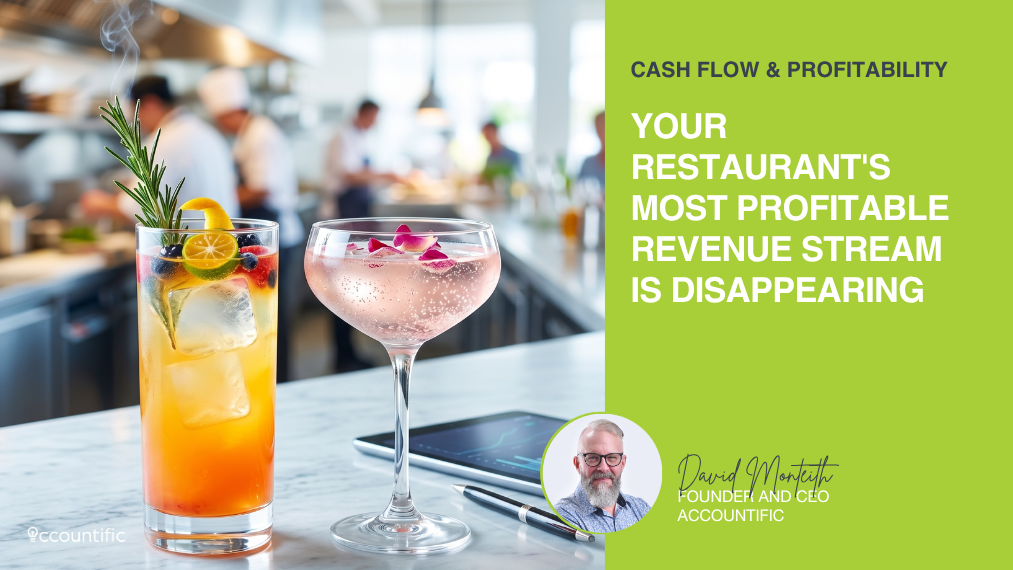
How Declining Alcohol Sales Are Shrinking Your Full-Service Margin
TLDR:
Foodservice operators face a severe structural financial crisis as high-margin alcohol sales rapidly decline across the nation. National retail data indicate a sharp 10.6 percent reduction in alcohol purchases. This reduction removes the historical financial subsidy supporting tighter food margins. Full-service establishments must urgently recalculate break-even points and integrate high-margin zero-proof beverage programs. Weekly bookkeeping remains mandatory to survive. Meticulous control over prime costs and strict adherence to Canada Revenue Agency compliance deadlines ensure ongoing operational viability.
Why Read the Full Article
This comprehensive report breaks down the exact mathematical impact of shifting consumer beverage habits on full-service profitability. Readers will acquire actionable insights concerning menu engineering, advanced cash flow mechanics, and specific strategies to protect bank balances from hidden operational leaks.
Reach Out To Accountific
If the concepts discussed in this article feel overwhelming to manage alone, a specialized team performs these exact financial optimizations every day for restaurants in Canada. Gain absolute control over prime costs and tax compliance by partnering with the experts at Accountific.
—
The Structural Margin Crisis in Canadian Foodservice
The Canadian foodservice industry currently navigates an unprecedented structural transformation. Historical business models relied heavily on a specific mathematical balance. High-margin alcoholic beverages subsidized the inherently tighter margins of food production and labor. Today, this foundational equation is fracturing. Establishments operating within the full-service sector face compounding pressures from shifting consumer demographics, relentless food inflation, and a fundamental realignment in dining habits. You must understand the data to protect your bottom line.
Recent industry analysis reveals a grim reality for many operators. As of late 2025, approximately 44 percent of surveyed restaurants were operating at a loss or barely breaking even. This figure represents a severe deterioration from 2019 levels. In 2019, only 12 percent of establishments faced similar financial peril. Furthermore, restaurant bankruptcies surged by an alarming 30 percent throughout 2024. A temporary GST/HST holiday on restaurant meals buffered low sales projections during portions of 2025. Operators now brace for heightened challenges as temporary relief measures expire and market realities return. You cannot rely on temporary government assistance to balance your books.
The core issue extends beyond simple inflation or transient economic cycles. The crisis represents a permanent shift in consumer interaction with dining spaces. Diners facing an intense affordability crisis display heightened sensitivity to menu pricing. Per capita spending at full-service venues dropped significantly from $1,165 in 2019 to $1,035 in 2025. To compensate for shrinking household budgets, 65 percent of Canadians now replace traditional meals with a snack at least once a month. Industry analysts term this phenomenon “snackification.” Lunchtime traffic at quick-service locations increased by 7.6 percent. Consumers are migrating toward lower-cost alternatives.
For full-service operators, these shifting patterns demand immediate strategic interventions. Relying on outdated financial assumptions guarantees failure. Leadership teams must dissect every line item on the profit and loss statement to uncover hidden inefficiencies. You need to identify where your money is going before the bank account empties.
Analyzing the National Decline in Alcohol Sales
The most disruptive trend affecting full-service profitability involves the decline in alcohol consumption. Statistics Canada in late 2025 confirmed a severe contraction in beverage sales. Retailers recorded a staggering 10.6 percent drop in alcohol sales during October 2025. Retail sales contributed partially to this specific monthly dip. Broader datasets, however, confirm a long-term structural decline across the country.
Over the 2024 to 2025 fiscal year, sales of alcohol by volume declined by 3.0 percent across the nation. This contraction marks the fourth consecutive year volume sales have fallen. On average, Canadians of legal drinking age purchased the equivalent of 8.0 standard alcoholic beverages per week in 2025. This number fell from 8.7 in the previous year and 9.7 a decade ago.
To visualize the scope of the problem, consider the specific retail sector performance during the pivotal fourth quarter.
| Retail Subsector | October 2025 Performance | Primary Contributing Factor |
| Food and Beverage Retailers | -2.0% decline | Softened consumer spending |
| Supermarkets and Grocery | -0.7% decline | Inflationary budget management |
| Beer, Wine, and Liquor Stores | -10.6% decline | Shifting habits and regional labor disruptions |
| Core Retail Sales (Excluding Auto/Gas) | -0.5% decline | Broad economic caution |
Generational behaviors drive this transformation. A comprehensive Restaurants Canada 2025 Foodservice Facts Report indicates 41 percent of Canadians decreased their alcohol consumption over the past year. Older demographics lead this charge. Primary motivations include health concerns, cited by 71 percent of respondents. Lifestyle choices and financial caution represent the remaining motivators.
Simultaneously, younger patrons exhibit distinct purchasing patterns. Gen Z and Millennial consumers increasingly practice “zebra striping.” This method involves alternating between alcoholic and non-alcoholic drinks during a single outing. Nearly half of Gen Z drinkers incorporate non-alcoholic beverages into social events. Consequently, operators must acknowledge the reality facing their beverage programs. The days of relying on multiple rounds of high-margin cocktails to inflate average cheque sizes are disappearing.
The Disproportionate Impact on Full-Service Margins
Understanding the severity of declining alcohol sales requires a deep dive into restaurant mathematics. A well-run bar program historically generates 70 to 80 percent gross margins on every drink sold. Conversely, food operations inherently carry much higher expenses. Prime costs represent the combination of Cost of Goods Sold and direct labor. These expenses typically consume 60 to 65 percent of food revenue. When factoring in fixed costs such as rent, utilities, insurance, and administrative overhead, the overall net profit for an average full-service establishment hovers dangerously low. Net profit typically sits between 3 and 5 percent.
Alcohol sales act as a critical financial stabilizer. Consider a theoretical table of four guests generating a $200 cheque. Assume $80 originates from alcohol, yielding an 80 percent gross margin. The restaurant secures $64 in gross profit from beverages alone. Now, assume those patrons eliminate alcohol and replace the $80 with additional food items, yielding only a 35 percent gross margin. The gross profit on the substituted portion falls to $28. The top-line revenue remains identical at $200. The restaurant, however, loses $36 in gross profit. This mathematical reality explains why operators feel squeezed despite maintaining busy dining rooms. Every dollar of lost beverage revenue costs more in margin than a dollar of lost food revenue.
| Revenue Source | Average Gross Margin | Financial Impact on Net Profitability |
| Premium Spirits and Cocktails | 75% to 82% | Critical subsidy for overhead expenses |
| Wine Programs | 60% to 65% | Moderate subsidy dependent on volume |
| Standard Food Menu | 30% to 35% | Insufficient to cover fixed overhead alone |
| Value Food Menu | 20% to 25% | Direct drain on operational cash flow |
This margin erosion forces a dramatic recalibration of break-even points. The break-even point dictates the precise revenue level required to cover all fixed and variable costs before generating a single dollar of net profit. Operators relying on financial models designed in 2022 are operating blindly. A restaurant breaking even at 70 percent seating capacity in 2022 faces higher utility rates today. The same restaurant faces increased minimum wages, elevated food costs, and diminished alcohol subsidies. Today, that identical establishment likely requires 85 percent capacity simply to cover fixed costs.
Failing to recognize this shift guarantees a slow descent into insolvency. Management must meticulously track the shifting ratio between food sales and beverage sales. If the beverage mix drops from 30 percent of total sales to 18 percent, leadership must immediately identify replacement revenue streams offering comparable profitability. You must know your numbers.
Engineering a High-Margin Zero-Proof Menu
Progressive operators view the decline in traditional alcohol consumption not as a crisis, but as an opportunity for innovation. The zero-proof movement presents a legitimate, high-margin solution for operators seeking to replace lost beverage revenue. The global market for non-alcoholic alternatives is expanding rapidly. Forecasts project the industry will reach $13.6 billion by 2032, expanding at an annual growth rate near 9.6 percent.
Premium non-alcoholic cocktails, often termed mocktails, command significant price points when executed correctly. High-quality mocktails priced between $12 and $16 generate margins of 60 to 70 percent. These figures closely approach traditional alcohol margins. Upscale venues report non-alcoholic menus accounting for 30 to 40 percent of total beverage revenue.
Developing a profitable zero-proof program requires strategic sourcing and culinary creativity. Bartenders now utilize premium alcohol-free spirits, fermented teas, and complex botanicals to replicate the sensory experience of classic cocktails. Ingredients such as elderflower, calamansi, rose, and smoked syrups provide the complexity patrons expect when paying premium prices. The creation process is not rocket science. A dedicated staff member testing flavor profiles will produce an exceptional menu.
Furthermore, zero-proof programs offer unique operational advantages. Establishments bypass the heavy taxation applied to traditional spirits. Inventory management becomes simpler. Security risks associated with alcohol overconsumption disappear. To maximize the financial benefit, operators must present zero-proof options with the same level of sophistication afforded to the wine list. Descriptive menu language, specialized glassware, and intricate garnishes justify premium pricing and elevate the guest experience. A beverage program review constitutes a necessary annual financial exercise for full-service operators. Understanding which non-alcohol offerings replace lost drink margins remains a survival imperative.
To sell a $14 zero-proof cocktail, you must deliver theater. Serve the beverage in chilled coupe glasses. Use oversized, crystal-clear ice cubes. Smoke the rim with torched rosemary. The perceived value must equal the monetary request. When guests feel the luxury of the experience, the absence of alcohol becomes irrelevant.
Protecting Prime Costs Through Menu Data
Optimizing profitability extends beyond the beverage program. Smart owners use menu engineering to increase their profits and offset rising operational expenses. Menu engineering involves categorizing every item based on two distinct metrics: popularity and profitability. You must protect the bread and butter of your menu.
The evaluation process places menu items into four quadrants:
- Stars: Items demonstrating high profitability and high popularity. These dishes require prominent placement on the physical menu and active promotion by serving staff.
- Puzzles: Items demonstrating high profitability but low popularity. These dishes require intervention. Operators often adjust the menu description, alter the presentation, or lower the price slightly to stimulate sales.
- Plow Horses: Items demonstrating low profitability but high popularity. These dishes drive traffic but erode margins. Leadership must carefully reduce portion sizes, substitute cheaper ingredients, or enact incremental price increases.
- Dogs: Items demonstrating low profitability and low popularity. These dishes drain resources, complicate inventory management, and generate waste. Operators must ruthlessly remove these items from the menu.
Psychological pricing and descriptive writing play crucial roles in this optimization process. Simple text fails to sell high-margin items effectively. Consider the difference between listing “Steak and Potatoes” versus “8oz AAA Alberta Sirloin with Duck-Fat-Roasted Fingerling Potatoes and a Red Wine Jus.” One represents a mundane list. The alternative tells a compelling story designed to make mouths water and justify a premium price point.
Controlling Cost of Goods Sold requires relentless vigilance. Establishing a daily waste log system helps identify kitchen inefficiencies. Monitoring inventory turnover rates ensures capital remains fluid. A healthy restaurant turns its inventory four to eight times per month. Turnover rates falling below four indicate severe overstocking. Overstocking leads inevitably to spoilage and margin destruction.
To uncover your restaurant’s financial red flags, leadership must transition away from gut-feel management and adopt data-driven daily routines. Measuring the theoretical food cost against the actual food cost reveals exactly how much profit disappears into the trash bin or walks out the back door. Missing ingredients destroy your net margin.
TouchBistro survey data from 2026 highlights the immense pressure on these exact costs. Operators are spending an average of 37 percent more on food costs due to the impact of tariffs and supply chain volatility. Nearly 94 percent of surveyed independent operators report spending more on labor costs compared to the previous year. Consequently, 71 percent have raised menu prices. Raising prices endlessly alienates customers. Instead, rigorous portion control and waste management offer sustainable paths to profitability.
Reading the Cash Flow Statement Like a Professional
Generating a profit on paper provides no guarantee of survival. The ultimate lifeblood of any foodservice operation is cash flow. A critical distinction often overlooked involves the 3 financial reports that put you in control. Many restaurants operate on an accrual basis of accounting. Under this method, sales are recorded the moment a guest completes a meal, regardless of when the funds clear the merchant account.
Several factors create dangerous discrepancies between reported profit and available liquidity. Third-party delivery applications often withhold funds for extended periods before initiating payouts. Credit card processors require several days to clear transactions. Additionally, catering invoices frequently sit in accounts receivable for thirty to sixty days. Consequently, an establishment appearing highly profitable on the monthly income statement frequently faces a severe liquidity crisis, unable to cover immediate obligations like supplier invoices or Friday payroll.
Owners must recognize the specific sections of the Cash Flow Statement to avoid insolvency. Operating Activities capture cash generated from core business functions, tracking funds received from patrons against cash paid for wages and inventory. Investing Activities reflect capital spent on long-term assets, including heavy equipment or property improvements. Financing Activities detail the movement of debt and equity.
This scenario occurs when an establishment ties up excessive capital in perishable inventory. Purchasing bulk ingredients to secure a minor supplier discount seems logical, but the practice locks essential operating capital on the shelves. This money becomes entirely inaccessible for urgent needs until the inventory sells. The cash flow dries up while the freezer remains full.
Operators evaluate their survival capacity using the Quick Ratio. This metric compares highly liquid assets against immediate liabilities. A Quick Ratio falling below 1.0 indicates an impending inability to pay immediate debts. Monitoring cash flow weekly, rather than waiting for stale monthly reports, empowers leadership to anticipate financial shortfalls and avoid catastrophic crises. To discover how 3 financial reports put you in control of your restaurant’s future, you must prioritize the balance sheet alongside the income statement.
Selling gift cards provides an immediate cash boost, but this money is a liability, not revenue. When cards are redeemed in slower months, the redemption creates a cash outflow without a corresponding inflow. The redemption process leads to a cash crunch if not forecasted properly.
Conquering the CRA Compliance Schedule
Operating within a squeezed margin environment leaves zero room for administrative errors. The CRA mandates strict compliance schedules. Failing to meet these obligations results in severe financial penalties and daily interest charges. For a business surviving on a three percent net margin, a single CRA penalty easily erases an entire month of hard-earned profit.
Understanding the corporate and personal tax filing deadlines requires absolute precision. For most individuals and standard corporate structures matching the calendar year, April 30 serves as the critical deadline to file income tax returns and remit taxes owed. Self-employed individuals, including sole proprietors managing independent cafes, receive an extension to file returns until June 15. Any balance owing, however, remains due on April 30. Incorporated businesses utilizing non-calendar fiscal years must submit returns six months after their fiscal year-end, while ensuring corporate tax installments are paid on time to avoid interest.
Payroll remittances demand even tighter administrative control. Employers must deduct income tax, Canada Pension Plan contributions, and Employment Insurance premiums from employee wages. For regular remitters holding an average monthly withholding amount below $25,000, the CRA must receive these source deductions on or before the 15th day of the month following the pay period. For example, deductions calculated for January wages require remittance by February 15.
| Remitter Type | Definition | CRA Remittance Deadline |
| Regular Remitter | Withholding below $25,000 monthly | 15th day of the following month |
| Quarterly Remitter | Withholding below $3,000 monthly | 15th day following the quarter end |
| Accelerated (Threshold 1) | High volume withholding | 25th for first half; 10th for second half |
| Accelerated (Threshold 2) | Ultra-high volume withholding | Within 3 working days after pay date |
The end of February introduces a dangerous bottleneck for administrative teams. Employers must issue T4 slips to all employees and file the corresponding payroll returns on time. Failure to execute this process flawlessly triggers automatic penalties based on the number of slips filed late. Furthermore, managing the nuances of tip declarations, statutory holiday pay, and vacation accruals transforms standard payroll into a complex liability minefield.
When you miss a deadline, the CRA assesses penalties instantly. Late remittances trigger immediate percentage-based fines escalating with repeated offenses. The interest compounds daily. A profitable weekend dinner service vanishes rapidly when applied against compounding federal tax penalties. You must prioritize compliance above all operational desires.
Bulletproofing Your Books Against CRA Audits
Beyond routine deadlines, food business operators live under the constant threat of a CRA audit. The agency utilizes advanced data analytics to target high-risk groups. The restaurant sector consistently flags for review due to cash-heavy transactions and complex tip structures.
A fundamental requirement for audit survival involves the strict separation of personal and business finances. Blending funds creates a bookkeeping nightmare and represents a CRA audit that you must survive. Using a personal credit card to purchase urgent kitchen supplies or depositing a busy Friday night cash drop into a personal checking account destroys the auditable trail. To remain compliant, operators must maintain a dedicated business bank account and a separate business credit card. Every dollar of revenue must flow directly into the business account. Every operational expense must originate from the business card. Get your ducks in a row immediately.
Validating expenses requires meticulous documentation. The CRA rejects vague credit card statements. Original receipts remain mandatory. For a receipt to hold validity during an audit, especially for purchases exceeding $100, the document must display the date, the seller’s name, the buyer’s name, a full description of the goods, and the seller’s GST/HST number. If a cash register tape lacks this data, the purchaser must immediately document the missing information on the reverse side.
Deductible expenses carry specific rules. Vehicle expenses require a highly detailed logbook tracking the date, destination, purpose, and exact kilometers driven for every business trip. Meals and entertainment expenses generally follow the 50 percent rule, restricting the deductible amount to half the total cost. Staff costs, including distinctive branded uniforms or mandatory non-slip kitchen footwear, qualify for deductions. General clothing does not qualify.
Scrambling to organize a shoebox full of faded receipts at year-end guarantees missed deductions and heightens audit anxiety. Surviving regulatory scrutiny depends entirely on implementing proactive, digital systems. Modern operators digitize receipts instantly, categorizing expenses weekly to build an impenetrable defense against investigations. Food waste inventory losses qualify as deductible expenses under COGS, but you must document the spoilage thoroughly. Without documentation, the auditor assumes the food generated undeclared cash revenue.
Achieving Absolute Financial Control
The sheer volume of administrative tasks required to run a profitable, compliant restaurant overwhelms even the most dedicated operators. Owners are masters of food, hospitality, and staff management, not spreadsheet architects. Attempting to balance the shifting margins of the zero-proof movement, track fluctuating prime costs, calculate the Quick Ratio, and guarantee payroll compliance on the 15th of the month creates severe burnout. Financial administration steals focus from the dining room floor, degrading the customer experience.
Food business owners require absolute control over financial administration. Accountific provides a specialized bookkeeping, payroll, and tax compliance service designed exclusively for restaurants in Canada, including cafes, bakeries, and food trucks. The team members are not generalists. The firm lives and breathes the intricacies of restaurant finances.
To gain clarity requires accurate, timely data. Accountific delivers weekly bookkeeping updates. Providing proactive insights ensures operators always possess a current, accurate picture of financial health, enabling agile decision-making instead of relying on gut feelings. When operators track revenue by specific categories, differentiating between food, alcohol, non-alcoholic beverages, and delivery, leadership sees exactly how much margin erosion occurs from the bar program.
The Accountific solution functions as a comprehensive, one-stop shop, alleviating the big three administrative burdens: bookkeeping, payroll, and tax compliance. This unified approach gives owners one trusted partner and complete peace of mind. By transforming raw POS data into actionable insights, such as menu engineering reports, the firm empowers leadership to implement dynamic pricing strategies and recalibrate break-even assumptions.
The path to stability follows a structured, four-step journey.
Step 1: Book a Consultation. This involves a no-obligation first step to understanding specific operational needs.
Step 2: Setup or Review. The team builds a clean, efficient accounting system from scratch or untangles existing legacy data.
Step 3: Automate the Process. The firm leverages advanced technology to make data collection seamless and efficient.
Step 4: Achieve Control. Through weekly reporting and expert support, the operator achieves absolute control, sitting firmly in the driver’s seat of the business.
The Canadian restaurant landscape requires fearless adaptation. The structural margin crisis induced by a 10.6 percent decline in alcohol sales demands immediate, mathematical intervention. Establishments clinging to historical assumptions regarding 80 percent beverage margins will join the rising statistics of insolvent operations. Survival dictates a proactive pivot toward high-margin zero-proof beverage programs, aggressive menu engineering to optimize prime costs, and a relentless focus on cash flow mechanics over theoretical profit.
Simultaneously, the regulatory environment offers no leniency. Accurate GST/HST filings, timely payroll remittances, and impenetrable audit trails form the bedrock of sustainable operations. Navigating this complex intersection of shifting consumer behavior and rigorous compliance requires more than hard work. The situation demands specialized financial expertise.
For operators seeking to eliminate administrative stress, optimize tight margins, and reclaim their time, professional support provides the definitive advantage. Secure the financial foundation necessary to build a thriving, profitable business. Take the first essential step toward operational clarity and book a consultation with David.
——————–
David Monteith, founder of Accountific, is a seasoned digital entrepreneur and a Xero Silver Partner Advisor. Leveraging over three decades of business management and financial expertise, David specialises in providing tailored Xero solutions for food and beverage businesses. His deep understanding of this industry, combined with his proficiency in Xero, allows him to streamline accounting processes, deliver valuable financial insights, and drive greater success for his clients.