
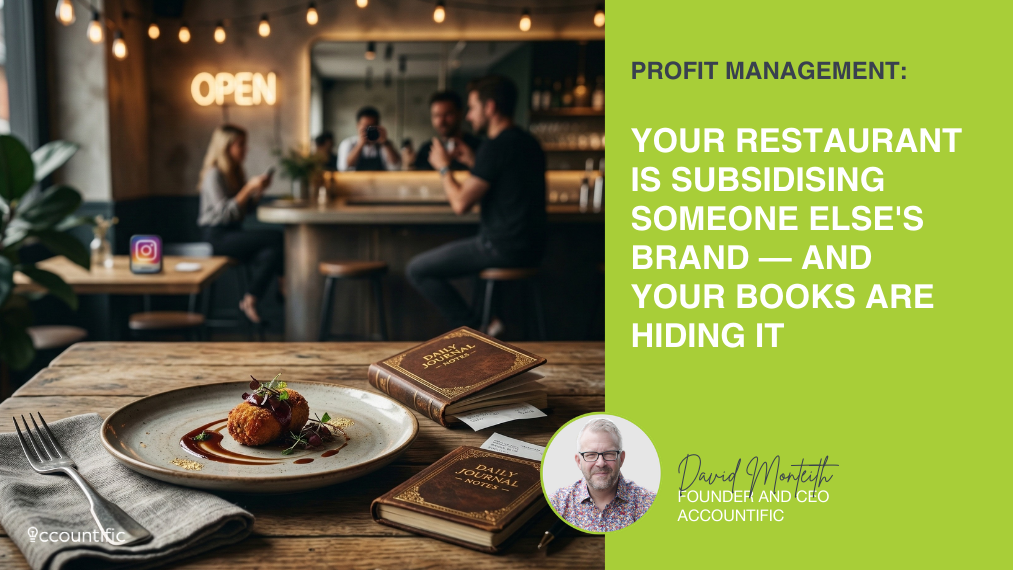
The Restaurant Menu Is Paying for Someone Else’s Brand
TLDR: Hidden Subsidies in Collabs, Influencers, and “Exposure”
Smart operators treat every collaboration as a distinct business line. Exposing the true cost of influencer marketing requires tracking food costs, dedicated labour, and displaced guest revenue. Proper accounting prevents the restaurant from subsidising vanity metrics and ensures marketing investments generate positive cash flow.
Why Read the Full Article
The following article provides a step-by-step framework for calculating the true financial impact of restaurant marketing partnerships. The data reveals the hidden expenses destroying margins and explains the strict Canada Revenue Agency documentation requirements for promotional meals.
How Accountific Helps
If implementing these financial controls feels overwhelming, a specialised team handles these administrative burdens for restaurants in Canada. Gain absolute clarity over restaurant margins by partnering with Accountific.
—
The Brutal Economic Reality of the Canadian Foodservice Market
Operating a profitable food business requires absolute financial discipline. A packed dining room creates a dangerous illusion of success. Staff members rush between tables. The kitchen pushes out hundreds of plates. The cash register rings constantly. Observers assume the business generates massive profits. The truth lies buried in the bookkeeping. Volume does not equal profitability. Selling high quantities of low-margin items drains the bank account.
Current economic indicators present a severe challenge for operators. Data from a recent Restaurants Canada report reveals that forty-four per cent of Canadian restaurants operate at a loss or barely break even. Rising operational expenses squeeze margins across the entire country. Over a two-year period, food costs rose by thirteen per cent and labour costs climbed eleven per cent. Meanwhile, consumer behaviour reflects the strain of inflation.
The broader Canadian foodservice market supports around 79,000 full-service establishments and employs approximately 1.2 million workers. Despite the massive scale of the industry, individual operators fight daily battles for survival. A temporary holiday on federal taxes provided brief relief, but the underlying structural issues remain severe. Food and labour remain the biggest concerns, with eighty-nine per cent of operators citing labour costs as a top pressure point, while eighty-eight per cent point to rising food costs.
Operators face immense pressure to drive traffic into empty dining rooms. Many owners turn to social media personalities and localised brand partnerships to generate exposure. Owners offer complimentary meals, host elaborate tasting events, and pay appearance fees in exchange for digital content. This transaction seems harmless on the surface. The operator assumes the resulting exposure will bring future paying guests. The data tells a different story. A management science study analysing thousands of sponsored videos found that sponsored content sometimes damages an influencer’s subscriber count. Exposure holds unpredictable value. Hidden costs destroy the fragile profit margins required to survive in the hospitality sector.
Restaurants in Canada must shift the focus from vanity metrics to contribution margin. Follower counts do not pay commercial rent. Only positive cash flow sustains the operation. To achieve sustainable profitability, operators must scrutinise every marketing initiative through a rigid financial lens.
The Deceptive Economics of the Sold-Out Event
A common scenario plays out in urban centres across the country. A restaurant owner partners with a local food blogger to host a speciality menu launch. The agreement requires the restaurant to provide a free tasting menu for the blogger and three guests. The blogger promises to post three videos on social media platforms. The restaurant owner anticipates a flood of new reservations.
The evening arrives. The dining room fills up quickly. The kitchen struggles to keep pace with the sudden influx of orders. Servers work overtime to accommodate the chaos. At the end of the night, the sales report shows a significant spike in gross revenue. The owner declares the collaboration a massive success.
This conclusion relies on flawed logic. Gross revenue ignores the expenses required to generate the sales. A meticulous review of the numbers often reveals a net loss. The complimentary tasting menu consisted of prime ingredients. The sudden rush required calling in an extra prep cook and paying overtime wages to the dishwashing team. The chaotic service resulted in two comped bills for regular customers angry about long wait times.
Smart operators treat every collaboration as a distinct business line. Owners isolate the specific revenue and subtract the specific expenses to determine the true return on investment. Standard accounting practices often blur the lines, burying promotional costs within general operating expenses. Uncovering the truth requires constructing a micro profit and loss statement for every event.
The restaurant industry operates on razor-thin margins. Average net profit margins range from three to five per cent for full-service restaurants, and six to nine per cent for quick-service operations. When a business operates with a five per cent net margin, wasting one hundred dollars on a failed marketing experiment requires generating two thousand dollars in new sales simply to replace the lost capital. Ignorance of this mathematical reality leads directly to insolvency.
Constructing a Micro Profit and Loss Statement for Partnerships
Separating promotional expenses from standard operating costs provides complete financial clarity. The Cost of Goods Sold category covers the direct cost of ingredients and packaging used to create menu items. Operating expenses cover indirect costs like rent and general marketing. Blurring these categories makes margin analysis impossible.
A micro profit and loss statement isolates the financial performance of a single initiative. The statement includes specific lines for collaboration revenue, dedicated food costs, dedicated labour, and opportunity costs. Key metrics such as food cost percentage, labour cost percentage, and gross margin dictate the viability of the entire operation.
Identifying the True Cost of Goods Sold and Opportunity Costs
Calculating the true cost of goods sold requires precision. If the kitchen prepares a complimentary meal valued at two hundred dollars on the menu, the restaurant loses the wholesale cost of the ingredients. If the average food cost percentage sits at thirty per cent, the true cost of goods sold equals sixty dollars. Restaurant food costs should ideally remain between twenty-five and thirty-five per cent of total food sales.
Speciality collaborations often involve premium ingredients rarely found on the regular menu. Truffles, imported seafood, and rare spirits carry significantly higher wholesale costs. Operators must track these specific invoices and assign the costs directly to the collaboration budget. If a chef brings in Wagyu beef for an influencer event, the invoice must be tagged specifically to the marketing budget, not the general meat category. Failing to separate these invoices artificially inflates the weekly food cost percentage, causing management panic and leading to incorrect operational decisions, such as raising regular menu prices to compensate for the marketing expense.
Labour expenses present a similar challenge. Base payroll covers the standard staffing requirements for a typical shift. Collaborations demand extra resources. The kitchen team spends additional hours prepping the speciality items. Management spends time coordinating logistics with the promotional partner. These hours represent hard dollars spent to execute the marketing initiative.
Consider a detailed financial breakdown for a single influencer event:
| Expense Category | Description | Estimated Capital Outlay |
| Direct Influencer Compensation | Upfront payment for social media posts | $500.00 |
| Promotional Cost of Goods Sold | Wholesale cost of complimentary food items | $120.00 |
| Dedicated Labour Expenses | Extra prep hours and management coordination | $180.00 |
| Physical Marketing Materials | Custom menus and branded promotional signage | $75.00 |
| Content Licensing Fees | Purchasing rights to reuse influencer photographs | $100.00 |
| Total Direct Cost | Capital invested in the collaboration | $975.00 |
This total direct cost represents the baseline investment. To break even, the collaboration must generate enough gross profit to cover the nine hundred and seventy-five dollars. If the restaurant operates on a sixty-five per cent gross margin, the initiative must generate one thousand five hundred dollars in new, attributable sales simply to reach the break-even point.
Operators frequently fail to calculate this required return on investment. The owner observes a bustling dining room and assumes financial success, completely ignoring the massive capital outlay required to generate the temporary surge in traffic.
The Devastating Impact of Opportunity Cost and Guest Displacement
Direct costs only tell half the story. The most significant financial drain often goes entirely unnoticed. Opportunity cost measures the potential revenue lost by choosing one action over another alternative. In the hospitality industry, opportunity cost manifests as guest displacement.
These loyal patrons form the financial backbone of the operation. Loyal guests visit predictably. Regulars order high-margin items. Consistent patrons require zero marketing effort to acquire.
Hosting a massive promotional event often forces loyal regulars to dine elsewhere. A packed dining room full of discount-seekers leaves no tables available for the weekly neighbourhood guests. The formula for displacement cost involves multiplying the number of displaced tables by the average cheque size, then subtracting the variable costs saved.
If an influencer event occupies four prime tables for two hours on a Friday night, the restaurant loses the capacity to seat regular paying guests.
| Displacement Variable | Value |
| Displaced Prime Tables | 4 |
| Average Cheque Size Per Table | $120.00 |
| Total Displaced Gross Revenue | $480.00 |
| Variable Cost Savings (30% COGS) | -$144.00 |
| Net Displacement Cost | $336.00 |
Adding the net displacement cost to the direct expenses reveals the absolute financial reality of the collaboration. The direct cost is nine hundred and seventy-five dollars; the true cost is one thousand three hundred and eleven dollars. A poorly planned event silently cannibalises existing revenue streams while inflating operating expenses. Losing a weekly regular over a one-time viral stunt destroys long-term cash flow.
Customer Lifetime Value provides further clarity. A regular guest who visits twice a month and spends one hundred dollars per visit generates two thousand four hundred dollars annually. Over five years, this loyal guest has brought twelve thousand dollars in revenue. Displacing this guest to accommodate an influencer who generates zero returning traffic represents a catastrophic financial error.
Compliance Traps: The Canada Revenue Agency and Barter Transactions
Giving away food feels like an inexpensive marketing tactic. Operators pull ingredients from the walk-in cooler, plate the dish, and serve the influencer. The physical money never leaves the cash register. This creates a dangerous illusion of free advertising. The Canada Revenue Agency enforces strict rules regarding promotional meals and bartered services. Ignorance of the tax code guarantees severe penalties during an audit.
Business owners must understand the fundamental difference between standard advertising expenses and meals and entertainment deductions. Purchasing a digital advertisement on a search engine qualifies as a fully deductible marketing expense. Providing food to a third party falls under intense regulatory scrutiny.
Navigating Canada Revenue Agency Documentation Requirements
Providing a free meal to an influencer in exchange for social media exposure constitutes a barter transaction. The Canada Revenue Agency views the fair market value of the meal as taxable income for the recipient. If an influencer receives a tasting menu normally priced at one hundred and fifty dollars, the influencer must report the one hundred and fifty dollars as business income on their personal tax return.
The restaurant faces an equally complex burden. Operators generally claim expenses for food, beverages, and entertainment at fifty per cent of the incurred cost. Attempting to write off personal dining or undocumented promotional meals triggers immediate audit warnings.
Proper documentation forms the only defence against tax penalties. A shoebox filled with faded register tapes fails to meet the legal standard. For every promotional meal provided, the restaurant must log specific details. The record must include the date, the name of the recipient, the specific business purpose of the meeting, and a full description of the items served.
Organising this critical data demands specialised expertise. Relying on handwritten notes guarantees mistakes. Implementing a digital, organised system provides proof for every claim during an audit. Properly categorising promotional expenses prevents tax-time panic and ensures the restaurant maximises legitimate deductions. To understand the severe consequences of inadequate record-keeping, operators should ask themselves how they could survive a CRA audit.
A recent survey by the Canadian Federation of Independent Business indicates business owners prioritise cutting income taxes to relieve financial pressure. Paying unnecessary penalties due to sloppy bookkeeping directly contradicts this goal. Accurate financial tracking provides the foundation for tax optimisation.
The Complexities of Charitable Donations and Inventory
Restaurants often participate in charity tie-ins, donating food or hosting events to support local causes. While admirable, the tax implications of donating inventory are complex. Under current Canadian tax law, donors of food and consumer products receive no direct tax benefit for the donation.
A registered charity is capable of issuing an official donation receipt to a business for the market value of a gift out of inventory. If the transaction results in a material benefit to the business, such as promotion or advertising, no gift at law exists, and the charity should not issue an official donation receipt. The business then writes off the cost as a standard business expense. Navigating these specific tax scenarios requires pristine bookkeeping to separate charitable inventory from the standard cost of goods sold.
Structuring Profitable and Protective Brand Partnerships
Restaurants in Canada must stop absorbing all the financial risk during marketing collaborations. Standard agreements often require the restaurant to provide unlimited complimentary food, pay an upfront appearance fee, and hope for a positive outcome. The influencer assumes zero risk. If the promotional post fails to generate a single reservation, the restaurant still pays the bills.
Strategic operators structure contracts to mandate shared risk and shared upside. A professional partnership agreement protects the margins and defines clear performance metrics.
Instead of flat fees, agreements should tie compensation to trackable sales. Affiliate marketing structures work exceptionally well in the hospitality sector. The restaurant provides the influencer with a unique promotional code. The influencer shares the code with the target audience. The restaurant tracks every reservation or online order associated with the specific code. The influencer receives a percentage of the actual revenue generated. This structure guarantees the restaurant only pays for measurable results. Cost per acquisition (CPA) is the expense incurred to acquire each customer through influencer channels.
Clear deliverables form the core of a protective contract. Vague promises of exposure hold no legal weight. The agreement must specify the exact number of social media posts, the specific platforms used, and the precise timeline for publication.
The restaurant must secure usage rights for the generated content. High-quality photography and videography hold immense value. The contract should grant the restaurant perpetual rights to repurpose the influencer content across internal marketing channels, email newsletters, and website galleries. This transforms a one-time promotional post into a permanent marketing asset.
Contracts must also address liability and brand protection. If a collaboration involves a pop-up event with an external chef, the agreement must specify insurance requirements. The external party must provide proof of commercial general liability insurance to protect the host restaurant against property damage or personal injury claims. Operating without proper liability coverage exposes the host business to catastrophic financial risk.
Aligning Team Operations with Financial Reality
Implementing sophisticated financial tracking achieves nothing if the operations team fails to understand the strategy. Restaurant staff often confuse a busy shift with a successful shift. Servers prefer packed dining rooms because higher volume usually translates to higher tip income. The kitchen team feels a sense of accomplishment after surviving a brutal dinner rush.
Managers must communicate the financial mechanics behind promotional events. The entire staff needs to understand why giving away an expensive steak reduces the margin on ten other tables. Transparency builds a culture of profitability. Satisfied customers are more likely to return, driving repeat business and revenue growth, and businesses investing in training see higher profit per employee.
When the team understands the high cost of a collaboration, staff members adapt their service style to maximise returns. Training the staff to upsell during influencer events helps recover the initial promotional investment. If the influencer receives a complimentary tasting menu, the server should aggressively promote premium wine pairings, speciality cocktails, and upgraded side dishes. Capturing ancillary revenue offsets the cost of the free food.
Educating the team also prevents operational disaster during the event. A viral social media post sometimes generates an overwhelming surge of unexpected customers. If the kitchen lacks the capacity to execute the menu, food quality plummets. Ticket times increase dramatically. Paying customers receive terrible service. The negative reviews generated during the chaotic shift cause long-term reputational damage.
Management must implement strict capacity controls during promotional pushes. Limiting the number of available reservations ensures the kitchen maintains quality standards. Reserving specific sections of the dining room for regular, full-paying guests protects the core revenue stream. The goal involves generating profitable new business, not destroying the existing customer base.
Strategic Pricing and Volume Considerations
In the ever-fluctuating world of the restaurant business, managing menu pricing is a critical challenge. While the immediate reaction involves increasing menu prices to offset rising input costs, this strategy frequently drives customers towards economical dining options at home. An alternative approach involves lowering menu pricing to increase customer volume, compensating for higher input costs through increased sales.
Applying this volume strategy to influencer collaborations requires extreme caution. Offering targeted discounts or combo meals during a collaboration draws crowds, but the reduction in pricing must lure a massive number of patrons without completely erasing the profit margin. If a restaurant discounts a signature burger by thirty per cent for a promotional event, the kitchen must sell dramatically more burgers simply to generate the same gross profit dollars.
| Pricing Strategy | Sales Price | Food Cost | Gross Profit Per Item | Items Sold | Total Gross Profit |
| Standard Service | $20.00 | $6.00 | $14.00 | 50 | $700.00 |
| Promotional Discount (30% Off) | $14.00 | $6.00 | $8.00 | 87 | $696.00 |
The data in the table illustrates a terrifying reality. A thirty per cent discount requires selling seventy-four per cent more volume to break even on gross profit dollars. The kitchen works significantly harder, the equipment suffers more wear and tear, and the business gains absolutely zero additional profit. Volume strategies frequently fail in the restaurant industry because operators underestimate the exponential increase in sales required to offset margin degradation.
The Search Engine Optimisation Reality
Digital visibility dictates the success of modern food businesses. SEO stands for Search Engine Optimisation, the art of making a business appear in Google when someone searches for a specific keyword.
Collaborations provide an excellent opportunity to build digital authority, provided the operator understands backlink strategy. When partnering with food bloggers or local publications, the contract should stipulate the inclusion of a do-follow backlink to the restaurant website.
Cuisine-specific keywords, location-based keywords, and service-focused keywords must populate the digital content generated by the collaboration. If an influencer posts a video about a new menu item, the caption should include high-value search terms. Focusing entirely on fleeting social media algorithms ignores the permanent, compounding value of organic search engine traffic. A well-placed backlink from a reputable local food blog continues driving reservations for years after the initial promotional event concludes.
Transforming Raw Data into Strategic Dominance with Accountific
Gathering point-of-sale data, tracking wholesale invoices, and monitoring payroll expenses produces a mountain of raw numbers. Raw numbers hold zero value without proper analysis. Most food business entrepreneurs lack the time and the technical training to convert spreadsheets into actionable business intelligence. Owners rely on gut feelings to make crucial pricing decisions. This instinct-driven approach guarantees failure in a low-margin industry.
Restaurant owners face a heavy administrative burden. Managing payroll, issuing annual tax forms, and ensuring compliance steals focus away from the kitchen floor and the guest experience. The Canada Revenue Agency imposes unforgiving deadlines for remittance payments. Missing a payroll deadline triggers severe financial penalties, shattering a fragile cash flow position. For an in-depth analysis of managing these stressful obligations, review how smart restaurants handle GST, payroll, and T4 deadlines without panic.
Accountific serves as the specialised partner for Canadian food business owners. Generalist bookkeepers often misunderstand the unique rhythms of the hospitality sector. Generalists fail to separate prime costs from general operating expenses. Generalists deliver outdated financial statements weeks after the month ends.
Accountific lives and breathes restaurant finances. The service provides weekly bookkeeping, delivering a constant, accurate picture of financial health. This proactive system enables agile decision-making. When ingredient prices spike, the owner sees the impact immediately and adjusts menu pricing before margins collapse.
The Accountific Process for Absolute Financial Control
Accountific deploys a rigorous four-step methodology to eliminate administrative chaos and build a foundation for sustainable profit.
Step One: The Deep Diagnostic Review
The relationship begins with a comprehensive analysis of the existing financial infrastructure. Accountific specialists examine the general ledger, review point-of-sale configurations, and identify historical bookkeeping errors. This diagnostic phase uncovers hidden margin leaks and ensures the chart of accounts aligns perfectly with hospitality industry standards.
Step Two: System Restructuring and Clean Up
A chaotic ledger produces useless reports. The Accountific team rebuilds the accounting system from the ground up. The team separates the cost of goods sold into specific categories for food, draft beer, bottled wine, and non-alcoholic beverages. The specialists isolate promotional expenses and track collaboration costs as independent line items. This pristine structure forms the basis for advanced margin analysis, tagging collaboration-related revenue and costs separately to compare each marketing effort like a mini business line.
Step Three: Technological Automation
Manual data entry wastes time and introduces human error. Accountific leverages technology to automate the flow of information. Integrating the point-of-sale system directly with the accounting software ensures that daily sales data is automatically updated. Digitising the accounts payable process eliminates the shoebox of faded receipts, guaranteeing perfect documentation for every Canada Revenue Agency deduction.
Step Four: Proactive Weekly Reporting
The final step transforms the restaurant owner from a reactive passenger into a proactive operator. Accountific delivers customised weekly financial reports. The dashboard displays critical metrics like prime cost percentage, current cash flow, and the exact return on investment for recent marketing initiatives. The system builds a simple dashboard showing which partnerships deserve renewal and which quietly drain the operating margins. Armed with timely, precise data, the owner makes strategic decisions based on mathematical certainty rather than emotional guesswork.
Taking the First Step Toward Sustainable Profitability
The Canadian restaurant industry remains an incredibly challenging environment. Rising ingredient costs, increasing minimum wages, and hesitant consumer spending create a tightrope for operators. Survival demands a ruthless commitment to financial efficiency.
Funding the lifestyles of social media personalities through hidden subsidies destroys profit margins. Giving away premium food, burning through expensive labour hours, and displacing loyal regular guests represents a fast track to insolvency. Treating every collaboration as a distinct business line, tracking displacement costs, and structuring protective contracts ensures marketing investments generate positive cash flow.
Achieving this level of financial sophistication requires dedicated infrastructure. Managing the complex web of bookkeeping, payroll processing, and Canada Revenue Agency compliance demands specialised expertise. Attempting to balance these administrative burdens while running a busy kitchen inevitably leads to costly mistakes and overwhelming stress.
The ultimate outcome of professional financial management is absolute control. A clear, up-to-the-minute understanding of true profitability empowers owners to build stable, thriving businesses. Gain the financial clarity required to dominate the local market. Take the first step toward running a smarter, highly profitable food business by scheduling a comprehensive strategy session. Secure the financial foundation of the operation by initiating a conversation at Accountific.
——————–
David Monteith, founder of Accountific, is a seasoned digital entrepreneur and a Xero Silver Partner Advisor. Leveraging over three decades of business management and financial expertise, David specialises in providing tailored Xero solutions for food and beverage businesses. His deep understanding of this industry, combined with his proficiency in Xero, allows him to streamline accounting processes, deliver valuable financial insights, and drive greater success for his clients.