
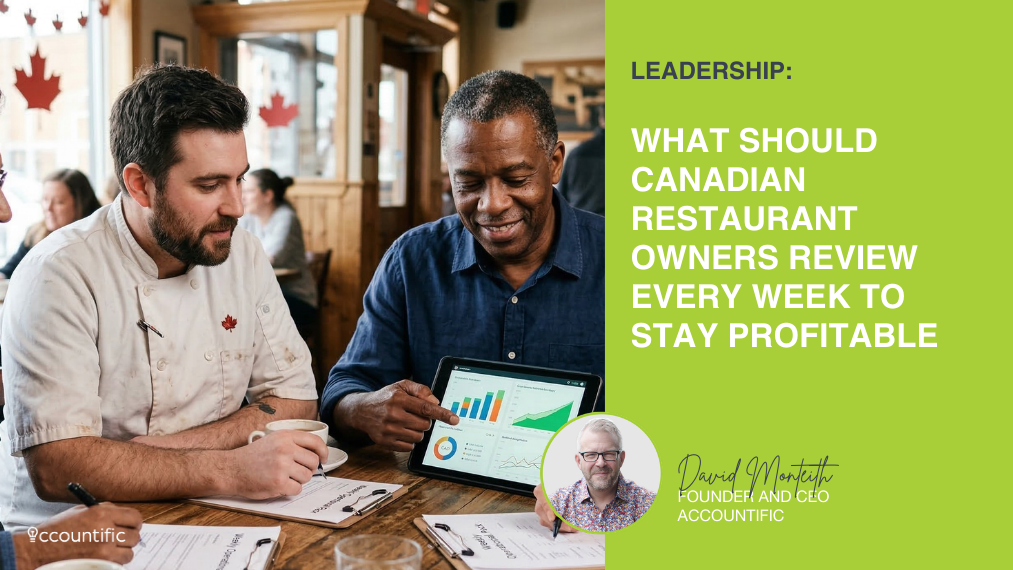
How to Run a Weekly Leadership Meeting that Actually Moves Numbers
TLDR: The Weekly Numbers-First Meeting Framework for Canadian Operators
The Canadian foodservice industry faces intense financial pressure. Restaurant owners must abandon “gut-feel” management and adopt the “One Shift CEO” method. This involves dedicating 45 minutes every week to a strict, numbers-driven meeting with your leadership team. You review prime costs, labour efficiency, and tax compliance to build a proactive financial culture.
Why Read the Full Article
This guide provides the exact 45-minute agenda you need to run an effective meeting. You will learn which specific key performance indicators to track and how to design weekly operational experiments. It shows you exactly how to stop staff from venting and start forcing them to take ownership of the numbers.
How Accountific Helps
Implementing these financial controls requires pristine weekly data. If organising this information feels like a heavy burden, there is a team that does this every day for restaurants in Canada. Find out how Accountific can automate your bookkeeping and provide the exact weekly leadership pack you need to run your meetings with confidence.
—
The Canadian foodservice sector faces severe financial pressures. Rising minimum wages combine with fluctuating consumer demand to squeeze profit margins relentlessly. Nationwide closures are predicted to reach 4,000 locations this year alone. Establishments must transition from reactive management to proactive financial control. The “One Shift CEO” methodology provides a structured framework for this transition. Dedicating a single weekly operational block to rigorous metric-driven review transforms frontline managers into financial co-pilots.
Operating a profitable dining establishment requires culinary excellence alongside rigid fiscal discipline. The economic environment demands precise operational execution. Recent reports indicate that 44 percent of operators report operating at a loss or barely breaking even. Establishments relying solely on increasing menu prices risk alienating a highly price-sensitive consumer base. Survival depends entirely on internal cost optimisation and forensic financial management.
The Fallacy of Gut-Feel Administration
Many independent owners navigate complex financial environments relying primarily on intuition. This “gut-feel” approach assumes busy dining rooms automatically equate to profitable operations. High revenue often masks severe underlying inefficiencies. Without precise data, strategic decision-making becomes impossible. Managers schedule staff based on historical habits rather than accurate sales forecasts. Chefs order ingredients without calculating precise theoretical yields or tracking exact waste percentages.
The resulting financial ambiguity breeds chronic stress. Owners frequently feel entirely isolated. You operate as the sole individual concerned with cash flow and vendor payments. Frontline managers lack visibility regarding actual profitability metrics. They focus exclusively on customer satisfaction and immediate operational firefighting. When financial crises emerge, the reaction is typically swift and panicked. Blanket mandates to cut labour or reduce portion sizes often damage the customer experience. This initiates a downward spiral of declining traffic and further revenue loss.
Restaurants in Canada require a systematic approach to financial literacy across the entire management team. The focus must shift from emotional reactions to objective data analysis. Information must flow seamlessly from your Point of Sale system into a centralised accounting framework.
Defining the “One Shift CEO” Framework
The “One Shift CEO” concept reframes business administration entirely. You stop squeezing financial review into exhausted hours after closing. You allocate one specific weekly shift to strategic planning instead. This dedicated block becomes your most valuable time investment. You schedule this meeting during a notoriously slow afternoon. You step away from the kitchen to assume the role of Chief Executive Officer.
This designated time serves a singular purpose. The meeting connects frontline operational decisions directly to your Profit and Loss statement. The process requires a fixed agenda anchored entirely to objective performance metrics. Involving key personnel distributes the intellectual burden of financial stewardship. Your General Manager and Executive Chef must attend.
Transitioning to this model requires discipline. Interruptions remain strictly forbidden. The meeting does not serve as a forum for complaining about unreliable suppliers. Every discussion point must tie directly to a specific numerical value. If a manager wishes to discuss a staffing challenge, the conversation must centre on the labour cost percentage. You demand the exact financial impact of the proposed solution. This rigorous adherence to data neutralizes emotional venting.
The Architecture of a Numbers-First Leadership Meeting
A successful leadership meeting operates within strict 30 to 45-minute parameters. Extending the duration risks losing focus. Long meetings often devolve into unproductive grievances. The agenda remains identical week after week. This consistency allows managers to prepare adequately. They arrive with solutions rather than simply presenting problems.
Establishing the Keyword Agenda
Traditional meeting agendas often feature vague topics like “Kitchen Update” or “Staffing Issues.” These broad categories encourage sprawling conversations. The keyword agenda approach replaces these generalities with specific metrics.
Instead of listing “Kitchen Update”, your agenda specifies “Week 14 Food Waste Percentage vs. Target.” Instead of “Front of House Performance”, the agenda dictates “Server Upsell Averages and RevPASH Analysis.” This precision signals the expected depth of the conversation immediately. Participants understand exactly which numbers require defence and explanation.
The 45-Minute Breakdown
Structured time allocation guarantees all critical financial sectors receive adequate attention. A recommended breakdown ensures maximum efficiency.
| Meeting Segment | Duration | Primary Objective | Key Metrics Reviewed |
| Macro Financial Review | 10 Minutes | Assess overall business health and cash flow. | Net Sales vs. Budget, Cash Position, Tax Holding Account Balances. |
| Prime Cost Dissection | 15 Minutes | Analyse the two largest controllable expenses. | COGS Percentage, Labour Cost Percentage, Overtime Hours. |
| Leakage and Efficiency | 10 Minutes | Identify operational vulnerabilities and lost revenue. | Void Value, Discount Value, Table Turnover Rate, RevPASH. |
| Experiment Design | 10 Minutes | Translate historical data into future strategy. | Assigning one specific measurable micro-experiment for the upcoming week. |
This exact structure forces efficiency. The team reviews the macro picture first. Did the establishment hit the sales target? If a shortfall occurred, the team identifies the specific daypart responsible. The conversation shifts rapidly to operational vulnerabilities. High numbers in these categories require immediate investigation. The team concludes by designing a targeted action plan.
Metric One: Demystifying Prime Cost for Frontline Management
Successfully managing the prime costs of food and labour dictates your ability to turn a profit. Prime Cost serves as the ultimate indicator of operational efficiency. A widely accepted industry benchmark suggests Prime Cost should not exceed 60 percent of total gross sales. Achieving this target requires granular attention to both components.
Analysing Cost of Goods Sold and Food Waste
Cost of Goods Sold calculates the direct expenses incurred to prepare and serve items to guests. The formula requires precise inventory management. You add your beginning inventory to your weekly purchases, then subtract your ending inventory. Dividing this figure by total food sales yields your food cost percentage.
Canadian operators face severe headwinds regarding food procurement. General food costs have escalated significantly. Maintaining a target food cost percentage requires aggressive menu engineering and relentless waste reduction.
Food waste represents a catastrophic drain on profitability. The Canadian food system wastes 46.5 percent of all produced food. During the weekly meeting, your Executive Chef must account for known waste. They must explain variances between theoretical food costs and actual food costs. Theoretical food cost represents the perfect execution of a recipe. Actual food cost represents the reality of spilled ingredients and oversized portions.
Addressing waste requires systemic change. Throwing away edible food destroys your profit margin instantly. The meeting allows you to mandate specific portioning controls. You hold the kitchen accountable for utilising digital scales and standardised ladles.
Metric Two: Labour Cost Optimisation
Labour stands as the most difficult variable to control. Unlike a case of tomatoes, operators cannot store excess labour hours on a shelf for future use. Idle staff during a slow shift represent permanently lost capital.
The Canadian regulatory landscape complicates this challenge significantly. Minimum wage rates experience continuous upward adjustments. Understanding these regional mandates remains essential for accurate financial forecasting.
| Province | 2026 Projected/Confirmed General Minimum Wage |
| British Columbia | $17.85 (Effective June 1) |
| Ontario | $17.60 (Effective October 1) |
| Prince Edward Island | $17.00 (Effective April 1) |
| Quebec | $16.60 (Effective May 1) |
| Alberta | $15.00 (Frozen since 2018) |
These escalating base rates exert immense pressure on the overall labour budget. Effective management demands abandoning static scheduling. Managers frequently build weekly schedules based on employee availability. They schedule to guarantee hours rather than aligning staff levels with accurately forecasted sales volume.
During the One Shift CEO meeting, your team must review scheduling efficiency. The metric “Sales Per Employee Hour” provides critical context. Your leadership team uses the weekly meeting to trim unnecessary hours from the upcoming schedule. Adjusting call-in times by 15 or 30 minutes shaves marginal costs without impacting service quality. You align your workforce directly with anticipated guest traffic.
Metric Three: Controlling Leakage Through Void Analysis
Profitability often bleeds through thousands of tiny administrative actions. Voids and discounts represent a massive vulnerability for any dining establishment. A certain volume of complimentary items remains necessary for service recovery. Excessive discounting signals severe operational dysfunction.
A void occurs when a user removes an item from a bill before payment processing. A discount involves removing the financial charge for an item after preparation. Both actions destroy profit margins. When a kitchen prepares a steak sent back for overcooking, you lose the raw ingredient cost. You lose the labour cost of the initial preparation. You lose the labour cost of the refire. You still only collect revenue for a single dish.
Your weekly leadership meeting must feature a ruthless interrogation of the POS void report. The owner and managers look for specific patterns. Does one specific server continually void beverages? This pattern frequently indicates internal theft. Does a particular menu item suffer a high rate of customer rejection? This indicates a flaw in the recipe or inadequate kitchen execution.
Analysing these figures weekly allows your leadership team to identify training gaps immediately. Rather than discovering a massive loss at the end of the month, the manager addresses the specific server within days. Correcting the behaviour seals the financial leak instantly. Continuous staff education plays a massive role in reducing these errors. Review this detailed guide discussing the strategic significance of employee training to understand how skill development protects your margins.
Metric Four: Navigating Regulatory Compliance
Canadian restaurant owners operate under intense scrutiny from the Canada Revenue Agency. Failure to meet strict remittance deadlines triggers severe financial penalties. These penalties compound existing cash flow challenges. A primary objective of your weekly financial review involves ensuring the business remains entirely compliant with all federal and provincial tax obligations.
The Danger of Ghost Money
A prevalent operational error involves the mismanagement of trust funds. When an establishment collects GST/HST from a guest, those funds do not belong to the restaurant. When you deduct Income Tax and Canada Pension Plan premiums from an employee paycheque, you merely hold this money in trust for the government.
Many operators lack rigorous financial discipline. They leave these trust funds co-mingled within the main operating checking account. They spend the government’s money to survive the week. This phenomenon creates a ticking time bomb. When the CRA remittance deadline arrives, the bank account lacks the necessary funds.
The CRA does not tolerate delinquency regarding payroll source deductions. They impose compounding daily interest alongside severe penalties scaling from 3 percent to 10 percent based on the duration of the delay. In severe cases involving gross negligence, the CRA invokes Section 227.1 of the Income Tax Act. This action assigns personal liability to corporate directors. The government possesses the authority to seize personal assets to satisfy the corporate tax debt.
Implementing the Tax Holding Account Strategy
Your weekly meeting mitigates this risk entirely. The leadership team implements a strict cash management protocol. Every week, a predetermined percentage of gross sales automatically transfers from the main operating account into a separate Tax Holding Account.
A standard algorithm involves transferring 100 percent of collected GST/HST. You add an estimated 15 to 18 percent of gross sales for payroll to cover source deductions. You allocate an additional 2 to 3 percent for corporate tax liabilities. During the One Shift CEO meeting, the owner physically verifies the completion of these transfers. This weekly discipline guarantees the funds remain available when the CRA deadlines arrive.
This system protects owners during periods of intense cash flow restriction. Discover advanced tactics for surviving these periods by reading how smart restaurants handle GST, payroll, and T4 deadlines without panic.
Designing Operational Experiments from Financial Data
The true power of your weekly leadership meeting lies in translating backward-looking financial data into forward-looking operational strategy. Discussing poor numbers serves no purpose without a corresponding action plan. The team utilises the final ten minutes of the agenda to design a micro-experiment.
These experiments must adhere to strict criteria. They require specific parameters, measurable outcomes, and a short duration. Attempting to overhaul the entire menu simultaneously creates chaos. Adjusting the placement of three high-margin items on the digital menu board constitutes a controlled experiment.
Consider a scenario where the weekly data reveals a low Revenue Per Available Seat Hour during the Thursday dinner service. The leadership team designs an experiment to address this metric. The General Manager hypothesises the low RevPASH stems from slow table turnover resulting from delayed dessert service. The experiment involves cross-training the host stand to assist with clearing plates. Hosts deliver dessert menus immediately upon the completion of entrees.
The following week, the team reviews the new RevPASH data for the Thursday service. If the number improves, the protocol becomes a permanent operational standard. If the number remains unchanged, the team discards the hypothesis and designs a new experiment. This continuous iterative testing breeds a culture of constant optimisation.
Leveraging Specialised Financial Infrastructure for Long-Term Control
Executing the One Shift CEO methodology requires pristine financial data. A leadership meeting loses all value if participants debate the accuracy of the numbers. Relying on outdated monthly statements provided by a traditional accountant defeats the purpose of agile management entirely. Discovering food costs spiked in week one during the fourth week means the financial damage spans an entire month.
The modern Canadian restaurant environment necessitates specialised financial infrastructure. You require a firm delivering specialised bookkeeping, payroll, and tax compliance exclusively for Canadian food business owners. This specialisation ensures the financial reporting aligns perfectly with the unique operational realities of the foodservice industry.
Specialised financial partners follow a distinct operational process to deliver absolute control to the restaurant owner. They begin with a deep diagnostic review to audit existing financial systems. They rebuild the accounting framework to isolate Prime Costs accurately. Manual data entry introduces human error. Modern financial management relies on technological integration. Sales data flows automatically from your POS directly into your accounting platform.
Automation handles the administrative burden. The specialised bookkeeping service generates a critical weekly leadership pack. This concise report arrives in your inbox prior to the scheduled One Shift CEO meeting. You see your Prime Cost percentage, labour variances, and impending tax deadlines instantly.
Outsourcing the heavy lifting of data organisation to a specialised partner allows you to reclaim hours of valuable time. You arrive at the weekly meeting armed with objective truth. You are fully prepared to lead the strategic discussion rather than drowning in a mess of disorganised spreadsheets.
Committing to a rigorous leadership cadence allows you to transcend the daily chaos of the dining room floor. You build a sustainable business model capable of weathering inflation and relentless regulatory scrutiny. This transition requires discipline and an unwavering commitment to objective data. Accountific delivers the specialised financial support providing the exact data you need. We build your accounting framework, automate the data collection, and deliver the weekly insights required to run your meetings effectively. Take the first step toward running a smarter, more profitable restaurant and book a consultation today.
——————–
David Monteith, founder of Accountific, is a seasoned digital entrepreneur and a Xero Silver Partner Advisor. Leveraging over three decades of business management and financial expertise, David specialises in providing tailored Xero solutions for food and beverage businesses. His deep understanding of this industry, combined with his proficiency in Xero, allows him to streamline accounting processes, deliver valuable financial insights, and drive greater success for his clients.