
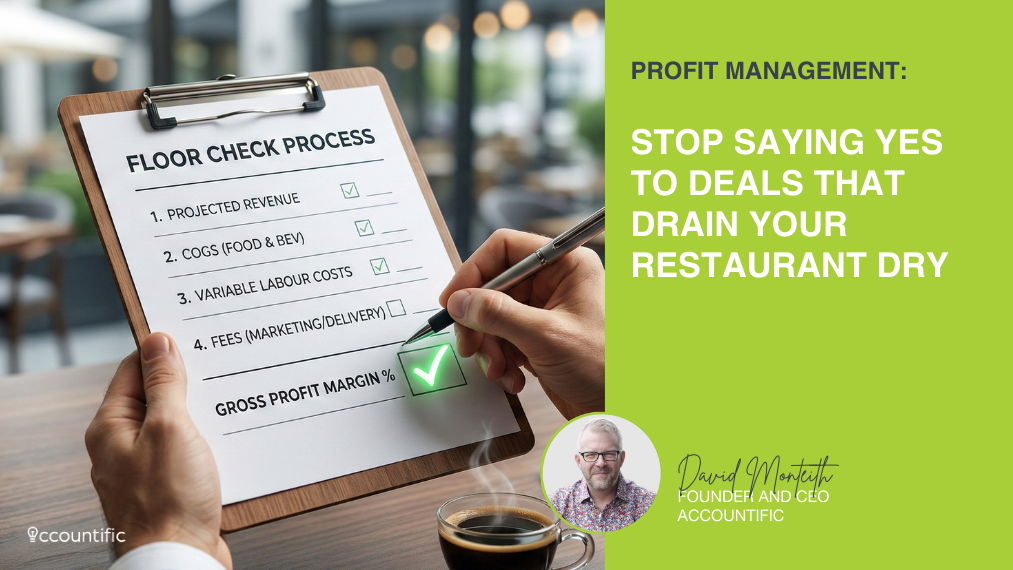
TLDR: A strategic guide for Canadian restaurant owners on designing a profit floor
Most restaurant owners evaluate new opportunities by gut feel, and it costs them. A profit floor is a single number (a minimum gross profit per guest, per hour, or per event) that every new idea must beat before you say yes. You set it from your own last-quarter data, not from industry averages or wishful thinking. With that number in hand, a five-minute floor check replaces hours of pros-and-cons debate, and you stop filling your calendar with busy work that earns nothing.
Why Read the Full Article
The summary tells you what a profit floor is. The full article shows you exactly how to calculate your specific number from real bookkeeping data, how to write a one-page floor-check tool your managers can actually use, and how to track the exceptions you choose to make so they work for you rather than quietly eroding your margins in 2026.
If pulling last quarter’s gross profit numbers by cover, by event, or by shift sounds like a day’s work you do not have, there is a team that does exactly this every week for restaurants in Canada. Accountific specialises in bookkeeping, payroll, and tax compliance for Canadian food business owners, and they can build your profit floor from your own data. Find out more at accountific.co.
—
A local brewery slides into your inbox. They want to co-host a Thursday night tasting event. Tables of six, fixed menu, their branding all over your room. Sounds exciting. Your front-of-house manager has already said it sounds “like fun.”
You spend forty minutes on a mental pros-and-cons list. You say yes.
Three weeks later, the event runs. The room is full. You’re exhausted. And when you look at the numbers, you made less per cover than you do on a quiet Tuesday.
Sound familiar? For restaurants in Canada, this pattern is not unusual. It is the single most common way that well-intentioned owners drain the very margins they work so hard to protect.
The fix is not better intuition. It is one number.
Why “Busy” Is Not the Same as “Profitable”
Canada’s restaurant industry is under significant pressure. According to Restaurants Canada’s revised 2026 foodservice forecast, insurance costs have risen 14 per cent, food costs 13 per cent, and labour costs 11 per cent over the past two years. At the same time, the 2026 commercial foodservice sales growth forecast has been revised down to just 2.3 per cent. Margins were already thin. Now they are thinner.
Full-service restaurants in Canada typically operate on a net profit margin of 3 to 5 per cent, according to Innovation, Science and Economic Development Canada’s industry financial performance data. That means for every hundred dollars that comes through your door, between $95 and $97 goes back out. There is no room for decisions made by feel.
Yet most owners, when a new opportunity arrives, still do the same thing: they weigh whether it sounds good. They think about whether it fits the brand. They estimate, roughly, whether it might be worth it.
That process is exhausting. It is inconsistent. And it is chronically biased toward yes, because the person asking is usually someone you like, and the event is usually a few weeks away, which feels abstract and manageable right now.
The antidote is a profit floor.
What a Profit Floor Actually Is
Think of your profit floor as the minimum gross profit your restaurant must generate per guest, per labour-hour, or per event before an opportunity earns a spot on your calendar.
It is not a target. It is a threshold. Below it, no deal gets done. The floor does not care whether the idea is interesting, whether the partner is charming, or whether the event might bring in some new faces. If the numbers do not clear the floor, the answer is no.
Think of it as the cover charge at the door of your business. Every idea has to pay it.
This is a different way of thinking from the typical pros-and-cons list. A pros-and-cons list is subjective. Your profit floor is not. It is a pre-decided, data-backed rule, and because it is decided in advance, it removes the emotional weight from individual decisions. Your managers stop bringing you bad ideas. You stop agonising over them.
The Canadian Federation of Independent Business has repeatedly found that insufficient demand is the primary barrier for small businesses, with 54 per cent of small-to-medium enterprise owners identifying weak demand as their main constraint. When demand is soft, the instinct is to accept any opportunity that puts bodies in seats. Your profit floor is the mechanism that stops you from confusing activity with revenue.
Choosing the Right Metric for Your Floor
There is no single right way to express your profit floor. Choose the version that is easiest for you and your team to calculate at the point of decision.
Gross profit per cover is the most universal option for full-service restaurants. It measures revenue per guest minus the direct food and beverage cost for that guest. It answers the question: did each seat pay its food-cost freight and leave something behind for everything else?
Gross profit per labour-hour is useful when the opportunity changes your staffing pattern significantly, such as bringing in extra prep cooks for a catering job or extending a shift for a private event. If you are committing staff time, you need to know whether each hour of that time is generating enough contribution margin to be worth it.
Gross profit per event is the right lens for anything that takes over your space for a fixed period: buyouts, charity nights, pop-up collaborations. Here, you are measuring total event revenue minus total direct event costs, then asking whether the resulting gross profit justifies everything else the event demands of your team.
For most independent restaurants in Canada, starting with gross profit per cover is the right move. It is the metric that maps most directly to your daily operation, and it is the easiest to explain to a floor manager in thirty seconds.
Using Last Quarter’s Numbers to Set a Real Floor
Here is where owners get into trouble: they set a profit floor based on what they wish they were making, rather than what they are actually making.
Do not do that. A profit floor built on fantasy will either approve everything (because your wishful average is too low) or reject everything (because your wishful average is too high). Neither is useful.
Pull your last quarter’s actual bookkeeping data. You need two figures: your total gross profit for the quarter, and the total number of covers served in the same period. Divide the first by the second. That is your average gross profit per cover. It is your baseline floor.
For example: if your restaurant grossed $180,000 in the last quarter, your cost of goods sold was $63,000, and you served 4,500 covers, your gross profit per cover is $26. That number is your floor. Any opportunity that projects lower than $26 per cover is, by definition, below your average performance. You would be better off running your regular service.
If your bookkeeping is not current or organised enough to pull these numbers quickly, that is the first problem to solve. As outlined in How Strategic Bookkeeping is Saving Canadian Restaurants from the Brink, the owners who are making data-backed decisions in 2026 are not the ones with the best instincts. They are the ones with the cleanest, most current financial records.
The 5-Minute Floor Check
Once you have your floor number, the floor check becomes simple. You run it before you say yes to anything.
Step one: estimate the expected revenue from the opportunity. For a fixed-menu event, that is, covers multiplied by menu price. For a discount promotion, it is your expected volume at the reduced price.
Step two: estimate the direct food and beverage cost. Use your standard food cost percentage as a quick proxy if you do not have time to cost the specific menu.
Step three: subtract cost from revenue to get the gross profit. Divide by the number of covers. Does that number clear your floor?
If yes, the idea deserves further evaluation. If no, the answer is no. You do not need a meeting. You do not need to sleep on it. The floor has decided.
This five-minute check also works for discount decisions. Say a local tourism company wants to offer your restaurant to their clients at 20 per cent off. Run the floor check. At a discounted average spend of $52 per person with a food cost of $18, your gross profit per cover is $34. If your floor is $26, this clears. If they then ask for 30 per cent off, rerun the check. At $45 average spend with $18 food cost, you are at $27. Tight, but still over your floor. At 40 per cent off, you are at $39 average spend, $18 cost, and $21 per cover. Below the floor. No deal.
This is the kind of rapid, numeric decision-making that protects restaurants in Canada from death by discount.
Teaching Your Managers to Use the Floor
One of the biggest sources of financial leakage in restaurants is the manager who commits to something on your behalf without knowing the numbers. A well-meaning front-of-house manager books a charity night, agrees to a kids-eat-free Sunday, or confirms a group booking with a special rate. You find out about it days later and feel obligated to honour it.
Your profit floor stops this. Build it into a one-page checklist that lives at the host stand or in your manager’s binder. The checklist needs three inputs: expected covers, expected average spend per cover, and estimated food cost percentage. The formula does the rest.
When a new enquiry comes in, the manager fills in what they know, runs the check, and the result is either “this clears the floor, bring it to the owner” or “this does not clear the floor, here is how we decline politely.” You are no longer the firewall for every enquiry. The floor is.
This also builds financial literacy in your team. Managers who understand the floor concept understand why pricing decisions matter. They stop viewing a 20 per cent discount as a nice gesture and start seeing it for what it is: a direct reduction in your contribution margin on every cover.
When to Break Your Own Rule on Purpose
A profit floor is a tool, not a prison sentence.
There are legitimate reasons to approve an opportunity that falls below your floor. A community fundraiser might build goodwill that brings in repeat guests over the following quarter. A collaboration with a high-profile food influencer might generate coverage that is worth more than the margin you sacrifice on the night. A quiet Monday buyout at a thin margin is better than empty seats producing zero contribution to your fixed costs.
The keyword in all of these cases is “on purpose.” You are not ignoring the floor because the event sounds nice. You are consciously choosing to treat the below-floor margin as the cost of a specific strategic outcome. And you are tracking it.
Tag every floor exception in your books. Use a simple label in your chart of accounts or in your bookkeeping software: “Floor Exception – [Reason].” At the end of each quarter, look at every tagged exception. Did the charity dinner generate the repeat visits you hoped for? Did the influencer event bring measurable new covers in the following weeks? If the strategic outcome materialised, the exception was earned. If it did not, you have data to make a different call next time.
This is the discipline that separates operators who control their finances from those who are controlled by them. For a deeper look at how data from your POS and bookkeeping can drive smarter menu and promotion decisions, the Accountific article Master the Data-Driven Strategy Smart Restaurants Use to Beat Inflation walks through exactly how to connect your financial records to forward-looking choices.
How Accountific Helps
Setting a profit floor is not complicated in theory. In practice, it requires clean, current bookkeeping that lets you pull last quarter’s gross profit and cover counts in minutes rather than days.
Accountific provides weekly bookkeeping for Canadian food business owners. That means your numbers are always current. When an opportunity lands in your inbox on a Wednesday, you do not have to wait until month-end to know whether it clears your floor. You look at last week’s data, and you have your answer.
Beyond the baseline, Accountific calculates your profit floor from your historical data and builds it into a simple checklist or calculator that your team can use. Events, promotions, and partnerships get tagged in your books so you can see, at quarter’s end, which decisions respected the floor and which ones were exceptions, and whether those exceptions paid off.
Tax compliance, payroll, and bookkeeping handled in one place means you are not piecing together your financial picture from three different systems. You have one clean, current picture. That picture is what makes your profit floor reliable.
If you are ready to stop making financial decisions by feel and start making them by number, the first step is a conversation. Book a no-obligation consultation with the Accountific team and find out what your profit floor should be.
——————–
David Monteith, founder of Accountific, is a seasoned digital entrepreneur and a Xero Silver Partner Advisor. Leveraging over three decades of business management and financial expertise, David specialises in providing tailored Xero solutions for food and beverage businesses. His deep understanding of this industry, combined with his proficiency in Xero, allows him to streamline accounting processes, deliver valuable financial insights, and drive greater success for his clients.