
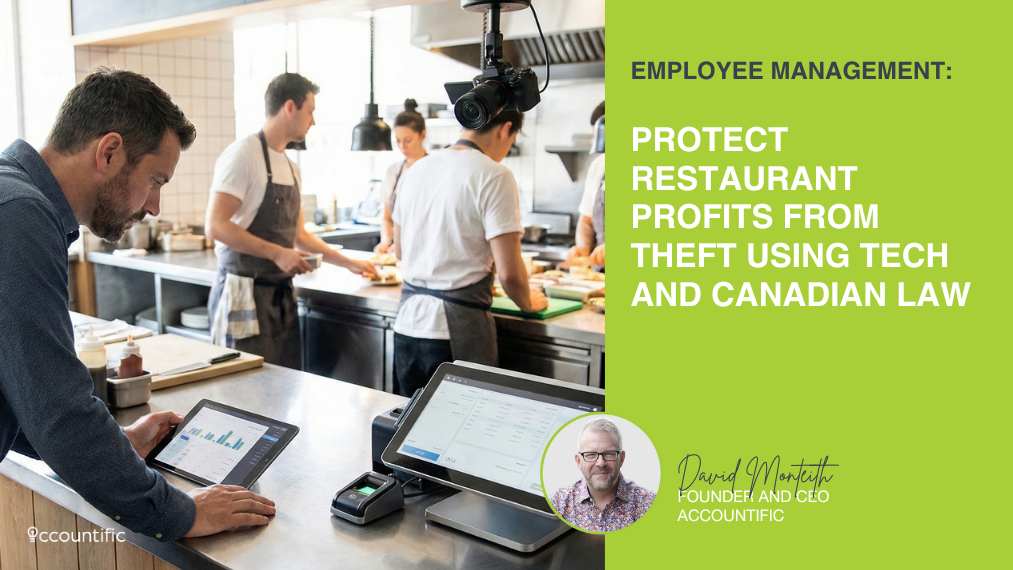
How Technology Can Prevent Employee Theft and Cash Shrinkage
TL;DR: Lock Down Your Restaurant’s Profits in 2026
The Reality: In the tight economic landscape of 2026, relying on the “traditional playbook” is dangerous. With restaurant bankruptcies surging and margins shrinking, the 3-4% of revenue lost to employee theft and waste has become an existential threat.
The Trap: Most Canadian restaurant owners don’t realize that deducting cash shortages from wages is now a major legal risk. Employment standards in provinces like Ontario and BC effectively prohibit “financial punishment” for theft, leaving you vulnerable to lawsuits if you try to recover losses through payroll.
The Solution: If you can’t deduct, you must prevent. This article outlines the “Digital Fortress” strategy—replacing manual oversight with Biometric POS security, AI-driven anomaly detection, and Computer Vision in the kitchen. These tools don’t just stop theft; they provide the forensic data required to legally terminate dishonest staff without fear of wrongful dismissal claims.
Why Read the Full Article? You will get a comprehensive blueprint on the exact technologies (from Smart Safes to “Sweethearting” detectors) that are saving Canadian restaurants today. Plus, learn how to calculate the ROI of prevention and build a culture where honest employees thrive.
Ready to secure your bottom line? Stop the silent hemorrhage of capital. Book a call with Accountific to build a fortress around your business.
—
1. The Canadian Hospitality Landscape: An Industry at the Inflection Point
The Canadian restaurant sector stands at a critical juncture as it navigates the fiscal landscape of 2026. The years leading up to this moment, spanning the post-pandemic recovery, the inflationary surges of 2023-2024, and the stabilization efforts of 2025, have fundamentally reshaped the operational and financial realities for business owners. The industry is no longer operating under the “traditional playbook” that guided restaurateurs for decades; instead, it faces a maelstrom of compounding pressures ranging from persistent labour shortages to an increasingly discerning and price-sensitive consumer base.
For the clients of Accountific and the broader community of Canadian restaurant owners, the margin for error has effectively evaporated. The stark reality is reflected in the insolvency statistics: restaurant bankruptcies in Canada surged by 30% in 2024, a trend that has continued to reverberate through 2025 and into the current year. This wave of closures is not merely a result of bad food or poor service but is frequently the consequence of an inability to manage the widening gap between soaring operational costs and shrinking profit margins. In this precarious environment, knowing how strategic bookkeeping is saving Canadian restaurants from the brink is essential, and the silent hemorrhage of capital through employee theft and cash shrinkage has evolved from a nuisance into an existential threat.
The economic pressure cooker of 2026 is characterized by a distinct shift in consumer behavior. A significant portion of the population has pulled back on discretionary spending. By 2025, reports indicated that 75% of Canadians had reduced their discretionary expenditures, with dining out being the primary area of cutback. This contraction in top-line revenue makes the preservation of every dollar of gross sales paramount. When foot traffic declines—as seen in full-service and metropolitan establishments struggling with hybrid work models and lower office occupancy —the financial impact of internal theft is amplified. A 4% loss to shrinkage in a booming economy is damaging; in a contracting economy, it is fatal.
Furthermore, the operational model of the Canadian restaurant has mutated. The rise of “hybrid” dining, where takeout and delivery comprise a substantial percentage of revenue, has created new vectors for fraud. The physical visibility that once allowed a manager to survey the floor and detect malfeasance is gone. Transactions now occur in the digital ether of third-party delivery apps, ghost kitchens, and contactless kiosks. The “invisible transaction” is the new norm, and it requires a new breed of vigilance—one that relies not on eyes and ears, but on data and algorithms.
This article serves as a comprehensive strategic blueprint for Canadian restaurant owners. It moves beyond the anecdotal fear of theft to provide a rigorous, evidence-based analysis of how technology—specifically Artificial Intelligence (AI), Computer Vision, and biometric authentication—can serve as the ultimate loss prevention tool. In an era where Canadian labour laws strictly prohibit the deduction of cash shortages from wages, technology offers the only viable path to accountability and financial security.
1.1 The Macroeconomic Drivers of Theft
To understand the prevalence of theft in 2026, one must examine the macroeconomic forces exerting pressure on the workforce. The “Fraud Triangle,” a foundational concept in criminology, posits that three elements must be present for occupational fraud to occur: Pressure, Opportunity, and Rationalization. The economic climate of 2026 has intensified the “Pressure” component to critical levels for the average foodservice employee.
While inflation has stabilized compared to the peaks of previous years, the cost of living in major Canadian urban centers remains historically high. For restaurant staff, often earning wages that hover near the statutory minimum, the disparity between income and the cost of housing, food, and transportation creates a desperate financial impetus. When employees face personal financial crises, the ethical threshold for theft lowers. This is not to excuse the behavior, but to diagnose its root cause: financial desperation is a powerful motivator.
Simultaneously, the industry is grappling with a profound labour sentiment crisis. By 2025, labour market sentiment in the food industry had deteriorated significantly, with nearly half of businesses reporting negative conditions. A disengaged, anxious workforce is statistically more prone to internal deviance. Research indicates that employees who perceive their workplace as unfair or who are planning to leave the company are significantly more likely to engage in theft, absenteeism, and counterproductive behaviors. In an environment where 70% of operators report hiring difficulties, and many are forced to operate with understaffed teams, the “Opportunity” for theft increases as supervision becomes stretched thin.
1.2 The Evolution of the “Shrinkage” Concept
In the past, shrinkage was primarily associated with the physical disappearance of cash from the register or a bottle of liquor from the shelf. In 2026, the definition has expanded to encompass a complex ecosystem of loss. Shrinkage now includes:
- Digital Fraud: Manipulation of loyalty points, voiding of digital orders, and “phantom” delivery refunds.
- Inventory Variance: The gap between theoretical usage (what the recipe says was used) and actual usage (what is missing from the shelf), driven by over-portioning, waste, and theft.
- Time Theft: Fraudulent clock-ins or “ghost employees” on the payroll, particularly in larger operations with detached oversight.
The financial impact of these varied forms of shrinkage is staggering. The Retail Council of Canada reported that total losses related to theft and shrinkage reached $9.1 billion across the retail sector in 2024, nearly doubling from previous benchmarks. While this figure encompasses broader retail, the trend line for foodservice mirrors this escalation. For a restaurant operating on thin margins, often between 3% and 5%, a shrinkage rate of 3% effectively wipes out the owner’s profit. The battle against shrinkage is, therefore, the battle for profitability itself.
2. The Legal Landscape: Why Technology is the Only Defense
A critical and often misunderstood aspect of loss prevention in Canada is the strict regulatory framework regarding wage deductions. Many restaurant owners operate under the outdated assumption that they can simply deduct cash shortages, walkouts, or breakage costs from an employee’s paycheck. In 2026, this assumption is not only incorrect but also legally dangerous.
Across Canada’s major provinces, employment standards legislation has been interpreted to protect employees from bearing the “cost of doing business.” This legal reality necessitates a technological approach to loss prevention because “financial punishment” is largely off the table. If an employer cannot recover lost funds through payroll deductions, the only viable strategy is to prevent the funds from leaving the business in the first place.
2.1 Provincial Regulatory Breakdown
The laws vary slightly by province, but the core principle remains consistent: wages are sacrosanct.
Table 1: Comparative Analysis of Wage Deduction Laws in Key Provinces
| Province | Governing Statute | Legal Stance on Shortage Deductions | The “Business Cost” Doctrine | Source |
| Ontario | Employment Standards Act, 2000 | Strictly Prohibited if anyone else had access. | Employers cannot deduct for “faulty work,” cash shortages, or lost property if any other person (including managers or other staff) had access to the cash or property. A general “blanket authorization” signed at hiring is often void in these cases. | Samfiru Tumarkin LLP |
| British Columbia | Employment Standards Act | Strictly Prohibited as “business costs.” | The Act explicitly forbids requiring an employee to pay for “business costs,” which includes theft, breakage, or dine-and-dash scenarios. Even with written consent, such deductions are illegal because they contravene the minimum standards of the Act. | Government of British Columbia |
| Alberta | Employment Standards Code | Restricted. | Deductions for cash shortages or loss of property are not allowed if other persons had access to the cash or property. Deductions require specific written authorization for the specific amount; a generic employment contract clause is insufficient if multiple people used the till. | Government of Alberta |
Detailed Analysis of the “Sole Access” Loophole:
In Ontario and Alberta, there is a theoretical loophole regarding “sole access.” If an employee is the only person with access to a cash drawer, and there is a shortage, a deduction might be permissible if there was prior written authorization. However, in the practical reality of a busy restaurant in 2026, “sole access” is a legal fiction. Managers perform overrides, colleagues cover breaks, and tech support accesses the POS. Proving “sole access” in a labour tribunal is exceptionally difficult. Consequently, the default assumption for any Canadian restaurant owner must be that deductions for theft or error are illegal.
2.2 The Risk of Wrongful Dismissal
Beyond wage deductions, the termination of employees for theft is fraught with legal risk. To terminate an employee for “just cause” (without notice or severance) in Canada, the employer must meet a high burden of proof. Mere suspicion is insufficient. The employer must prove, on a balance of probabilities, that the specific employee committed the theft.
This is where technology becomes the ultimate legal shield. In the absence of hard data, an accusation of theft can lead to a wrongful dismissal lawsuit, which can cost the business tens of thousands of dollars in legal fees and damages. However, if the employer can present a forensic package—comprising biometric login logs, timestamped computer vision footage of the theft, and AI-driven variance reports—the termination is legally secure. Technology provides the objective, irrefutable evidence required to uphold a “just cause” dismissal in a Canadian court.
Furthermore, the implementation of rigorous technological controls serves as a deterrent that protects the employer from liability. By creating a system where theft is immediately detected, the employer avoids the “condonation” trap—where lax enforcement over time creates an argument that the behavior was tacitly accepted. In 2026, consistent, data-driven enforcement is the cornerstone of a defensible HR strategy.
3. The Digital Fortress: Point-of-Sale (POS) Security and AI Integration
The Point of Sale (POS) system has evolved from a simple transactional tool into the central nervous system of restaurant security. In 2026, leading POS platforms integrate Artificial Intelligence (AI) and Machine Learning (ML) to monitor operations in real-time, identifying anomalies that would escape even the most vigilant human manager.
3.1 Biometric Authentication: The End of Code Sharing
One of the most pervasive security vulnerabilities in restaurants has historically been the use of PIN codes or swipe cards for manager authorization. In a busy environment, managers often shout codes across the kitchen or leave swipe cards unattended. This allows staff to perform unauthorized voids, comps, or discounts—classic methods of theft.
In 2026, biometric authentication has become the industry standard for securing the POS.
- Mechanism: Modern POS terminals come equipped with integrated fingerprint scanners or infrared palm vein readers.
- Application: To authorize a high-risk function (e.g., voiding a check over $50, opening a cash drawer without a sale, or applying a 100% discount), the manager must physically authenticate with their biometric marker.
- Impact: This creates an immutable audit trail. It eliminates the “he stole my code” defense. If a void is processed, the system confirms that the manager was physically present at the terminal. This accountability alone drastically reduces opportunistic fraud.
- Privacy Compliance: To address Canadian privacy concerns (under PIPEDA and provincial equivalents), these systems utilize “template” storage. The system does not store an image of the fingerprint; it stores a mathematical hash derived from the print. This hash cannot be reverse-engineered into an image, ensuring the security of employee biometric data.
3.2 AI-Driven Anomaly Detection
Traditional loss prevention relied on managers reviewing end-of-day reports to spot “red flags.” This manual process is time-consuming and prone to error. AI-driven POS systems now automate this vigilance.
- Behavioral Baselining: The AI analyzes historical data to establish a “baseline” of normal behavior for every employee. It learns that Server A typically voids 2% of items, while the restaurant average is 1.8%. It understands that Saturday nights have higher void rates than Tuesday lunches due to volume.
- Contextual Alerting: When an employee’s behavior deviates from this baseline, the system flags it. For example, if a server’s void rate spikes to 8% on a specific shift, or if they process a series of cash refunds immediately after the manager leaves the floor, the AI identifies this as a statistical anomaly.
- Refund Fraud Ranking: Advanced predictive analytics models now rank refunds by a “suspicion score”. Instead of auditing 50 refunds, a manager is presented with the “Top 3 Suspicious Refunds” of the day. The algorithm considers factors such as:
- Time of Transaction: Refunds processed after close or during low-traffic periods.
- Payment Method: Cash refunds issued on credit card transactions.
- Item Velocity: High-value items (steaks, alcohol) are being refunded at unusual rates.
- Employee History: Correlations between specific employees and refund spikes.
3.3 The “Sweethearting” Detector
“Sweethearting”—the practice of giving free food or drinks to friends and family—is a pervasive form of theft. It is often difficult to detect because the transaction simply “doesn’t happen” in the POS. However, AI is changing this.
- Pattern Recognition: AI algorithms look for specific combinations of data that suggest sweethearting. For example, if a table sits for 90 minutes (tracked via table management software) but only orders soft drinks and a side salad, the AI flags this as suspicious. The duration of the stay implies a full meal was consumed but not rung in.
- Draft Interference: In the bar environment, IoT sensors on tap lines measure the exact volume of liquid poured. This data is reconciled in real-time with the POS. If 20 ounces of beer flow through the tap, but only a 16-ounce pint is rung in, the system flags the 4-ounce variance immediately. This detects both “generous pours” (over-pouring) and direct theft (giving drinks away).
4. The All-Seeing Eye: Computer Vision in the Kitchen
Perhaps the most transformative technology in the 2026 restaurant security stack is the integration of Computer Vision (CV) into kitchen operations. CV systems use cameras to “watch” the food preparation and service process, translating visual data into actionable analytics.
4.1 Matching Physical to Digital
The core function of restaurant CV is to reconcile the physical reality of the kitchen with the digital reality of the POS.
- The Workflow: Cameras are mounted above the prep stations and the pass (the area where food is plated for service).
- The “Unmatched Item” Alert: When a cook places a burger on the pass, the CV system recognizes the object as “Burger.” It simultaneously queries the POS to see if there is an active, unfulfilled ticket for a burger.
- The Detection: If the system “sees” a burger but there is no corresponding ticket, it creates an alert. This immediately identifies “verbal orders”—where a server asks the kitchen for food without ringing it in. This is a common method of theft where the server pockets the cash for the item.
- Operational Efficiency: Beyond theft, this system improves accuracy. It can alert the kitchen if they have made a burger when the ticket actually called for a chicken sandwich, reducing waste due to errors.
4.2 Automated Waste Tracking
Waste is a major component of shrinkage. Often, theft is disguised as waste (“I dropped the steak, so I threw it out”). CV brings transparency to this process.
- Smart Bins: Cameras mounted above waste bins record every item thrown away. The CV algorithms identify the item (e.g., “half a pizza,” “spoiled produce”).
- The Reconciliation: The system checks if this waste was logged in the inventory management system. If an item enters the trash but is not logged, a variance is flagged. This differentiates between legitimate waste (which is a cost of doing business) and “ghost waste” (which is often theft).
- Behavioral Modification: The mere presence of these “smart cameras” acts as a powerful psychological deterrent. Staff know that the system is objective and unblinking, which significantly reduces casual grazing and unauthorized consumption. Implementing strategic waste management boosts your restaurant’s resilience and revenue by ensuring every ounce of product is accounted for.
5. Inventory Management: Closing the Theoretical vs. Actual Gap
In the restaurant business, inventory is cash in a different form. Effective loss prevention in 2026 requires treating a case of steaks with the same security protocols as a bundle of twenty-dollar bills. The metric of success in this domain is the Variance between Theoretical Food Cost and Actual Food Cost.
5.1 Defining the Metric
To detect theft, a restaurant owner must first know what should be there.
- Theoretical Inventory: This is calculated based on sales data and standardized recipes. If a restaurant sells 100 burgers, and each burger recipe calls for one bun and 6 ounces of beef, the theoretical inventory depletion is 100 buns and 600 ounces of beef.
- Actual Inventory: This is determined by physical counting. Beginning Inventory + Purchases – Ending Inventory = Actual Usage.
- The Variance: Actual Usage – Theoretical Usage = Variance.
5.2 The Danger Zone
A variance of zero is impossible due to minor waste and evaporation. However, industry benchmarks in 2026 provide clear guardrails:
- 0% – 2% Variance: Indicates excellent control.
- 2% – 4% Variance: Suggests operational sloppiness—over-portioning, cooks not following recipes, or unreported waste.
- > 4% Variance: This is a strong indicator of theft. When the variance exceeds this threshold, it is rarely accidental.
5.3 Technological Solutions for Inventory Control
Manual inventory counting is tedious and error-prone. In 2026, automation is key to accuracy.
- Digitized Receiving: Mobile apps allow staff to scan barcodes upon delivery. This ensures that the inventory entering the building matches the invoice exactly. It prevents “shorting” by vendors or collusion, where a driver delivers less than what is signed for.
- Integrated Scales: Bluetooth-enabled scales connect directly to the inventory app. When a prep cook weighs a container of sliced tomatoes, the weight is automatically logged. This eliminates “pencil whipping”—where staff guess the weights to finish the tedious task of inventory faster.
- Real-Time Variance Reporting: Modern systems (like MarketMan, checked against POS data) provide variance reports in near real-time. Instead of waiting for the end of the month to discover that 50kg of cheese is missing, the manager gets a weekly or even daily report. This allows for immediate investigation.
- Menu Engineering: Data analytics help identify “Dogs”—items that are low profit and low popularity. Removing these items simplifies the inventory. Fewer Stock Keeping Units (SKUs) mean easier counting and fewer places for theft to hide. Furthermore, “cross-utilization” of high-value ingredients (using the same expensive cheese in three dishes instead of one) ensures that the inventory turns over faster, making it easier to track. You can explore more on this topic by reading about Canadian restaurant strategies for thriving in inflation to see how menu optimization plays a crucial role.
6. Cash Management in a Hybrid World
While the world is moving toward digital payments, cash remains a significant part of the restaurant economy in 2026, particularly in bars, QSRs, and smaller independent eateries. Paradoxically, as cash volume decreases as a percentage of total sales, the internal controls surrounding it often loosen, making it more vulnerable to theft.
6.1 The “Smart Safe” Revolution
The “Smart Safe” or cash recycler has become standard equipment for secure operations. These devices function like reverse ATMs located under the counter.
- Immediate Validation: When a staff member accepts a $20 bill, they feed it directly into the smart safe. The machine validates the bill (checking for counterfeits) and counts it.
- Provisional Credit: Through API integration with the restaurant’s bank, the cash is immediately credited to the business account, even though it is physically still in the store. This improves cash flow.
- Theft Prevention: Once the bill is in the safe, it cannot be accessed by staff. This eliminates the “buffer skim”—where a bartender keeps extra cash in the till to pocket later. It also reduces the risk of external robbery, as staff do not have keys to the cassette.
- Dual Control: Removing the cash cassettes for transport (by armored car services like Garda or Brinks) requires “dual authentication”—typically a digital key from the carrier and a biometric or digital authorization from the manager.
6.2 The Blind Drop Protocol
For establishments that still use traditional tills, the Blind Drop remains the gold standard for reconciliation.
- The Flaw of “Z-Reads”: In a typical close-out, a server prints a “Z-read” (sales report), which tells them they owe $450. If they have $430 in the drawer, they know they are short. They might put in $20 of their own money (to hide the error) or, if they have $470, they pocket the $20 overage. This “forced balancing” hides operational problems.
- The Blind Drop Solution: In a blind drop, the server does not see their sales total. They simply count the cash in the drawer and enter that amount into a secure app or write it on a drop envelope. The manager (or the software) compares the blind count to the system’s expected total.
- Digital Enhancement: In 2026, this is managed via mobile apps. The server enters their count on their own device. The app submits the data to the cloud. The manager receives a variance report instantly. This prevents collusion and ensures that every variance—positive or negative—is recorded.
6.3 Automated Cash Drawers
In the QSR sector, the “Robo-Till” (automated cash dispenser) effectively removes the employee from the cash handling process entirely.
- Mechanism: The cashier rings up the order. The customer feeds coins and bills into a machine facing them. The machine dispenses the exact change.
- Impact: The cashier never touches the money. Shortages due to “mistakes” are eliminated. Hygiene is improved. This technology reduces the “Opportunity” side of the Fraud Triangle to near zero for cash transactions.
7. The Human Factor: Building a Culture of Integrity
Technology is a powerful tool, but it operates within a human system. The most effective loss prevention strategy is to build a culture where employees do not want to steal. In 2026, technology is used not just to police staff, but to support and empower them, addressing the psychological drivers of theft.
7.1 Addressing the “Jerks” Theory
Research consistently shows that employees who feel treated unfairly are more likely to steal as a form of “retributive justice”. If an employee feels the owner is “stealing” their labour (through unpaid overtime, chaotic scheduling, or tip skimming), they rationalize theft as “getting what is mine.”
- Tip Transparency Software: Platforms like TipHaus automate the tip pooling process. Staff can log in and see exactly how much they earned, how the pool was calculated, and when it will be paid. This transparency eliminates the suspicion of management malfeasance, removing a major rationalization for theft.
- AI Scheduling: Smart scheduling tools (like 7shifts) ensure fairness. They prevent “clopenings” (closing late and opening early the next day), which lead to burnout and resentment. They also ensure that lucrative shifts are distributed equitably based on data, not favoritism. A well-rested, fairly treated employee is a lower security risk.
7.2 Reducing Financial Pressure
Financial desperation is a key driver of theft. In a high-cost environment, employees may steal simply to buy groceries or pay rent.
- Earned Wage Access (EWA): This financial technology allows employees to access a portion of their accrued wages before payday. If an employee needs $50 on a Wednesday, they can withdraw it instantly via an app for a nominal fee. This provides a legal, safe alternative to stealing $50 from the till to cover an emergency expense. It directly attacks the “Pressure” side of the Fraud Triangle.
7.3 Whistleblower Tools
The “Code of Silence” often prevents honest employees from reporting the theft of their peers.
- Anonymous Reporting Apps: Modern HR platforms include anonymous chat functions where staff can report policy violations or theft without fear of retaliation.
- Incentivization: Savvy operators in 2026 use these platforms to offer rewards for verified information that leads to loss recovery. This incentivizes the “honest majority” to police the “dishonest minority.”
8. Strategic Implementation: The Accountific Approach
For the clients of Accountific, implementing these technologies is an investment in financial resilience. The role of the bookkeeper is central to this strategy. Accountific does not just record history; it provides the data visibility that makes loss prevention possible.
8.1 The ROI of Prevention
The cost of technology must be weighed against the cost of loss.
- The Scenario: A restaurant with $1.5 million in annual sales and a 4% shrinkage rate loses $60,000 per year to theft and waste.
- The Investment: Implementing a tech stack comprising a Smart Safe, AI-enabled POS, and Inventory Software might cost $10,000 upfront and $400 in monthly SaaS fees.
- The Return: If this technology reduces shrinkage to 1.5% (saving $37,500/year), the system pays for itself in less than 5 months. Beyond that, it adds nearly $40,000 of pure profit to the bottom line annually.
8.2 The Role of the Bookkeeper
Accountific supports this transition by:
- GL Coding: Creating specific General Ledger codes for “Inventory Variance” and “Cash Shortage” to track these metrics separately from the general “Cost of Goods Sold.”
- Variance Reporting: Providing clients with weekly dashboards that overlay labour costs, sales, and inventory variance, highlighting trends that require operational intervention. This aligns with our philosophy to steer your Canadian restaurant to absolute profit with weekly financial GPS.
- Audit Support: In the event of a “just cause” termination, the financial records produced by Accountific serve as part of the evidentiary package, demonstrating the financial impact of the theft.
8.3 A Phased Rollout Plan for 2026
For restaurant owners, a “big bang” implementation can be overwhelming. A phased approach is recommended:
Phase 1: Secure the Perimeter (Months 1-3)
- Cash: Implement strict Blind Drop procedures or install a Smart Safe.
- POS: Enable biometric authentication for all manager functions.
- Access: Audit user permissions to ensure only the GM has void/comp authority.
Phase 2: Visibility (Months 4-6)
- Inventory: Implement theoretical vs. actual tracking for the “Top 20” high-value items (proteins, alcohol).
- Culture: Roll out Tip Transparency software and Earned Wage Access.
Phase 3: Advanced Intelligence (Months 7+)
- AI: Activate POS anomaly detection modules.
- Vision: Install Computer Vision cameras in the kitchen and pass areas if variance remains above 2%.
9. Conclusion
In 2026, the restaurant industry is unforgiving of inefficiency. The “thief” in the restaurant is not always a malicious actor; often, they are a symptom of a broken system—a system characterized by loose controls, opaque processes, and a culture that fails to address the financial and psychological needs of its workforce.
The technological revolution in Loss Prevention offers a path forward. By integrating Biometrics, Artificial Intelligence, Computer Vision, and Smart Cash Management, restaurant owners can construct a defense that is robust, legally defensible, and financially viable.
For the Canadian restaurant owner, the message is clear: You cannot manage what you do not measure. In an era of shrinking margins, the establishments that survive and thrive will be those that leverage technology to ensure that every dollar of sales earned is a dollar of sales kept. The tools are available; the imperative is to use them.
Do not let another year of hard work slip away due to a loose financial system. You manage the guest experience; Accountific will manage the numbers. We provide the specialized bookkeeping and strategic oversight required to lock down profits. Take the first step toward total financial control today. Book a call with Accountific to build a fortress around your business.
Appendix: 2026 Loss Prevention Technology Checklist
Table 2: Essential Technologies for the Modern Secure Restaurant
| Technology Component | Primary Function | Theft Vector Addressed |
| Biometric POS Terminals | Identity Verification | Unauthorized voids, comps, and discount abuse (“Manager Code Theft”). |
| Smart Safe / Recycler | Cash Validation & Deposit | Cash skimming, “buffer” schemes, internal/external robbery. |
| Computer Vision (Kitchen) | Physical-Digital Reconciliation | “Verbal orders,” unrecorded waste, kitchen grazing. |
| AI Variance Analytics | Pattern Recognition | “Sweethearting,” refund fraud, subtle inventory diversion. |
| Digital Inventory App | Precision Counting | Vendor shorting, pencil-whipping counts, theoretical variance. |
| Tip Pooling Software | Transparency | Retaliatory theft driven by suspicion of wage theft. |
| Earned Wage Access | Financial Wellness | Need-based theft driven by financial desperation. |
——————–
David Monteith, founder of Accountific, is a seasoned digital entrepreneur and a Xero Silver Partner Advisor. Leveraging over three decades of business management and financial expertise, David specialises in providing tailored Xero solutions for food and beverage businesses. His deep understanding of this industry, combined with his proficiency in Xero, allows him to streamline accounting processes, deliver valuable financial insights, and drive greater success for his clients.