
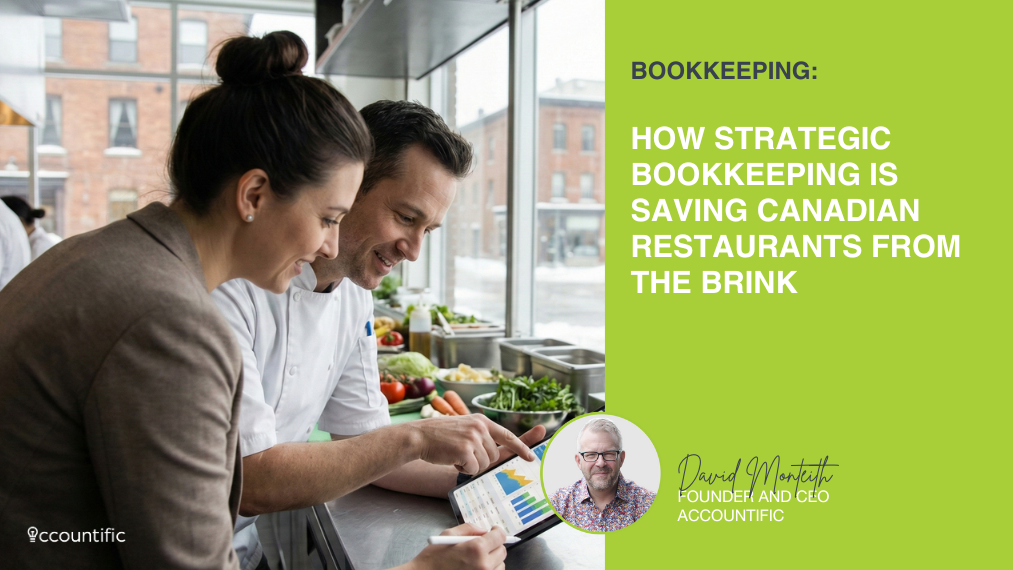
Leading the Future of Bookkeeping: How Canadian Bookkeepers Power Clarity, Compliance, and Growth in 2026
TL;DR: The Strategic Imperative for Canadian Hospitality in 2026
The Reality: The Canadian food and beverage sector is facing a “closure crisis” in 2026, with a projected net loss of 4,000 establishments. The era of reactive, compliance-focused bookkeeping is over. To survive structural inflation (4–6%) and razor-thin margins, financial management must evolve from a back-office chore to a frontline strategic necessity.
Key Takeaways:
- The “Weekly” Standard: Monthly P&Ls are too slow. Leading operators now demand a weekly reconciliation cadence to catch food waste and labour overages before they become permanent losses.
- Regulatory Minefield: New 2026 tax rules—including the increased capital gains inclusion rate (66.67%) and strict digital platform reporting (UberEats/DoorDash)—require professional oversight to avoid CRA audits.
- Inflation Strategy: Not all costs are equal. While meat prices are volatile (up 5–7%), other categories are stable.
- AI Integration: Modern bookkeeping uses AI for anomaly detection and predictive inventory, turning data into a “13-week cash flow forecast” that is essential for survival.
Why You Need to Read the Full Article: This isn’t just high-level theory; the full report provides the specific inflation breakdown by food category (meat vs. seafood vs. dairy) that you need for menu planning. It details the exact Prime Cost targets (60%) you must hit, explains how to navigate the new capital gains tax changes, and outlines the specific government grants still available for digital adoption and training. If you want to move from “surviving” to “optimising,” the full details are essential.
The Next Step: Don’t let 2026 be the year you fly blind. Transition to the weekly model and turn your data into your competitive advantage. Get clarity and control today with Accountific.
——————–
The Strategic Imperative of the New Fiscal Era
The Canadian food and beverage sector stands at a precipice in 2026. It is a moment defined by a stark duality: the immense potential for technological transformation versus a punishing economic reality that threatens the survival of thousands of independent operators. As the industry navigates this complex landscape, the role of financial management has shifted from a back-office compliance function to a frontline strategic necessity. The era of the reactive bookkeeper—focused solely on historical data entry and tax filing—has been rendered obsolete by the velocity of market changes, the sophistication of regulatory requirements, and the sheer volatility of input costs.
This comprehensive report explores the pivotal role of modern bookkeeping in securing the future of Canadian food businesses. It analyses the severe economic headwinds predicted for 2026, including a forecasted closure of nearly 4,000 restaurants and persistent food inflation ranging from 4% to 6%. Against this backdrop, it details how forward-thinking firms like Accountific are redefining the profession through weekly reconciliation cadences, AI-driven insights, and a holistic approach to financial clarity.
We examine the regulatory minefield of 2026, from the increased capital gains inclusion rate to new digital platform reporting rules, highlighting the imperative for professional guidance. Furthermore, the report delves into the technological revolution, where artificial intelligence and predictive analytics are optimising everything from inventory management to labour scheduling, providing operators with the real-time visibility needed to protect razor-thin margins. Finally, we outline the pathways to resilience, exploring how accurate financial data unlocks access to government grants, capital financing, and operational efficiencies that distinguish the thriving enterprises of tomorrow from the casualties of today.
Part I: The Economic Crucible of 2026
To understand the urgent necessity of advanced bookkeeping, one must first confront the brutal economic reality defining the Canadian hospitality sector in 2026. The operating environment has shifted from post-pandemic recovery to a complex struggle against structural inflation, debt maturity, and evolving consumer psychology.
1.1 The “Closure Crisis” and Market Contraction
The most alarming statistic dominating industry discussions in early 2026 is the projection that Canada will lose a net 4,000 dining establishments this year. This figure represents a significant acceleration in market contraction, driven not by a single catastrophic event but by the accumulation of financial pressures that have eroded the resilience of independent operators.
The underlying causes of this “closure crisis” are multifaceted and deeply rooted in the financial structures of the industry. During the years leading up to 2026, many operators survived by leveraging personal savings, refinancing loans, or relying on temporary government supports such as the CEBA loan forgiveness extensions (which have since expired). By 2026, these financial buffers have largely evaporated. The maturation of pandemic-era debts and the crystallisation of deferred liabilities have created a liquidity crunch for businesses that lack robust cash flow management.
Sylvain Charlebois, director of the Agri-Food Analytics Lab, notes that the industry is “under stress,” with inflation and rising food prices forcing diners, pubs, and eateries to close their doors at an accelerating rate. The statistics reveal a grim reality: in the previous year alone, 7,000 restaurants ceased operations, and the projection for 2026 suggests the bleeding has not stopped. This attrition is not evenly distributed; it disproportionately affects independent restaurants that lack the scale, brand leverage, or balance-sheet flexibility of major chains. For these smaller operators, the margin for error has effectively vanished. A restaurant operating without precise, weekly visibility into its financial health is navigating a minefield without a map. To survive, operators must learn to maximise restaurant profits, gain control, cut costs, and thrive.
1.2 The Inflationary Landscape: A Category-by-Category Analysis
Inflation in 2026 is not a monolithic force; it is a nuanced pressure that affects different aspects of the food supply chain with varying intensity. Canada’s Food Price Report for 2026 forecasts an overall food price increase of 4% to 6%, a rate that significantly outpaces the ability of most restaurants to raise menu prices without alienating consumers.
The specific breakdown of these price increases reveals critical strategic implications for menu planning and procurement:
| Food Category | Forecasted Price Increase (2026) | Operational & Strategic Implication |
| Meat | 5% – 7% | High volatility in beef and pork requires strict portion control, potential menu substitution, or the introduction of “market price” adjustments for premium cuts. |
| Vegetables | 3% – 5% | Seasonal sourcing becomes a critical cost-saving strategy. Operators must work closely with local suppliers to mitigate import costs. |
| Bakery | 2% – 4% | Relative stability in grains offers a potential area for margin protection, favouring concepts heavily reliant on dough-based products (pizza, sandwiches). |
| Dairy & Eggs | 2% – 4% | Moderate increases allow for predictable budgeting, though speciality cheeses may see higher variances. |
| Seafood | 1% – 2% | A potential area for high-margin specials due to lower comparative inflation. Highlighting seafood options may offer a value perception benefit to consumers. |
| Restaurants | 4% – 6% | The cost of dining out tracks closely with overall food inflation, limiting the competitive advantage of pricing strategies. |
| Total Food | 4% – 6% | Overall Cost of Goods Sold (COGS) budgets must be adjusted upward. |
The disparity between the inflation rates of seafood (1-2%) and meat (5-7%) suggests immediate strategic pivots for menu planners. A bookkeeper analysing purchase ledgers can highlight these trends in real-time, advising the owner to push the seafood linguine over the steak frites to protect the bottom line. This level of advisory service transforms the bookkeeper from a historian into a strategist, enabling the business to adapt its offering to the economic reality before losses accumulate. For a deeper dive into these tactics, review Canadian restaurant strategies for thriving in inflation.
1.3 Consumer Psychology and the Revenue Mix
Beyond the cost of goods, the revenue side of the ledger is under pressure from shifting consumer behaviours. The “tipping fatigue” phenomenon has altered the value proposition of full-service dining. As consumers recoil from aggressive tipping prompts and high service costs, there is a measurable shift toward “dining in” or trading down to fast-casual options where tipping is less expected. This behaviour compresses the average check size and reduces the gross revenue potential of each seat in the dining room.
Furthermore, a decline in alcohol sales—traditionally the highest-margin category for restaurants—poses a severe threat to profitability. Retailers across the country recorded a 10.6% drop in alcohol sales in late 2025, a trend that has bled into 2026. For many restaurants, alcohol sales subsidise the lower margins of the food menu. As consumers drink less or opt for lower-cost beverages, the fundamental business model of the full-service restaurant is destabilised. Operators must find new ways to drive margin, whether through non-alcoholic “mocktail” programs, which offer high margins without the alcohol, or through tighter controls on food costs.
1.4 Geopolitical Instability and Supply Chain Volatility
Compounding the domestic inflation issues are geopolitical factors that introduce unpredictability into the supply chain. The early 2026 trade landscape is shadowed by disputes with the United States, including tariffs that affect cross-border food supply chains. While the Canadian government has implemented counter-tariffs and remission measures to stabilise supply for certain goods like steel and aluminium (affecting equipment costs) and agricultural products, the uncertainty creates price volatility.
For a food business, this manifests as sudden spikes in the price of imported produce or equipment. A restaurant planning a kitchen renovation in 2026 faces uncertainty in capital expenditure budgeting due to potential tariffs on steel and aluminium, which are critical for commercial kitchen equipment. Additionally, trade relations with China regarding canola, beef, and seafood exports impact domestic supply levels and pricing. Advanced financial planning, supported by a knowledgeable bookkeeping partner, is essential to model these scenarios and secure necessary financing or grants before costs escalate further.
Part II: The Evolution of the Bookkeeper – From Data Entry to Strategic Partner
The role of the bookkeeper in Canada has undergone a radical transformation, culminating in the professional standards and expectations of 2026. No longer just a data entry clerk, the modern bookkeeper is a “Chief Clarity Officer,” essential for navigating the complexities of the current market.
2.1 The Paradigm Shift: Accountific and the Weekly Model
Historically, many small restaurant owners treated bookkeeping as an annual or quarterly annoyance—a “shoebox” of receipts handed off to an accountant solely for tax filing. In the high-velocity environment of 2026, this model is a death sentence. By the time a quarterly report is generated, three months of food waste, theft, or labour overages have already solidified into a permanent loss.
Leading firms like Accountific have pioneered the “Weekly Bookkeeping” model, which has become the gold standard for high-performing food businesses. This approach ensures that business owners know their numbers every week, transforming financial data from a lagging indicator into a leading one. This shift raises the question: Is fractional bookkeeping the future of restaurants?
- Weekly P&L: Identifying that food cost spiked to 38% last week allows for immediate investigation (e.g., was a delivery not checked in? Did a fridge fail?).
- Weekly Cash Flow Management: Knowing exactly who needs to be paid this Friday and what cash is clearing helps avoid overdrafts and vendor friction.
- Labour Analysis: Reviewing labour metrics weekly allows for schedule adjustments for the upcoming week, rather than lamenting a bad month after the fact.
Client reviews for Accountific highlight the transformative power of this model. One client, a serial restaurateur, noted that their “accounting process was very manual and labour intensive” before partnering with Accountific, which removed the “ongoing concern of major mistakes”. Another client emphasised that “Quarterly filings, and P&L reports are done timely, with minimal effort on our end,” allowing for a “better line of sight into our business’ operations”. This shift moves the psychological state of the owner from anxiety (“what is going to go wrong next?”) to confidence and control.
2.2 The Certified Professional Bookkeeper (CPB) Standard
The Certified Professional Bookkeepers of Canada (CPB Canada) has been instrumental in elevating the profession. National Bookkeeping Week 2026 (January 19-23) focuses on the theme “Starting 2026 With Purpose: Building Community, Knowledge, and Professional Confidence,” underscoring the shift toward high-level advisory services.
In 2026, bookkeepers are recognised as “strategic partners and trusted advisors” rather than mere record-keepers. Their expertise provides financial clarity and empowers confident decision-making for businesses of all sizes. The CPB designation ensures that these professionals adhere to a strict code of ethics and participate in continuous professional development, which is critical in a year defined by rapid regulatory changes.
For the restaurant client, this means their bookkeeper brings the collective intelligence of the entire profession to their business. When a new CRA ruling on “underused housing tax” or “digital platform reporting” emerges, the professional community digests it and develops best practices before the client even receives the government notification. This proactive stance is vital for compliance and risk management.
2.3 Community, Language, and Specialised Knowledge
The complexity of accounting in the food sector requires specialised knowledge. Generalist bookkeepers often miss the nuances of hospitality finance, such as the proper treatment of tip pools, the categorisation of “comps” and “voids,” and the intricacies of inventory valuation.
Accountific differentiates itself through this specialisation. David Monteith, the firm’s leader, is described as having a “digital entrepreneur” background with deep expertise in the “specific financial intricacies of the food world”. This allows the firm to offer insights that go beyond the numbers, such as advice on “food costing, dynamic pricing, resource management”. The value of a bookkeeper who “speaks the language” of the kitchen cannot be overstated; it bridges the gap between culinary creativity and financial discipline.
Part III: Regulatory & Tax Compliance in 2026 – The Compliance Minefield
The fiscal landscape of 2026 is characterised by increased CRA scrutiny, new reporting requirements for digital platforms, and significant changes to capital gains taxation. For Canadian food business owners, navigating these changes requires precise record-keeping and proactive planning.
3.1 Capital Gains Inclusion Rate and the LCGE
A major shift in the tax landscape for 2026 is the adjustment to the capital gains inclusion rate. While initially proposed for 2024, the legislation has set an effective date of January 1, 2026, for certain measures or indexation adjustments.
- The Change: For corporations and trusts, the capital gains inclusion rate increases from 50% to 66.67% (2/3). For individuals, the rate remains 50% on the first $250,000 of capital gains annually, but increases to 66.67% on amounts exceeding that threshold.
- Impact on Restaurant Owners: This is critical for any owner considering selling their business or a property held within a corporation. If a restaurant owner sells their business for a $1 million capital gain inside their corporation, the taxable portion jumps significantly.
- Old Rules (50%): $500,000 taxable income.
- New Rules (66.67%): $666,700 taxable income.
- Result: A substantially higher corporate tax bill, reducing the net proceeds available for reinvestment or retirement.
However, there is a crucial offset: the Lifetime Capital Gains Exemption (LCGE) has been increased to $1.25 million and will resume indexation in 2026. This allows owners of “Qualified Small Business Corporation Shares” to shelter a larger portion of their sale proceeds from tax entirely. A knowledgeable bookkeeper ensures that the corporate structure and share attributes are maintained meticulously over the years (e.g., ensuring 90% of assets are used in an active business) to ensure eligibility for this exemption when the time comes to exit.
3.2 Digital Platform Reporting Rules
Commencing fully in 2026, the CRA has tightened reporting rules for “platform operators” under the new digital economy tax measures. While this targets giants like UberEats, DoorDash, and Airbnb, it impacts restaurant owners downstream.
- Transparency: Platform operators must now report the income earned by “sellers” (restaurants) directly to the CRA.
- Reconciliation Risk: If a restaurant’s reported revenue does not match the data the CRA receives from UberEats or DoorDash, it triggers an automatic audit flag.
- The Bookkeeping Challenge: Reconciling delivery platform statements is notoriously difficult due to the mix of gross sales, commissions, marketing fees, and tax adjustments. A discrepancy of even a few percentage points can look like tax evasion to an automated CRA algorithm. Professional bookkeepers use specialised software to import these statements and split the transactions correctly, ensuring the “Revenue” line on the tax return matches the “Income” reported by the platform.
3.3 Payroll Compliance: CPP, EI, and Tips
Payroll remains one of the most complex areas for hospitality businesses due to the mix of hourly wages, tips, holiday pay, and high turnover. For 2026, the statutory deductions have been updated, increasing the cost of labour.
- CPP (Canada Pension Plan): The contribution rate remains at 5.95%, but the Maximum Pensionable Earnings (YMPE) has increased to $72,500. This means both the employer and employee pay CPP on a larger portion of salary, increasing the total labour burden.
- EI (Employment Insurance): The employer rate is 2.32% (1.4 times the employee rate of 1.66%), with maximum insurable earnings increasing to $68,500.
For a restaurant with 20 staff members, these incremental increases in the employer portion of CPP and EI add thousands of dollars to the annual payroll budget. Bookkeepers must ensure their payroll software is updated with these 2026 rates on January 1st to avoid under-remitting to the CRA, which attracts severe penalties.
Tip Reporting: The CRA continues to focus on the correct reporting of tips. “Controlled tips” (those distributed by the employer via a tip pool) are pensionable and insurable earnings. “Direct tips” (cash left on the table) are the employee’s responsibility. The blur between these lines is a common audit trap. Accountific and similar firms ensure that the payroll system is set up to handle “allocated tips” correctly, protecting the business from liability.
3.4 Automobile and Home Office Deductions
For owners who use personal vehicles for business (e.g., catering deliveries, supply runs), the 2026 limits have changed, offering slightly higher deductions to offset rising fuel and maintenance costs.
- Mileage Rate: Increased to 73 cents/km for the first 5,000 km, and 67 cents/km thereafter.
- CCA Ceiling: The capital cost allowance ceiling for Class 10.1 passenger vehicles has risen to $39,000 (plus taxes).
- Leasing Limits: Deductible leasing costs remain at $1,100 per month (plus taxes) for new leases entered into on or after January 1, 2026.
Additionally, the simplified home office deduction ($500 flat rate) remains available for 2026, allowing self-employed individuals and incorporated business owners who work from home (e.g., doing admin work) to claim expenses without detailed receipts. While small, maximising every valid deduction is part of a robust tax efficiency strategy.
Part IV: Technology & AI Integration – The Engine of Modern Bookkeeping
The most visible difference in 2026 bookkeeping is the technology stack. The days of manual data entry are gone, replaced by an ecosystem of integrated applications that talk to each other in real-time. Artificial Intelligence (AI) is the glue binding this system together, enabling a level of precision and speed previously unattainable for small businesses.
4.1 The AI-Driven Workflow: From OCR to Anomaly Detection
AI in accounting is not about “robot accountants” making strategic decisions; it is about “robotic process automation” (RPA) handling the grunt work so the human expert can analyse the results.
- OCR and Data Extraction: Tools like Dext or Hubdoc use AI-powered Optical Character Recognition (OCR) and Convolutional Neural Networks (CNNs) to scan invoices with 99% accuracy. When a chef snaps a photo of a vegetable delivery invoice, the AI identifies the vendor, the date, the total amount, and—crucially—can split the line items (e.g., separating “Food Cost – Produce” from “Supplies – Cleaning”). This technology corrects for skew, blur, and poor lighting, ensuring data integrity.
- Anomaly Detection: AI algorithms monitor the ledger for irregularities. If a hydro bill is usually $400 but comes in at $1,200, the system flags it. If a vendor invoice is a duplicate of one paid last month, the system blocks the payment. This “always-on” auditor is far more effective than a human spot-check, identifying duplicate contacts and incorrectly coded transactions instantly.
- Predictive Analytics: Advanced platforms now forecast future cash flow based on historical patterns. They can predict that “February is historically slow, and three payroll runs occur in the month, so cash will be tight in Week 3”.
4.2 The Integrated Restaurant Tech Stack
For a Canadian food business in 2026, the “Bookkeeping System” is actually a tripod of three connected systems that must function in harmony:
- Point of Sale (POS): (e.g., Toast, TouchBistro, Lightspeed). This captures revenue, tips, and rudimentary inventory data. Systems like Toast have integrated AI marketing assistants and scheduling tools, making them the central nervous system of the front-of-house.
- Labour Management: (e.g., 7shifts, Sling, UKG). This captures hours worked, schedules, and labour cost projections. AI-driven scheduling tools analyse sales forecasts to recommend optimal staffing levels, reducing overtime and understaffing.
- General Ledger (GL): (e.g., Xero, QuickBooks Online). This is the central brain where all data converges. Xero is noted for its “Clever bit of software integrating with Xero that highlights outstanding bookkeeping” and its ability to track cash flow in real-time.
The Flow of Data:
In 2026, the integration is seamless.
- End of Night: The POS sends the daily sales summary to Xero automatically. It separates food sales, beverage sales, tax collected, and tips paid out.
- Next Morning: The bank feeds the credit card deposits. The bookkeeper’s software matches the bank deposit to the POS sales entry.
- Payroll: The labour software pushes the approved hours to the payroll processor (e.g., Wagepoint), which then pushes the journal entry to Xero.
This automation allows for the Weekly Bookkeeping model that Accountific promotes. Because the data entry is automated, the bookkeeper spends their time on reconciliation and review, ensuring the connections are working and the data makes sense.
4.3 Specialised Restaurant AI: Predictive Inventory & Menu Engineering
Beyond the GL, AI is transforming operations on the ground. “Predictive Inventory” tools integrate with the POS to track ingredient usage in real-time.
- How it works: If you sell 50 burgers, the system knows you used 50 buns, 50 patties, and approx 10kg of fries. It subtracts this from your theoretical inventory.
- The AI Edge: The system learns that on rainy Tuesdays, you sell more soup and less salad. It suggests ordering changes before you run out or over-order.
- Waste Reduction: By highlighting the variance between “Theoretical Usage” (what you should have used) and “Actual Usage” (what is missing from the shelf), the system identifies waste and theft immediately. This is key to how strategic waste management boosts your restaurant’s resilience and revenue.
For the bookkeeper, this data is gold. It allows them to report not just “Food Cost %” but “Waste %,” giving the owner a specific lever to pull to improve profitability. This technology is critical in 2026, where waste reduction is one of the few controllable variables left to protect margins.
Part V: Operational Excellence via Financial Data
In 2026, financial data is an operational tool, not just a scoreboard. Successful restaurants use their numbers to engineer profitability, optimise labour, and manage cash flow with surgical precision.
5.1 Menu Engineering and Dynamic Pricing
With food inflation at 4-6%, a static menu is a liability. “Menu Engineering” is the process of analysing the profitability and popularity of each item to maximise gross profit.
- Stars: High profit, high popularity. (Strategy: Maintain quality, don’t change the recipe).
- Plowhorses: Low profit, high popularity. (Strategy: Increase price slightly or decrease portion size to improve margin).
- Puzzles: High profit, low popularity. (Strategy: Rebrand, promote, or move on the menu to drive sales).
- Dogs: Low profit, low popularity. (Strategy: Remove from menu immediately).
A bookkeeper provides the cost side of this equation by accurately tracking ingredient prices. If the price of beef jumps, the “Steak Frites” might move from a Star to a Plowhorse overnight. Without this data, the owner keeps selling a loser item, bleeding cash with every plate.
Dynamic Pricing: While “surge pricing” is controversial, dynamic pricing in 2026 is more subtle. It involves adjusting happy hour prices based on demand, or having a “Lunch Menu” vs “Dinner Menu” where prices reflect the different labour models of those shifts. AI tools help evaluate these pricing changes with context, reducing the risk of overcorrection.
5.2 Prime Cost Management
The Holy Grail of restaurant metrics is Prime Cost: Total Cost of Goods Sold + Total Labour Cost.
- The Benchmark: A healthy full-service restaurant aims for a Prime Cost of 60% or lower.
- The Reality: If Prime Cost hits 65% or 70%, the business is likely losing money after rent and overhead.
Weekly bookkeeping is the only way to manage this. Waiting for a monthly P&L means you operated at 70% Prime Cost for 30 days before noticing. Weekly reporting allows a manager to say, “We are at 62% for the week; I need to cut 10 hours from the schedule this weekend and push the high-margin pasta special to get back to 60%.”
5.3 Cash Flow Forecasting: The 13-Week Model
Cash flow kills more restaurants than the lack of profit. A profitable restaurant can go bankrupt if it cannot pay its vendors on Friday because the credit card deposits from the weekend haven’t cleared.
- The 2026 Challenge: High interest rates mean lines of credit are expensive. Relying on overdraft is a costly crutch.
- The Solution: A rolling 13-week cash flow forecast. This tool, maintained by the bookkeeper, predicts the cash balance for every week in the coming quarter. It accounts for the “lumpy” expenses like quarterly GST/HST remittances, three-payroll months, and annual insurance premiums.
- Seasonal Strategy: For Canadian restaurants, January and February are historically brutal. A cash flow forecast built in October helps the owner set aside reserves from the December holiday rush to cover the winter deficit.
Part VI: Labour, Talent, and Payroll Strategy
Labour is the most volatile expense line. In 2026, the “labour crisis” has evolved into a “labour optimisation” challenge, where technology and data play a crucial role in retention and efficiency.
6.1 The Real-Time Labour Metric
Standard practice in 2026 is tracking Sales Per Labour Hour (SPLH).
- Calculation: Total Sales / Total Hours Worked.
- Usage: If the target is $65 sales per labour hour, and the dashboard shows the restaurant is currently running at $45, the manager knows they are overstaffed right now. They can cut a server early.
Modern scheduling apps like 7shifts or Sling (integrated with Toast) provide this data live. The bookkeeper’s role is to audit this data against the actual payroll to ensure the “theoretical” labour cost matches the “actual” cash leaving the bank.
6.2 Navigating the “Tips” Economy
The structure of compensation varies significantly across the industry, impacting payroll processing.
- The “Keg” Model: High-volume steakhouses offer servers the potential to earn $250-$350 per night in tips, creating a high-retention environment but complicating tax reporting.
- The “Union” Model: Places like Fairmont Hotels offer union wages ($20-$24/hr) plus automatic gratuities, providing stability.
- The Compliance Angle: Regardless of the model, the accurate tracking of tip pools is essential. New AI-driven payroll integrations help automate the calculation of “stat holidays” and “vacation pay” on these variable earnings, ensuring compliance with provincial labour standards.
6.3 Retention through Clarity
Interestingly, transparent financial management aids retention. When staff understand the business’s goals (e.g., “We need to hit this sales target to unlock a bonus”), they are more engaged. Open-book management, facilitated by clear reports from the bookkeeper, fosters a culture of ownership among the team. This also involves understanding how poor workplace culture impacts employee retention in restaurants and implementing specific plans, such as the 607% ROI plan for keeping your best summer staff. Furthermore, recognising the strategic significance of employee training and development in restaurants is essential for long-term stability.
Part VII: Funding Growth & Resilience
Despite the closures, 2026 is also a year of opportunity for well-run businesses to expand, acquiring locations from failed competitors at a discount. Capitalising on this requires clean books and knowledge of government programs.
7.1 Canada Small Business Financing Program (CSBFP)
The Canada Small Business Financing Program (CSBFP) remains a vital tool for 2026. It helps businesses obtain term loans and lines of credit that they might not qualify for traditionally.
- Expansion: It covers up to $1.15 million in financing, including up to $1,000,000 for term loans (real estate, equipment, leasehold improvements) and $150,000 for lines of credit (working capital).
- Terms: The government shares the risk with the bank, often resulting in better interest rates and longer repayment terms (up to 15 years for term loans).
- The Catch: Banks require immaculate financial statements to approve these loans. A “shoebox” application will be rejected. Weekly, reconciled books demonstrate the financial discipline lenders require.
7.2 Grants and The Digital Adoption Legacy
While the major intake for the Canada Digital Adoption Program (CDAP) “Boost Your Business Technology” grant ($15,000) has seen sunsetting provisions or full subscription in many streams by 2026, the ecosystem it created persists. Businesses that secured CDAP funding in previous years are now in the implementation phase, using those funds to pay for the very subscriptions (POS, Inventory software) that drive efficiency.
However, new and ongoing grant opportunities exist for those who know where to look:
- Black Food Energy: Grants of over $10,000 for Black-owned restaurants, supported by DoorDash.
- Amex-DMZ Small Business Grant: Combined funding and mentorship for business growth.
- Provincial Programs:
- B.C. Employer Training Grant: Reimburses 80% of training costs up to $10,000 per employee, ideal for upskilling staff on new tech.
- Quebec (MAPAQ): Food processing programs offering up to $150,000 for productivity enhancements.
- Ontario Creates: Grants for digital and content creation, applicable to restaurants expanding their digital marketing presence.
A proactive bookkeeper monitors these opportunities, alerting the client when a grant aligns with their business plan (e.g., “There is a training grant available that could pay for us to train your staff on the new inventory software”). For a deeper understanding of the labour market context relevant to these grants, see Tackling Labour Shortages in Canada’s Restaurant Industry.
Conclusion: Clarity is the Ultimate Competitive Advantage
As 2026 unfolds, the Canadian food industry will bifurcate. On one side will be the operators who view bookkeeping as a compliance burden—a tax to be paid to the CRA. These businesses, flying blind without real-time data, are the ones most at risk of becoming part of the 4,000 predicted closures. They will be blindsided by ingredient spikes, drained by unseen waste, and caught unprepared by tax changes.
On the other side will be the operators who view bookkeeping as a strategic asset. These entrepreneurs, partnering with firms like Accountific, will possess Clarity.
- Clarity on their true margins, week by week.
- Clarity on their labour efficiency, shift by shift.
- Clarity on their compliance status protects them from audits.
- Clarity on their cash flow, allowing them to sleep at night.
In the hostile economic environment of 2026, clarity is not just a nice-to-have; it is the ultimate competitive advantage. The future of bookkeeping is not about counting beans; it is about planting them in the right soil, at the right time, to ensure a harvest. For the Canadian food business owner, the right bookkeeper is the difference between withering in the drought or growing through the storm.
Recommendations for Canadian Food Business Owners
- Audit Your Cadence: If you are receiving financial reports older than 14 days, your system is broken. Transition to a weekly bookkeeping cycle immediately.
- Integrate Your Stack: Ensure your POS, Labour, and Accounting software are integrated. If data is being manually typed from one to the other, you are paying for errors.
- Engage a Specialist: Generalist bookkeepers often miss the nuances of hospitality (tips, inventory, COGS). Hire a firm that understands the food business.
- Embrace AI, Don’t Fear It: Use the predictive tools in your POS and inventory platforms. Let the AI handle the data entry so you can handle the decision-making.
- Watch the Cash: Implement a 13-week cash flow forecast. In a high-inflation, high-interest world, cash is oxygen.
By taking these steps and leveraging the expertise of leaders in the field, Canadian food entrepreneurs can turn the challenges of 2026 into a defining year of resilience and success.
As the Canadian hospitality sector navigates the turbulence of 2026, the divide between businesses that merely survive and those that thrive will be defined by financial clarity. The predicted “closure crisis” and persistent inflation demand more than just tax compliance; they require a strategic partner capable of transforming weekly data into actionable insights on food costs, labour efficiency, and cash flow. Rather than facing these headwinds blind, operators must leverage real-time financial intelligence to protect their margins and capitalise on growth opportunities. To transition from reactive data entry to proactive financial leadership, partner with Accountific today and turn your numbers into your ultimate competitive advantage.
——————–
David Monteith, founder of Accountific, is a seasoned digital entrepreneur and a Xero Silver Partner Advisor. Leveraging over three decades of business management and financial expertise, David specialises in providing tailored Xero solutions for food and beverage businesses. His deep understanding of this industry, combined with his proficiency in Xero, allows him to streamline accounting processes, deliver valuable financial insights, and drive greater success for his clients.